
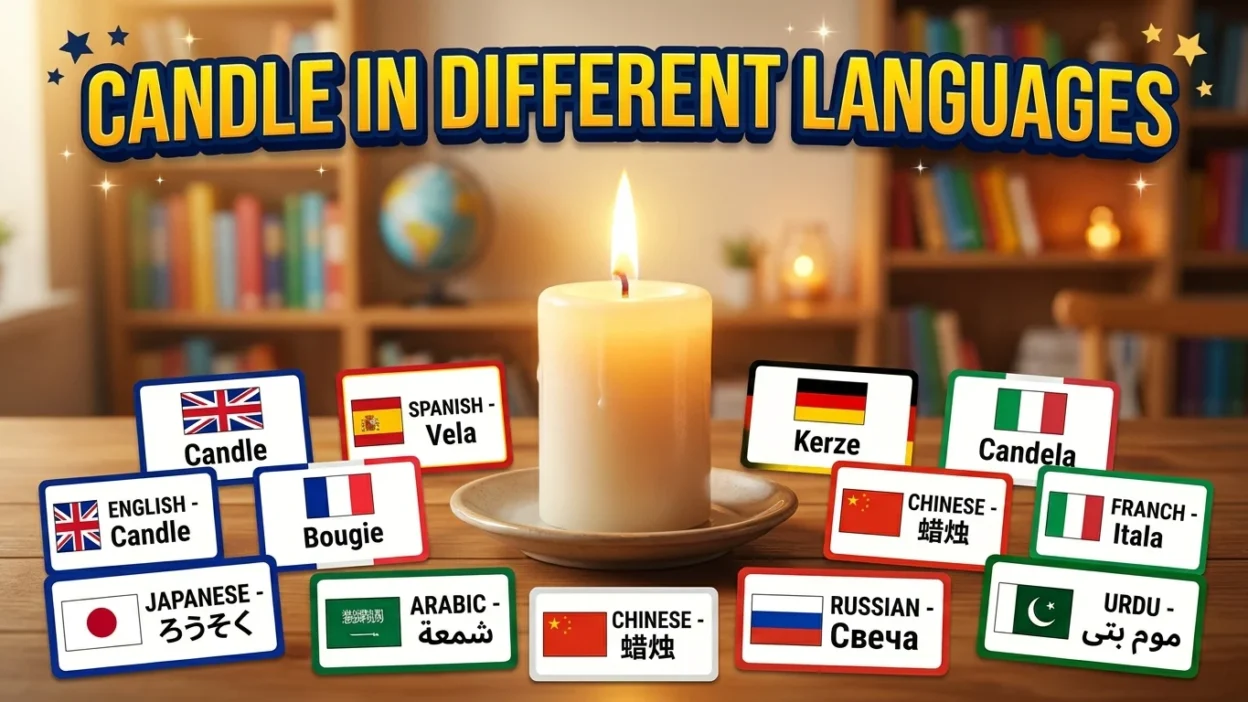
A candle is a simple everyday object that brings light, warmth, and comfort to our lives. However, its name changes across languages and cultures. Learning candle in different languages is a fun way to explore international vocabulary, discover new words, and understand how people describe familiar objects around the world.
If you are a student, language enthusiast, traveler, or curious learner, these translations can expand your vocabulary. From Spanish and French to Japanese and Arabic, this guide introduces 50 languages with their native words and easy English pronunciations.
Quick Answer
The word candle has different translations around the world. For example, it is vela in Spanish, bougie in French, Kerze in German, ろうそく in Japanese, and شمع in Arabic.
Candle Around the World
The following table features 50 languages, their native translations for candle, and simple pronunciation guides. Some languages use different words depending on the type of candle or regional vocabulary.
| Language | Native Word | Pronunciation |
|---|---|---|
| Spanish | Vela | VEH-lah |
| French | Bougie | BOO-zhee |
| German | Kerze | KEHR-tsuh |
| Italian | Candela | kahn-DEH-lah |
| Portuguese | Vela | VEH-lah |
| Dutch | Kaars | KAARS |
| Swedish | Ljus | YUUS |
| Norwegian | Stearinlys | steh-ah-REEN-luus |
| Danish | Stearinlys | steh-ah-REEN-luus |
| Finnish | Kynttilä | KUUN-tee-lah |
| Icelandic | Kerti | KEHR-tee |
| Polish | Świeca | SHVYEH-tsah |
| Czech | Svíčka | SVEECH-kah |
| Slovak | Sviečka | SVYECH-kah |
| Russian | Свеча | svye-CHA |
| Ukrainian | Свічка | SVEECH-kah |
| Bulgarian | Свещ | SVESHT |
| Serbian | Свећа | SVEH-cha |
| Croatian | Svijeća | SVYEH-cha |
| Romanian | Lumânare | loo-muh-NAH-reh |
| Greek | Κερί | keh-REE |
| Turkish | Mum | MOOM |
| Arabic | شمعة | SHAM-ah |
| Hebrew | נר | NEHR |
| Persian | شمع | SHAM |
| Urdu | موم بتی | MOOM BAT-tee |
| Hindi | मोमबत्ती | MOHM-buh-TEE |
| Bengali | মোমবাতি | MOHM-bah-tee |
| Punjabi | ਮੋਮਬੱਤੀ | MOHM-bat-tee |
| Gujarati | મીણબત્તી | MEEN-bat-tee |
| Marathi | मेणबत्ती | MAYN-bat-tee |
| Tamil | மெழுகுவர்த்தி | meh-zhoo-goo-var-thee |
| Telugu | కొవ్వొత్తి | kohv-voht-tee |
| Kannada | ಮೇಣದಬತ್ತಿ | MAY-nuh-bat-tee |
| Malayalam | മെഴുകുതിരി | meh-zhoo-goo-thee-ree |
| Chinese (Mandarin) | 蜡烛 | là zhú |
| Japanese | ろうそく | rōsoku |
| Korean | 양초 | yang-cho |
| Thai | เทียน | thian |
| Vietnamese | Nến | nen |
| Indonesian | Lilin | LEE-leen |
| Malay | Lilin | LEE-leen |
| Filipino | Kandila | kahn-DEE-lah |
| Swahili | Mshumaa | m-shoo-MAH-ah |
| Amharic | ሻማ | SHA-ma |
| Somali | Shumac | SHOO-mak |
| Hausa | Kyandir | chan-DEER |
| Yoruba | Abẹla | ah-BEH-lah |
| Zulu | Ikhandlela | ee-khan-DLEH-lah |
| Afrikaans | Kers | KERS |
Why Learn Candle in Different Languages?
Learning the word candle in different languages helps you develop vocabulary and understand how different cultures communicate. Everyday objects are excellent starting points for language learners because they are easy to recognize and remember.
This vocabulary is also useful when traveling, reading foreign-language content, or communicating with international friends. You can discover how familiar objects receive different names across countries. Learning simple words such as candle, lamp, light, and fire can make language practice more enjoyable and practical.
Cultural Significance of Candles Around the World
Candles have different meanings in various cultures. In some communities, they represent hope, peace, love, and remembrance. People light candles during religious ceremonies, weddings, festivals, and special family occasions.
In other traditions, candles create a peaceful atmosphere during meditation or quiet reflection. Their importance goes beyond providing light. They can symbolize celebration, spirituality, and meaningful memories. Learning their names in different languages also introduces you to the cultural traditions connected with this familiar household object.
How to Pronounce Candle in Different Languages
Pronunciation is an important part of learning new vocabulary. Although some translations look similar, their sounds can be completely different. For example, the Spanish word vela has two clear syllables, while the French word bougie has a softer sound.
Start by reading each pronunciation guide slowly. Repeat the word several times and listen to native speakers whenever possible. Pay attention to vowel sounds, syllable stress, and unfamiliar consonants. Practicing a few words daily can gradually improve your speaking confidence.
Different Words Related to Candles
Learning related vocabulary makes it easier to understand conversations about candles. These words are useful when shopping, describing household items, or discussing decorative products.
Here are some common English words associated with candles:
- Wax: The material used to make most traditional candles.
- Wick: The central thread that burns when a candle is lit.
- Flame: The visible fire produced by a burning candle.
- Scented candle: A candle designed to release fragrance.
- Candle holder: An object used to support a candle.
- Lantern: A protective structure that holds a light source.
- Candlelight: The light produced by burning candles.
Practical Uses of Candle Vocabulary
Knowing candle-related vocabulary can be helpful in everyday situations. For example, travelers may need to purchase candles in another country, while students might encounter the word in foreign-language books or educational activities.
It is also useful for people interested in home decoration, crafts, gift shopping, and candle-making businesses. Understanding different translations can help you recognize product names and communicate basic requirements. You can also use these words when writing descriptions, creating multilingual content, or learning about international home and lifestyle products.
Easy Tips for Remembering Candle Translations
Memorizing 50 new words may seem difficult, but using simple learning techniques can make the process easier. Instead of trying to learn everything at once, divide the vocabulary into small groups.
Try these practical methods:
- Learn five words daily: Focus on a small number of translations.
- Use flashcards: Write the English word on one side and its translation on the other.
- Practice pronunciation: Say each word aloud several times.
- Create sentences: Use new vocabulary in simple everyday sentences.
- Group similar languages: Compare words from languages with related vocabulary.
- Review regularly: Repeat previously learned words to improve memory.
Interesting Facts About Candles Around the World
Candles have an interesting history and cultural presence. Before modern electric lighting became common, people depended on candles and other traditional light sources to illuminate homes and workplaces.
Today, candles are also popular decorative and lifestyle products. Scented candles are used to create relaxing environments, while decorative candles add beauty to celebrations and special occasions. Interestingly, many languages have completely different words for the same object, even though candles serve similar purposes worldwide. This makes everyday vocabulary an interesting way to explore language diversity.
Common Mistakes When Learning Candle Vocabulary
One common mistake is assuming that every translation has exactly the same meaning in every situation. Some languages use different terms depending on whether someone means a traditional wax candle, a decorative candle, or another type of light source.
Another mistake is pronouncing foreign words using English spelling rules. Words such as French bougie and German Kerze require different pronunciation patterns. Learners should also avoid confusing candles with lamps, lanterns, or electric lights. Always consider the context and practice the correct native pronunciation.
Benefits of Learning Everyday Words in Different Languages
Everyday vocabulary provides a strong foundation for learning a new language. Words such as candle, table, chair, window, and door are commonly used and easy to connect with real objects.
Learning these terms improves reading, listening, and speaking skills. It also helps you understand cultural differences and communicate more confidently with people from other countries. Starting with familiar objects makes language learning less complicated and more enjoyable. Over time, adding new vocabulary can help you build stronger language skills and understand more complex conversations.
Key Takeaways
- Candle has different names across 50 languages.
- Common translations include vela, bougie, Kerze, and شمعة.
- Pronunciation varies depending on the language and its sound system.
- Candles represent light, warmth, celebration, and remembrance in many cultures.
- Learning everyday vocabulary is a practical way to improve language skills.
Conclusion
Learning candle in different languages is an interesting way to explore international vocabulary and cultural traditions. From Spanish vela to French bougie and Japanese ろうそく, each language offers a unique word for this familiar object. These 50 translations provide a helpful starting point for students, travelers, and language enthusiasts. Practice the words regularly, focus on correct pronunciation, and explore related vocabulary to improve your language skills. Even learning a simple everyday word can open the door to discovering different languages and cultures.
Frequently Asked Questions
1. What is candle in different languages?
Candle has different translations depending on the language. It is called vela in Spanish, bougie in French, Kerze in German, candela in Italian, and ろうそく in Japanese. These words describe a familiar object used for lighting, decoration, celebrations, and relaxation.
2. What is the French word for candle?
The French word for candle is bougie. It is pronounced BOO-zhee. This word is commonly used when discussing traditional candles, scented candles, and decorative lighting products. Learning it can be helpful when shopping in French-speaking countries or reading French lifestyle content.
3. What is candle called in Spanish?
The Spanish word for candle is vela, pronounced VEH-lah. It is a commonly used word in everyday Spanish vocabulary. You may encounter it when discussing home decorations, religious ceremonies, celebrations, or traditional lighting products in Spanish-speaking countries.
4. What is candle called in Japanese?
In Japanese, candle is written as ろうそく and pronounced rōsoku. This word refers to a traditional candle made from wax. Learning Japanese household vocabulary can help students recognize common objects and understand simple conversations about everyday life.
5. Why should I learn candle translations in different languages?
Learning candle translations helps expand your vocabulary, improve pronunciation, and understand cultural differences. It is useful for students, travelers, language enthusiasts, and people interested in international communication. Everyday words provide an easy starting point for exploring unfamiliar languages.