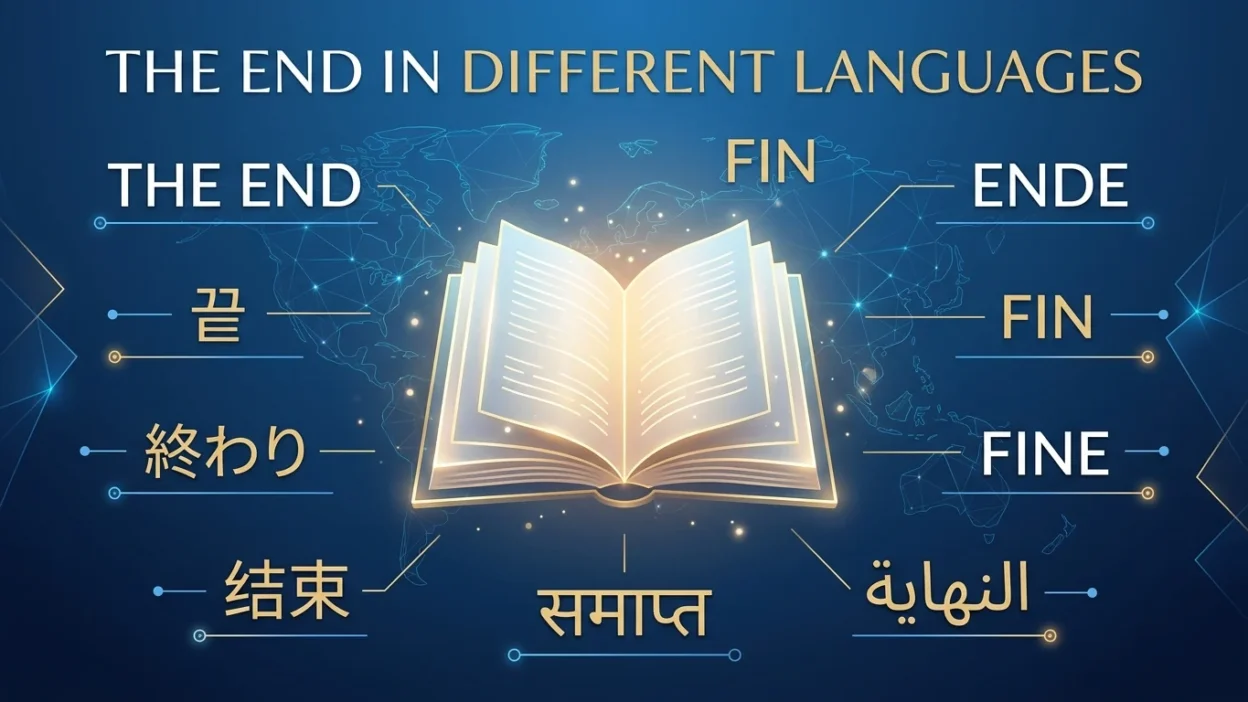
The phrase the end in different languages is widely used in books, movies, presentations and creative projects. Whether you’re writing a story, designing a video, or simply exploring languages, learning how different cultures express “the end” can add authenticity and global appeal to your work.
In this guide, you’ll discover the end in different languages with native spellings and easy English pronunciations. You’ll also learn why this phrase matters, how it’s used in different cultures, and practical tips for choosing the right translation for your project.
Quick Answer
The end in different languages is translated uniquely across cultures. From Fin in French to Finis in Latin, these translations are commonly used in films, books, presentations and multilingual creative content.
The End in Different Languages Around the World
| Language | Native Word | Pronunciation |
|---|---|---|
| English | The End | The End |
| French | Fin | Fan |
| Spanish | Fin | Feen |
| German | Ende | EN-duh |
| Italian | Fine | FEE-nay |
| Portuguese | Fim | Feem |
| Dutch | Einde | EYEN-duh |
| Swedish | Slut | Sloot |
| Norwegian | Slutt | Sloot |
| Danish | Slut | Sloot |
| Finnish | Loppu | LOP-poo |
| Icelandic | Endir | EN-dir |
| Polish | Koniec | KO-nyets |
| Czech | Konec | KO-nets |
| Slovak | Koniec | KO-nyets |
| Hungarian | Vége | VAY-ghe |
| Romanian | Sfârșit | Sfur-SHEET |
| Greek | Τέλος | TE-los |
| Russian | Конец | Ka-NYETS |
| Ukrainian | Кінець | Kee-NETS |
| Bulgarian | Край | Kry |
| Serbian | Kraj | Kry |
| Croatian | Kraj | Kry |
| Turkish | Son | Son |
| Arabic | النهاية | An-Ni-Ha-ya |
| Hebrew | הסוף | Ha-Sof |
| Persian | پایان | Pa-YAAN |
| Hindi | समाप्त | Sa-Maapt |
| Urdu | اختتام | Ikh-ti-taam |
| Punjabi | ਅੰਤ | Ant |
| Bengali | শেষ | Shesh |
| Gujarati | અંત | Ant |
| Marathi | शेवट | She-vat |
| Tamil | முடிவு | Mu-di-vu |
| Telugu | ముగింపు | Mu-gim-pu |
| Kannada | ಅಂತ್ಯ | An-tya |
| Malayalam | അവസാനം | Ava-sa-nam |
| Nepali | अन्त्य | Antya |
| Sinhala | අවසානය | Ava-sa-na-ya |
| Thai | จบ | Jop |
| Vietnamese | Kết thúc | Ket Thook |
| Indonesian | Akhir | A-kheer |
| Malay | Tamat | Ta-mat |
| Filipino | Wakas | Wa-kas |
| Chinese (Mandarin) | 结束 | Jie Shu |
| Japanese | 終わり | O-wa-ri |
| Korean | 끝 | Kkeut |
| Swahili | Mwisho | Mwee-sho |
| Hawaiian | Ka Hopena | Ka Ho-pe-na |
| Maori | Te Mutunga | Te Mu-too-nga |
Why Learn “The End” in Different Languages?
Learning the end in different languages is useful for writers, filmmakers, designers, students, and language enthusiasts. It allows you to add an authentic touch to books, videos, presentations and creative projects. A multilingual ending can make your work feel more inclusive and appealing to international audiences.
It is also an enjoyable way to explore new languages. Many translations reflect each language’s unique grammar and culture. Even learning a single word from different languages helps expand your vocabulary and appreciation for global communication.
Common Uses of “The End” Around the World
The phrase “The End” is commonly displayed at the conclusion of movies, novels, animations, documentaries, and stage performances. Some creators prefer using the original language to match the theme of their work. For example, French films often use Fin, while Italian productions may end with Fine.
Outside entertainment, the phrase is also used in presentations, school assignments, greeting cards and digital content. Choosing the appropriate translation adds creativity and makes your project feel more culturally connected.
Tips for Choosing the Right Translation
When selecting a translation, always consider your audience and the context of your project. If your story is set in Japan, using the Japanese word 終わり creates authenticity. Likewise, a French themed project may look more elegant with Fin.
Avoid relying solely on automatic translations because some languages use different words depending on the context. If you’re creating professional content, verify the spelling and pronunciation before publishing. This helps maintain accuracy and respect for the language.
Interesting Facts About “The End” in Different Languages
Many classic silent films ended with a single word, such as Fin or Fine, instead of a full sentence. These simple endings became iconic and are still recognized worldwide today. Some modern films no longer display “The End,” allowing the final scene to leave a lasting emotional impact.
Certain languages have multiple words that can mean “end” depending on whether you refer to a conclusion, destination, or final chapter. Understanding these subtle differences makes language learning even more interesting and helps you choose the most appropriate translation.
Conclusion
Learning the end in different languages is a fun and practical way to explore cultures while improving your language knowledge. Whether you’re creating a film, writing a novel, designing a presentation or simply satisfying your curiosity, these translations add authenticity and creativity. By understanding how different languages express the end of a story, you can communicate more effectively and appreciate the diversity of global languages.
Frequently Asked Questions
1. What is the most common translation of “The End” in different languages?
Popular translations include Fin in French and Spanish, Fine in Italian, Ende in German, Son in Turkish, and 終わり in Japanese. Each translation reflects the language and cultural style of its speakers.
2. Why is “The End” used in movies and books?
“The End” clearly tells the audience that a story has concluded. Although many modern productions no longer display it, the phrase remains a classic ending in films, books, comics, and presentations worldwide.
3. Can I use these translations in my creative projects?
Yes. These translations are commonly used in books, videos, presentations, websites, and artwork. Just make sure you choose the correct language and spelling for your intended audience.
4. Are all translations literal equivalents of “The End”?
Not always. Some languages use words that simply mean “end,” while others imply “conclusion” or “completion.” The meaning remains similar, but the exact wording may vary depending on the context.
5. What is the easiest way to remember “The End” in different languages?
Group similar languages together, practice a few words daily, and associate each translation with its country. Flashcards and repetition are excellent ways to remember them over time.

Olivia Riley is a passionate content administrator at Diflingo, where she manages and publishes high-quality articles focused on what to say in everyday conversations, special occasions, professional settings, and personal relationships. She ensures every guide is clear, practical, engaging, and helpful for readers.