
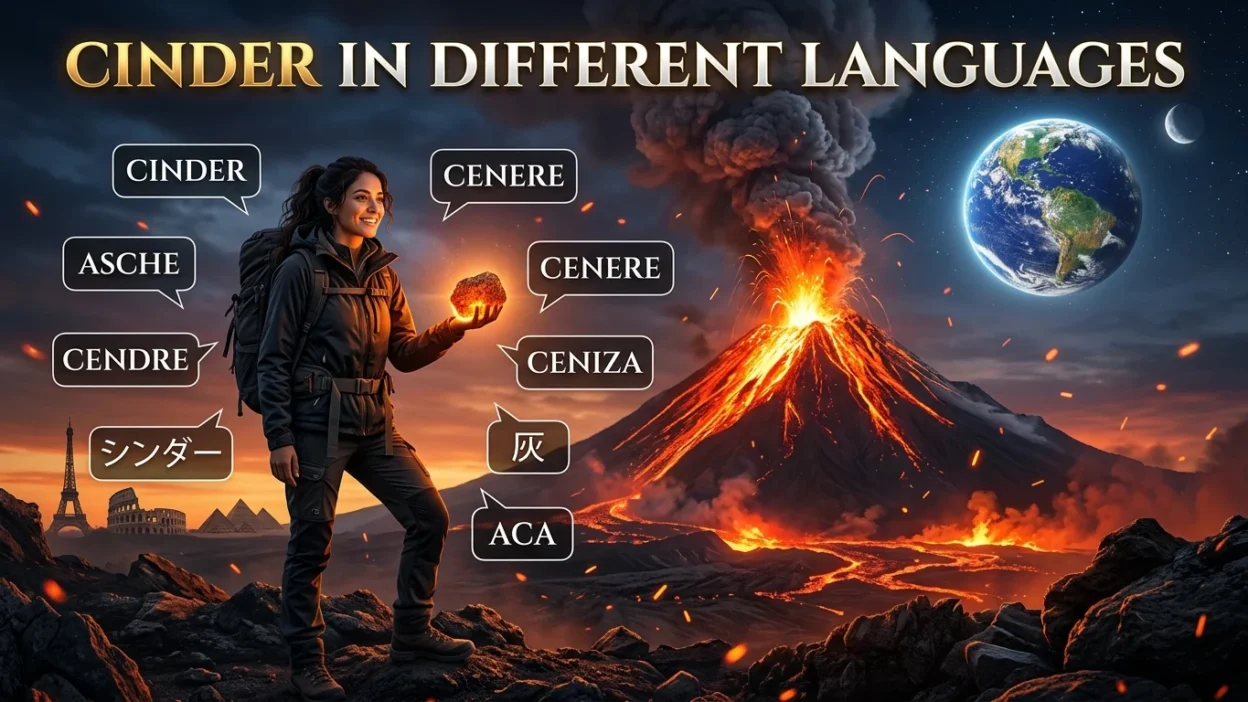
Learning cinder in different languages is an excellent way to expand your vocabulary while exploring how different cultures describe the small pieces of partially burned coal, wood or volcanic material left after a fire. The word cinder is commonly used in construction, geology, camping, literature, fireplaces and everyday conversations.
Whether you’re learning a new language, traveling or simply curious about global vocabulary, knowing how to say cinder in different languages can improve your communication skills and cultural understanding.
In this guide, you’ll discover cinder in different languages with native spellings and easy English pronunciations. You’ll also learn why this word is useful, where it’s commonly used and interesting facts about cinders around the world.
Quick Answer
Cinder in different languages includes the words used worldwide to describe small pieces of burned material or volcanic fragments left after combustion. Learning these translations improves your vocabulary, travel communication, and understanding of geology and everyday language.
Cinder in Different Languages Around the World
| Language | Native Word | Pronunciation |
|---|---|---|
| English | Cinder | SIN-der |
| Spanish | Ceniza | Seh-NEE-sa |
| French | Cendre | SON-druh |
| German | Schlacke | SHLAK-uh |
| Italian | Cenere | CHEH-neh-reh |
| Portuguese | Cinza | SEEN-zah |
| Dutch | Sintel | SIN-tel |
| Swedish | Slagg | Slag |
| Norwegian | Slagg | Slag |
| Danish | Slagge | SLAG-uh |
| Finnish | Kuona | KWO-na |
| Icelandic | Gjall | Gyatl |
| Polish | Żużel | ZHOO-zhel |
| Czech | Struska | STROOS-ka |
| Slovak | Troska | TROS-ka |
| Hungarian | Salak | SHA-lak |
| Romanian | Zgură | ZGOO-ruh |
| Greek | Σκωρία | Sko-REE-ah |
| Russian | Шлак | Shlak |
| Ukrainian | Шлак | Shlak |
| Bulgarian | Шлака | SHLA-ka |
| Serbian | Шљака | SHLYA-ka |
| Croatian | Šljaka | SHLYA-ka |
| Turkish | Cüruf | Joo-RUF |
| Arabic | خبث | Khabath |
| Hebrew | סיגים | See-geem |
| Persian | سرباره | Sar-ba-reh |
| Hindi | राख | Raakh |
| Urdu | راکھ | Raakh |
| Punjabi | ਰਾਖ | Raakh |
| Bengali | ছাই | Chhai |
| Gujarati | રાખ | Raakh |
| Marathi | राख | Raakh |
| Tamil | சாம்பல் | Saam-bal |
| Telugu | బూడిద | Boo-di-da |
| Kannada | ಬೂದಿ | Boo-di |
| Malayalam | ചാരം | Chaa-ram |
| Nepali | खरानी | Kha-ra-ni |
| Sinhala | අළු | A-lu |
| Thai | เถ้า | Thao |
| Vietnamese | Tro | Troh |
| Indonesian | Abu | A-boo |
| Malay | Abu | A-boo |
| Filipino | Abo | A-bo |
| Chinese (Mandarin) | 炉渣 | Lu Zha |
| Japanese | 燃え殻 | Moe-gara |
| Korean | 재 | Jae |
| Swahili | Majivu | Ma-jee-voo |
| Hawaiian | Lehu | Leh-hoo |
| Māori | Pungarehu | Poo-nga-re-hoo |
Why Learn “Cinder” in Different Languages?
Learning cinder in different languages is useful for travelers, students, language learners, geologists, campers, and anyone interested in nature or construction. The word often appears in discussions about fireplaces, volcanoes, industrial materials, road construction, and fire safety. Knowing its translation can make reading books, technical documents, and travel information easier.
It’s also helpful for understanding cultural expressions and historical references. In many languages, words for cinder, ash, or slag are used both literally and figuratively, appearing in stories, poetry, and traditional sayings. Expanding your vocabulary with these translations improves both language skills and cultural awareness.
Common Uses of “Cinder” Around the World
The word cinder is commonly used when talking about fireplaces, campfires, volcanoes, construction, and industrial processes. It usually refers to small pieces of partially burned wood, coal, or other materials that remain after combustion.
People may encounter cinders while camping, cleaning fireplaces, studying geology, or reading about volcanic landscapes. In construction, cinder blocks have long been used to build walls, fences, and other structures because they are lightweight and durable.
Beyond its literal meaning, cinder also appears in literature, folklore, and popular culture. The famous fairy tale Cinderella gets its name from the cinders and ashes where the main character was forced to work. This connection has made the word recognizable even to people who rarely encounter cinders in everyday life. In some cultures, cinders also symbolize transformation, endurance, and renewal after destruction.
Pronunciation Tips for Beginners
Learning the pronunciation of cinder in different languages becomes easier when you group similar words together. Many languages use words related to ash, slag, or burned material, while others have unique terms that reflect local traditions and industrial vocabulary.
For languages that use different writing systems, such as Arabic, Chinese, Japanese, Korean, Hindi, and Russian, listen to native pronunciation through language-learning apps or dictionaries. Repeat each word slowly while paying attention to vowel sounds, consonant combinations, and syllable stress. Practicing a few translations every day will gradually improve both your pronunciation and listening skills.
Interesting Facts About Cinders
Cinders are created when combustible materials such as coal or wood burn at high temperatures, leaving behind lightweight fragments and ash. In volcanic regions, the word cinder can also describe porous pieces of cooled lava ejected during volcanic eruptions.
These volcanic cinders often form impressive landscapes, including cinder cones, which are among the most common types of volcanoes on Earth. Historically, cinders were widely reused instead of being discarded. They were commonly mixed into building materials, spread on icy roads to improve traction and used in railway construction.
Today, although modern materials have replaced many traditional uses, cinders remain important in geology, environmental science, archaeology and historical research.
Conclusion
Learning cinder in different languages is a valuable way to expand your vocabulary while exploring topics related to fire, geology, construction and literature. Whether you’re studying earth science, reading international books, traveling or learning a new language, these translations help you communicate more effectively and understand cultural references from around the world.
Practicing these words regularly will strengthen your language skills while broadening your global knowledge.
Frequently Asked Questions
1. What is a cinder?
A cinder is a small piece of partially burned coal, wood, or volcanic material that remains after combustion or a volcanic eruption.
2. Is a cinder the same as ash?
Not exactly. Ash is the fine powder left after burning, while a cinder is usually a larger, partially burned fragment.
3. What are cinder blocks?
Cinder blocks are lightweight concrete building blocks traditionally made using cinders or similar aggregate materials for construction.
4. Why should I learn cinder in different languages?
Learning these translations improves your vocabulary for travel, geology, construction, literature, and everyday conversations across different cultures.
5. What is the easiest way to remember these translations?
Practice a few languages each day, group similar words together, listen to native pronunciation, and use the vocabulary while reading or studying.