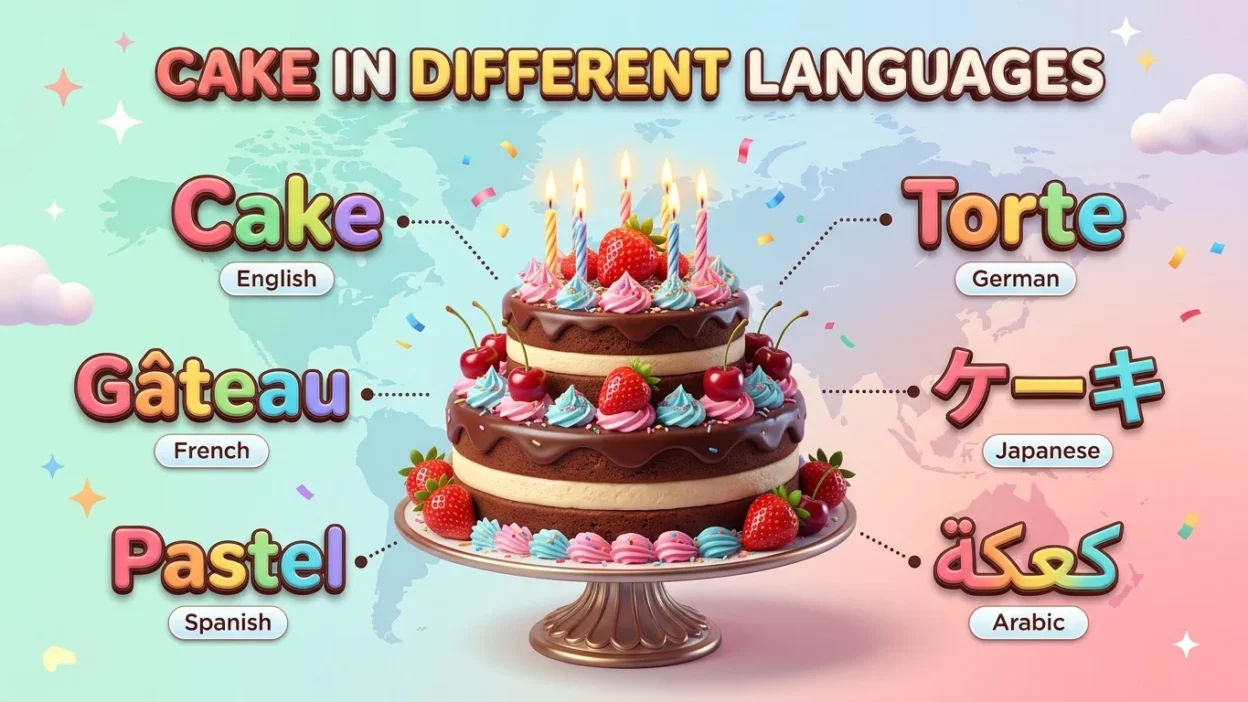
Cake is one of the most loved desserts worldwide. People enjoy it at birthdays, weddings, anniversaries, family gatherings, and special celebrations. Although this delicious treat is popular across the globe, its name changes from one language to another. Learning cake in different languages is an interesting way to explore international vocabulary and food traditions.
If you are a student, traveler, language enthusiast, or food lover, discovering these translations can expand your knowledge. From French gâteau to German Kuchen and Japanese ケーキ, every language has its own way of describing this popular dessert.
Quick Answer
Cake has different names around the world. It is called gâteau in French, Kuchen in German, torta in Spanish and Italian, bolo in Portuguese, and ケーキ (kēki) in Japanese.
Cake Around the World
| Language | Native Word | Pronunciation |
|---|---|---|
| English | Cake | Kayk |
| Spanish | Pastel / Tarta | Pas-tel / Tar-ta |
| French | Gâteau | Gah-toh |
| German | Kuchen | Koo-khen |
| Italian | Torta | Tor-tah |
| Portuguese | Bolo | Boh-loo |
| Dutch | Taart | Tahrt |
| Swedish | Tårta | Tor-tah |
| Norwegian | Kake | Kah-keh |
| Danish | Kage | Kay-eh |
| Finnish | Kakku | Kahk-koo |
| Icelandic | Kaka | Kah-kah |
| Russian | Торт | Tort |
| Ukrainian | Торт | Tort |
| Polish | Ciasto | Chyas-toh |
| Czech | Dort | Dort |
| Slovak | Koláč | Koh-laach |
| Hungarian | Torta | Tor-tah |
| Romanian | Tort | Tort |
| Greek | Κέικ | Keik |
| Turkish | Pasta | Pas-tah |
| Arabic | كعكة | Ka’kah |
| Persian | کیک | Keek |
| Urdu | کیک | Kayk |
| Hindi | केक | Kayk |
| Bengali | কেক | Kek |
| Punjabi | ਕੇਕ | Kayk |
| Tamil | கேக் | Kayk |
| Telugu | కేక్ | Kayk |
| Marathi | केक | Kayk |
| Gujarati | કેક | Kayk |
| Chinese (Mandarin) | 蛋糕 | Dàn gāo |
| Japanese | ケーキ | Kēki |
| Korean | 케이크 | Ke-i-keu |
| Thai | เค้ก | Khek |
| Vietnamese | Bánh kem | Banh kem |
| Indonesian | Kue | Koo-eh |
| Malay | Kek | Kek |
| Filipino | Keyk | Kayk |
| Swahili | Keki | Keh-kee |
| Hebrew | עוגה | Oo-gah |
| Irish | Cáca | Kaa-kah |
| Welsh | Cacen | Kah-ken |
| Scottish Gaelic | Cèic | Kayk |
| Basque | Tarta | Tar-tah |
| Catalan | Pastís | Pas-tees |
| Croatian | Kolač | Koh-lach |
| Serbian | Торта | Tor-tah |
| Bulgarian | Торта | Tor-tah |
| Lithuanian | Tortas | Tor-tas |
Note: Some languages use different words depending on the type of cake, regional vocabulary, and local traditions.
1. Why Learn Cake in Different Languages?
Learning food vocabulary is an enjoyable way to improve language skills. Cake is a familiar dessert, making its translations easier to understand and remember.
Knowing these words can also help when traveling internationally. You may recognize cake names on bakery menus, restaurant signs, dessert packages, and recipe websites.
For students, food bloggers, translators, and language enthusiasts, these translations provide useful everyday vocabulary. They also help people communicate about recipes, ingredients, and desserts with speakers of other languages.
2. Cultural Significance of Cake Around the World
Cake has an important place in celebrations across different cultures. People commonly serve it at birthdays, weddings, anniversaries, graduations, and family gatherings.
Different countries have developed their own traditional cakes and baking styles. Germany is famous for Black Forest cake, Japan is known for strawberry shortcake, and Italy has traditional desserts such as torta della nonna.
These traditions show that cake is more than just a sweet dessert. It represents happiness, hospitality, family connections, and memorable occasions around the world.
3. How to Pronounce Cake in Different Languages
Pronunciation is an important part of learning foreign vocabulary. Even when two languages have similar words, their sounds and speaking patterns can be different.
For example, French gâteau has a distinctive pronunciation, while German Kuchen includes a sound that may be unfamiliar to English speakers. Japanese ケーキ follows Japanese pronunciation patterns.
To improve your pronunciation, listen to native speakers and repeat each word slowly. Practicing regularly and breaking unfamiliar words into smaller sounds can make speaking easier.
4. Popular Types of Cake in Different Countries
Different countries enjoy different varieties of cake. Many traditional desserts reflect local ingredients, cooking techniques, and cultural preferences.
Here are some popular examples:
- Black Forest Cake: A famous German chocolate cake traditionally prepared with cherries and cream.
- Cheesecake: A creamy dessert enjoyed in many countries.
- Tres Leches Cake: A popular Latin American dessert soaked in three types of milk.
- Japanese Strawberry Shortcake: A soft sponge cake layered with whipped cream and strawberries.
- Pavlova: A meringue-based dessert popular in Australia and New Zealand.
- Victoria Sponge: A traditional British cake filled with jam and cream.
Exploring these desserts makes international food vocabulary more interesting and helps people discover different baking traditions.
5. Interesting Facts About Cake Names
Cake names are not always translated in the same way across languages. Some countries use specific words for sponge cakes, while others have broader terms for baked desserts.
For example, Spanish speakers may use pastel or tarta depending on their country and the dessert. In German, Kuchen is a general word for cake, while Torte often describes elaborate layered cakes.
Another interesting fact is that several languages have adopted words that sound similar to English cake. These similarities can make certain translations easier for beginners to remember.
6. Common Mistakes When Translating Cake
One common mistake is assuming that every language has only one word for cake. In reality, translations can change depending on the dessert, region, and local traditions.
For example, Turkish pasta means cake, not Italian pasta. Similarly, Spanish pastel and tarta can describe different sweet dishes depending on regional usage.
Another mistake is ignoring pronunciation. A word may look familiar but sound different when spoken by a native speaker.
Always consider the context, check regional vocabulary, and practice pronunciation before using a translation.
7. Practical Uses of Cake Vocabulary
Knowing cake translations can be useful in everyday situations, especially when traveling, ordering food, or communicating with international friends.
You can use these words when visiting bakeries, reading foreign-language menus, searching for international recipes, or discussing desserts online.
For example, someone visiting France can recognize gâteau on a bakery menu. In Germany, knowing the word Kuchen can make ordering dessert easier.
Food vocabulary is also helpful for students and content creators who write about recipes, international cuisine, and cultural traditions.
8. Easy Tips to Remember Cake Translations
Remembering 50 foreign words may seem difficult, but a few simple techniques can make the process easier.
Try these practical learning tips:
- Learn Five Words Daily: Start with five languages and gradually increase your vocabulary.
- Use Flashcards: Write the native word on one side and its English meaning on the other.
- Practice Speaking: Repeat each translation aloud to improve pronunciation.
- Group Similar Words: Learn languages with similar spellings together.
- Use Visual Learning: Connect each word with a picture of a cake.
- Create Sentences: Use new vocabulary in simple sentences to remember it longer.
Regular practice is more effective than memorizing everything in one sitting.
9. Benefits of Learning Food Words in Different Languages
Learning food vocabulary offers several benefits for language learners. It improves everyday communication, expands vocabulary, and helps people understand different cultures.
Cake is an excellent example because it is familiar in many countries but has different names and cultural associations.
These words can also help travelers communicate with bakery staff, understand international recipes, and explore foreign food traditions.
Additionally, learning translations builds confidence when speaking another language. Even knowing a few common food words can make conversations more enjoyable and meaningful.
Key Takeaways
- Cake has different names in more than 50 languages.
- Common translations include gâteau, Kuchen, torta, and bolo.
- Pronunciation varies depending on the language and region.
- Cake represents celebrations and traditions in many cultures.
- Regular practice makes international food vocabulary easier to remember.
FAQs:
1. How do you say cake in different languages?
Cake has many translations around the world. In French, it is gâteau; in German, Kuchen; in Spanish, pastel or tarta; in Italian, torta; and in Japanese, ケーキ. The exact word can vary depending on the language, region, and type of dessert.
2. What is the French word for cake?
The French word for cake is gâteau. It is commonly used for sweet baked desserts and appears in many French bakery names and recipes. Another related French word is pâtisserie, which refers to pastries and the art or business of making them.
3. What is cake called in Spanish?
In Spanish, cake is commonly called pastel or tarta. The preferred word depends on the country and the dessert. For example, tarta is widely used in Spain, while pastel is common in several Latin American countries.
4. What is the Japanese word for cake?
The Japanese word for cake is ケーキ (kēki). It is borrowed from the English word cake and written using the Japanese katakana writing system. Strawberry shortcake and other cream-based cakes are especially popular in Japanese bakeries.
5. Why do different languages have different words for cake?
Different languages develop vocabulary through their histories, cultures, and interactions with other societies. Some words come from older native expressions, while others are borrowed from foreign languages. Regional baking traditions also influence how people name different types of cakes.
Conclusion
Exploring cake in different languages is a simple and enjoyable way to discover international vocabulary and food traditions. From French gâteau and German Kuchen to Japanese ケーキ and Spanish pastel, every language offers a unique way to describe this popular dessert. These translations can help language learners, travelers, students, and food enthusiasts communicate more confidently. By practicing native spellings, learning pronunciation, and exploring cultural differences, you can make vocabulary learning both practical and interesting.

Olivia Riley is a passionate content administrator at Diflingo, where she manages and publishes high-quality articles focused on what to say in everyday conversations, special occasions, professional settings, and personal relationships. She ensures every guide is clear, practical, engaging, and helpful for readers.