Cupcakes are small, delicious cakes enjoyed by people of all ages. They come in many flavors, colors, and designs, making them a popular dessert for birthdays, weddings, parties, and everyday celebrations. Learning how to say cupcake in different languages is a fun way to explore food vocabulary and discover how different cultures describe sweet treats.
Whether you are a language learner, food lover, baker, or curious traveler, these translations can expand your vocabulary. From European languages to Asian and African languages, this guide explores cupcake in different languages, including native spellings and easy English pronunciations.
Quick Answer
The word cupcake has different translations around the world. Some languages use a direct translation, while others use borrowed words or local expressions to describe a small, individually baked cake.
Cupcake in Different Languages Around the World
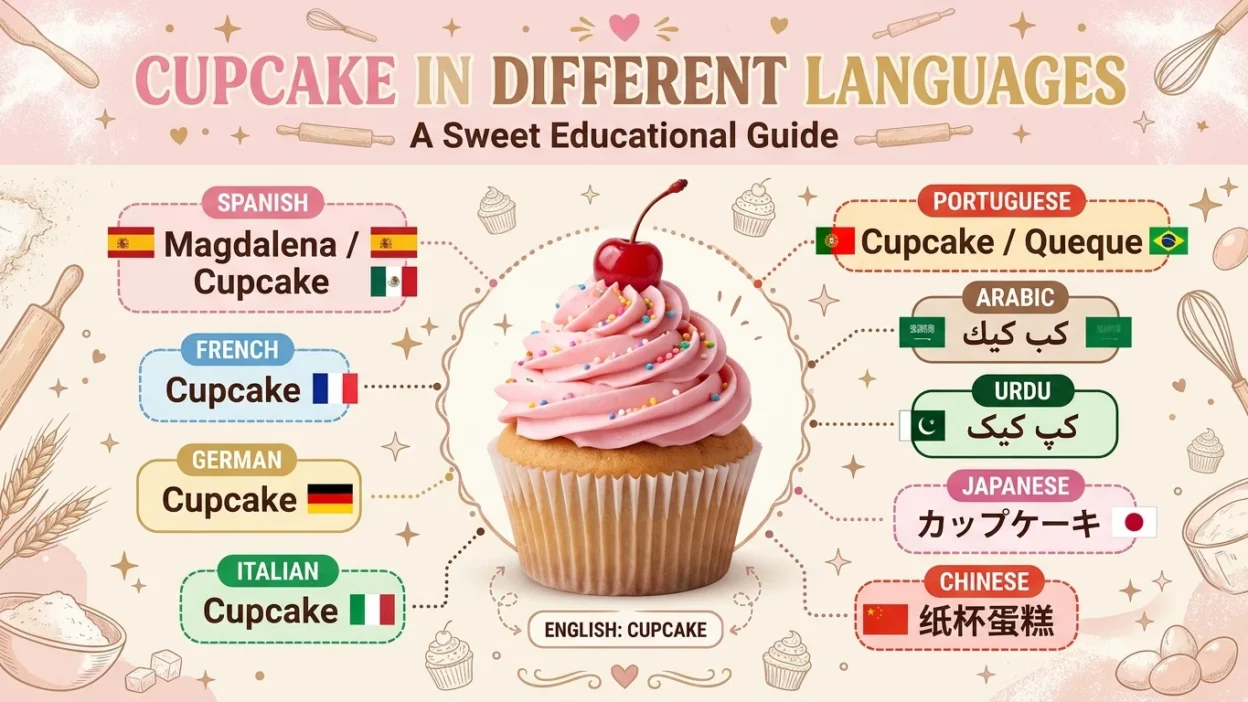
The following table features 50 languages, their commonly used cupcake translations, and simple pronunciation guides. Some translations describe a small cake rather than an exact equivalent of the English word cupcake.
| Language | Native Word | Pronunciation |
|---|---|---|
| Spanish | Magdalena | mag-duh-LEH-nah |
| French | Petit gâteau | puh-TEE gah-TOH |
| German | Cupcake | KUP-kayk |
| Italian | Cupcake | KUP-kayk |
| Portuguese | Bolinho | boh-LEEN-yoo |
| Dutch | Cupcake | KUP-kayk |
| Swedish | Cupcake | KUP-kayk |
| Norwegian | Cupcake | KUP-kayk |
| Danish | Cupcake | KUP-kayk |
| Finnish | Kuorrutettu kuppikakku | KWOH-roo-tet-too KOOP-pee-kahk-koo |
| Polish | Babeczka | bah-BETCH-kah |
| Czech | Košíček | koh-SHEE-chek |
| Slovak | Košíček | koh-SHEE-chek |
| Hungarian | Muffin | MOO-feen |
| Romanian | Brioșă | bree-OH-shuh |
| Greek | Κεκάκι | keh-KAH-kee |
| Russian | Капкейк | kap-KAYK |
| Ukrainian | Капкейк | kap-KAYK |
| Turkish | Kapkek | KAP-kek |
| Arabic | كعكة صغيرة | ka’kat sagheera |
| Persian | کیک فنجانی | kayk-e fenjaani |
| Urdu | کپ کیک | kap-kayk |
| Hindi | कपकेक | kup-kayk |
| Bengali | কাপকেক | kap-kek |
| Punjabi | ਕੱਪ ਕੇਕ | kap-kayk |
| Chinese (Mandarin) | 纸杯蛋糕 | zhǐ bēi dàn gāo |
| Japanese | カップケーキ | kappu kēki |
| Korean | 컵케이크 | keop-ke-i-keu |
| Thai | คัพเค้ก | khap-khek |
| Vietnamese | Bánh cupcake | banh KUP-kayk |
| Indonesian | Kue mangkuk | koo-eh MANG-kook |
| Malay | Kek cawan | kek CHA-wan |
| Filipino | Cupcake | KUP-kayk |
| Swahili | Keki ndogo | KEH-kee NDOH-goh |
| Afrikaans | Kolwyntjie | KOL-vayn-chee |
| Zulu | Ikhekhe elincane | ee-KHEH-kheh eh-lin-KAH-neh |
| Yoruba | Kẹ́kẹ́ kékeré | keh-keh keh-keh-reh |
| Igbo | Obere achicha | oh-BEH-reh ah-CHEE-chah |
| Amharic | ኩባያ ኬክ | koo-BAH-yah kek |
| Hebrew | קאפקייק | KAP-kayk |
| Irish | Cáca beag | KAW-kah byag |
| Welsh | Cacen fach | KAH-ken vahkh |
| Icelandic | Bollakaka | BOT-la-kah-kah |
| Croatian | Kolačić | koh-LAH-cheech |
| Serbian | Капкејк | KAP-kayk |
| Bulgarian | Къпкейк | KAP-kayk |
| Slovenian | Kolaček | koh-LAH-chek |
| Lithuanian | Keksiukas | kek-SYOO-kas |
| Latvian | Mafins | MAH-fins |
| Estonian | Tassikook | TAS-see-kook |
Why Learn Cupcake in Different Languages?
Learning cupcake translations is a simple and enjoyable way to improve your food vocabulary. It introduces you to words used in bakeries, cafes, restaurants, and grocery stores around the world.
For language learners, dessert vocabulary is especially useful because food is part of everyday conversation. Knowing these words can help you understand menus, follow recipes, and communicate when ordering sweets abroad.
It can also be helpful for food bloggers, bakery owners, and travelers who want to connect with international audiences. Even learning one new dessert word can make conversations more interesting and memorable.
Cultural Significance of Cupcakes Around the World
Cupcakes are popular in many countries, but different cultures have their own small cakes and traditional baked treats. Some resemble Western cupcakes, while others have unique ingredients, textures, and decorations.
In European countries, small sponge cakes and muffins are commonly enjoyed with tea or coffee. In Asian countries, bakeries often offer colorful individual cakes with cream, fruit, and other toppings.
These differences show how one dessert can inspire many variations. Although the name may change between languages, the idea of enjoying a small, delicious cake remains familiar across many cultures.
How to Pronounce Cupcake in Different Languages
Pronunciation is an important part of learning new vocabulary. Some languages borrow the English word cupcake, while others use completely different expressions.
For example, Mandarin Chinese uses 纸杯蛋糕, while Japanese uses カップケーキ. Both expressions have their own pronunciation patterns and writing systems.
Start by learning the pronunciation slowly and breaking unfamiliar words into smaller sounds. Listen to native speakers whenever possible, repeat the words aloud, and pay attention to syllable stress. Practicing a few translations every day can help you remember them more naturally.
Different Types of Cupcakes Around the World
Cupcakes come in countless flavors and styles. Traditional vanilla and chocolate cupcakes remain popular, but modern bakeries experiment with ingredients inspired by local food traditions.
Some common varieties include:
- Vanilla Cupcakes: Light cakes with vanilla flavor and creamy frosting.
- Chocolate Cupcakes: Rich chocolate cakes topped with chocolate icing.
- Strawberry Cupcakes: Sweet cakes featuring fresh strawberries or strawberry cream.
- Red Velvet Cupcakes: Soft red-colored cakes with cream cheese frosting.
- Lemon Cupcakes: Refreshing cakes with a tangy citrus flavor.
- Caramel Cupcakes: Sweet treats topped with caramel sauce.
- Coffee Cupcakes: Cakes flavored with coffee or espresso.
- Fruit Cupcakes: Cakes decorated with fresh seasonal fruits.
These varieties demonstrate how bakers can adapt a familiar dessert to different tastes and preferences.
Practical Uses of Cupcake Translations
Knowing cupcake translations can be useful in several everyday situations. If you travel internationally, you may encounter different names for small cakes on bakery menus or dessert displays.
Food bloggers can also use translated dessert terms to create content for international readers. Similarly, bakery businesses can include local language names in product descriptions to make their offerings easier to understand.
These translations are also useful for students completing language assignments or preparing food-related vocabulary lists. Whether you are ordering dessert, reading a recipe, or writing about baking, knowing the correct local expression can improve communication.
Easy Tips for Learning Cupcake in Multiple Languages
Learning 50 translations may seem difficult at first, but a few simple techniques can make the process easier.
Try these practical tips:
- Learn Five Words Daily: Focus on a small group of languages instead of memorizing everything at once.
- Use Flashcards: Write the language on one side and its translation on the other.
- Practice Speaking: Read each word aloud to improve pronunciation.
- Connect Words With Pictures: Associate each translation with a picture of a cupcake.
- Group Similar Words: Notice which languages use borrowed English words and which use local expressions.
Regular practice will help you remember translations and recognize patterns between languages.
Interesting Facts About Cupcakes and Their Names
Cupcakes have an interesting history, and their names reflect changes in baking traditions. The English word became popular for small individual cakes baked in paper or foil cups.
Interestingly, not every language has a traditional word that matches the modern cupcake exactly. Some languages borrow the English term, while others describe the dessert using words meaning small cake, cup cake, or muffin.
Another interesting fact is that cupcake decorations can vary widely. Some bakeries use buttercream, chocolate, fruit, nuts, or regional sweets to create unique designs that reflect local tastes.
Common Mistakes When Translating Cupcake
One common mistake is assuming that every language has an exact equivalent of the English word cupcake. In reality, some translations describe muffins, small sponge cakes, or other similar baked desserts.
Another mistake is relying only on English pronunciation when reading foreign words. Languages have different sound systems, so the same letters may produce different sounds.
It is also important to distinguish between a cupcake and a muffin. Although both are small individual cakes, they often differ in sweetness, texture, ingredients, and decoration. Checking the local meaning before using a translation helps you communicate more accurately.
Benefits of Learning Food Words in Different Languages
Learning food-related vocabulary offers several benefits beyond ordering meals. It helps you understand different cultures, discover traditional recipes, and communicate more confidently with people from other countries.
Cupcake is an enjoyable example because it connects language learning with something familiar and entertaining. You can use these translations in cooking discussions, travel conversations, educational activities, and international food content.
Food vocabulary is also easier to remember when connected to personal experiences. For example, learning the word for a dessert you enjoy can make language practice more engaging and encourage you to explore additional words.
Key Takeaways
- Cupcake has different names and expressions across 50 languages.
- Some languages borrow the English word, while others use local translations.
- Pronunciation varies according to each language’s sound system.
- Cupcake varieties reflect different baking traditions and cultural preferences.
- Learning dessert vocabulary makes language practice more enjoyable and practical.
Conclusion
Exploring cupcake in different languages is a fun way to combine food knowledge with language learning. From European translations to Asian and African expressions, every language offers an interesting way to describe this popular dessert. Although some translations refer to similar small cakes rather than an exact cupcake equivalent, they provide useful cultural and linguistic insights. Whether you are a student, traveler, baker, or dessert enthusiast, learning these 50 translations can expand your vocabulary and help you appreciate how people around the world enjoy sweet treats.
FAQs:
1. What is cupcake called in different languages?
Cupcake has different names depending on the language. For example, it is called 纸杯蛋糕 in Mandarin Chinese, カップケーキ in Japanese, کپ کیک in Urdu, and kapkek in Turkish. Some languages use the original English word instead of creating a separate translation.
2. What is cupcake called in Spanish?
In Spanish, a similar small individual cake is often called a magdalena, although the exact term can vary by region and recipe. The English word cupcake is also used in many Spanish-speaking bakeries, especially for decorated cakes with frosting.
3. What is cupcake called in French?
In French, cupcake is commonly called a cupcake, using the borrowed English word. Petit gâteau means small cake and can describe similar desserts, but it is not always an exact translation. French bakeries often use the English name for decorated individual cakes.
4. What is cupcake called in Japanese?
In Japanese, cupcake is written as カップケーキ and pronounced using Japanese syllables. The word is a phonetic adaptation of the English term. Cupcakes are commonly available in Japanese bakeries, often decorated with cream, fruit, chocolate, and colorful toppings.
5. Why do cupcake names differ between languages?
Cupcake names differ because languages develop their own food vocabulary and adopt foreign words in different ways. Some cultures translate the meaning directly, while others borrow the English name. Local baking traditions can also influence how similar desserts are described.