Culture is an important part of human life. It represents the traditions, beliefs, values, customs, food, art, and lifestyles that make every community unique. Learning the word culture in different languages helps us understand how people around the world describe their heritage and identity.
If you are learning a new language, exploring international traditions, or expanding your vocabulary, discovering culture in different languages is an interesting way to connect with people. Different languages express this concept through unique words that reflect their history, society, and way of life.
Quick Answer
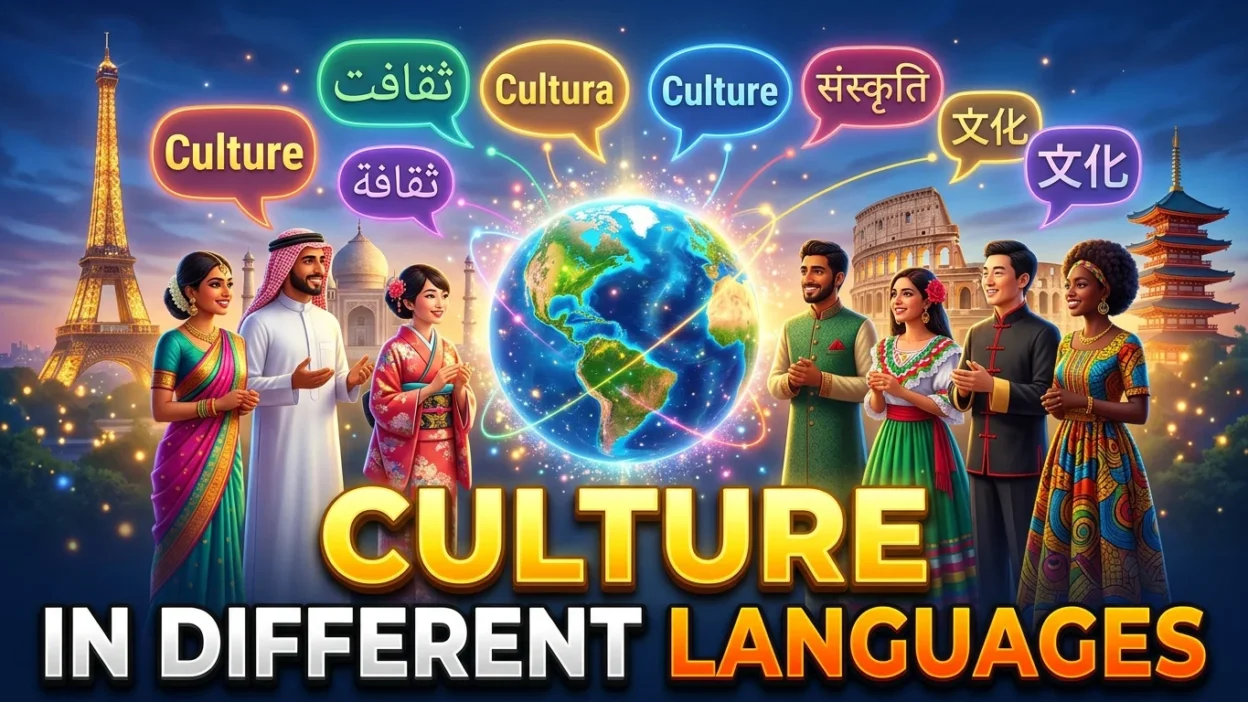
The word culture has different translations around the world. For example, it is Cultura in Spanish, Culture in French, Kultur in German, Cultura in Italian, and ثقافت (Saqafat) in Urdu.
Culture Around the World
Here are 50 translations of the word culture in different languages, along with their native spellings and easy English pronunciations.
| Language | Native Word | Pronunciation |
|---|---|---|
| English | Culture | KUL-chur |
| Spanish | Cultura | kool-TOO-rah |
| French | Culture | kul-TUR |
| German | Kultur | kool-TOOR |
| Italian | Cultura | kool-TOO-rah |
| Portuguese | Cultura | kool-TOO-rah |
| Dutch | Cultuur | kul-TOOR |
| Russian | Культура | kool-TOO-rah |
| Ukrainian | Культура | kool-TOO-rah |
| Polish | Kultura | kool-TOO-rah |
| Czech | Kultura | kool-TOO-rah |
| Slovak | Kultúra | kool-TOO-rah |
| Romanian | Cultură | kool-TOO-ruh |
| Greek | Πολιτισμός | poh-lee-tee-ZMOS |
| Turkish | Kültür | kool-TUR |
| Arabic | ثقافة | tha-QAA-fah |
| Urdu | ثقافت | sa-QAA-fat |
| Persian | فرهنگ | far-HANG |
| Hindi | संस्कृति | sun-SKRI-tee |
| Bengali | সংস্কৃতি | shong-SKRI-tee |
| Punjabi | ਸਭਿਆਚਾਰ | sabh-yaa-CHAAR |
| Gujarati | સંસ્કૃતિ | sun-SKRI-tee |
| Marathi | संस्कृती | sun-SKRU-tee |
| Tamil | பண்பாடு | pun-BAA-du |
| Telugu | సంస్కృతి | sun-SKRU-tee |
| Kannada | ಸಂಸ್ಕೃತಿ | sun-SKRU-tee |
| Malayalam | സംസ്കാരം | sum-skaa-RAM |
| Chinese (Mandarin) | 文化 | wén huà |
| Japanese | 文化 | bunka |
| Korean | 문화 | mun-hwa |
| Vietnamese | Văn hóa | vun HWAH |
| Thai | วัฒนธรรม | wat-tha-na-tham |
| Indonesian | Budaya | boo-DAH-yah |
| Malay | Budaya | boo-DAH-yah |
| Filipino | Kultura | kool-TOO-rah |
| Swahili | Utamaduni | oo-tah-mah-DOO-nee |
| Amharic | ባህል | bah-hil |
| Hebrew | תרבות | tar-BOOT |
| Finnish | Kulttuuri | koolt-too-ree |
| Swedish | Kultur | kool-TOOR |
| Norwegian | Kultur | kool-TOOR |
| Danish | Kultur | kool-TOOR |
| Icelandic | Menning | MEN-ning |
| Hungarian | Kultúra | kool-TOO-rah |
| Croatian | Kultura | kool-TOO-rah |
| Serbian | Култура | kool-TOO-rah |
| Bulgarian | Култура | kool-TOO-rah |
| Slovenian | Kultura | kool-TOO-rah |
| Lithuanian | Kultūra | kool-TOO-rah |
| Latvian | Kultūra | kool-TOO-rah |
Note: Pronunciations are approximate English-friendly guides. Some languages use broader or context-dependent meanings for the word culture.
Why Is Culture Important Around the World?
Culture plays an essential role in shaping how people live, communicate, and interact with others. It influences family traditions, celebrations, clothing, music, language, and everyday behavior.
Every community has cultural practices that reflect its history and identity. Learning about different cultures encourages respect, understanding, and appreciation for people with different backgrounds.
Understanding cultural vocabulary also makes international communication easier. It helps travelers, students, and language learners discuss traditions and social values more confidently.
Cultural Significance of the Word Culture
The word culture represents much more than traditional clothing, festivals, or food. It describes the shared knowledge, beliefs, customs, and practices that connect members of a community.
In some societies, culture is strongly connected to family values and religious traditions. In others, it may emphasize artistic expression, education, social behavior, and historical heritage.
Although different languages use different words, the basic idea remains connected to human identity and shared experiences. Understanding these differences helps people appreciate the richness of global communities.
How to Pronounce Culture in Different Languages
Pronunciation changes depending on the language, alphabet, and regional accent. Even when two languages use similar spellings, their sounds may be quite different.
For example, Spanish speakers pronounce Cultura with a clear emphasis on the second syllable. French speakers pronounce Culture differently, with a distinct French ending. German uses Kultur, which has a stronger final sound.
To improve pronunciation, listen to native speakers, practice slowly, and repeat each word several times. Learning the correct vowel sounds and syllable stress can make your pronunciation more natural.
Related Words Connected to Culture
Learning related vocabulary makes it easier to understand the broader meaning of culture. These words frequently appear in conversations about society, history, and traditions.
- Tradition: A custom or practice passed from one generation to another.
- Heritage: The history and cultural identity inherited from previous generations.
- Custom: A commonly accepted way of behaving within a community.
- Identity: The characteristics that define a person or group.
- Language: A system of communication used by a community.
- Values: Beliefs and principles that influence people’s decisions.
- Diversity: The presence of different backgrounds, traditions, and perspectives.
These expressions help language learners discuss cultural topics with greater confidence.
Practical Uses of the Word Culture
The word culture appears in everyday conversations, academic writing, travel discussions, and professional communication. It can describe the traditions of a country, the behavior of a community, or the environment within an organization.
For example, someone might discuss Japanese culture when talking about traditional festivals, food, or social customs. Similarly, workplace culture describes the shared attitudes and practices within a company.
Learning how to use this word correctly in different languages can improve communication. It is especially useful for students, translators, travelers, and people interested in international relationships.
Easy Ways to Learn Culture in Different Languages
Learning translations becomes easier when you use simple and consistent study methods. Instead of memorizing all 50 words at once, focus on a few languages every day.
Try these practical learning techniques:
- Create vocabulary lists: Write the word, its native spelling, and pronunciation together.
- Practice daily: Spend five to ten minutes reviewing new translations.
- Listen to native speakers: Use language-learning audio to understand natural pronunciation.
- Use flashcards: Review words regularly to improve long-term memory.
- Explore cultural examples: Connect each translation with a country’s traditions and lifestyle.
Regular practice helps you remember vocabulary and understand cultural differences more naturally.
Interesting Facts About Culture and Languages
Culture and language are closely connected because language carries traditions, stories, beliefs, and historical knowledge from one generation to another.
Here are some interesting facts:
- The English word culture comes from the Latin word cultura, associated with cultivation and care.
- Spanish and Italian use very similar words for culture.
- Chinese uses two characters, 文化, to express the concept.
- Urdu uses the word ثقافت to describe culture and civilization-related practices.
- Many languages have additional expressions for specific aspects of culture, such as traditional customs and heritage.
- Cultural traditions can change over time as communities interact and develop.
These facts show how languages preserve different aspects of human history.
Common Mistakes When Learning Cultural Vocabulary
One common mistake is assuming that similar-looking words always have exactly the same meaning and pronunciation. Words such as Cultura and Kultur look related, but their pronunciation differs.
Another mistake is using the word culture only to describe festivals, traditional clothing, or historical monuments. Culture also includes everyday habits, communication styles, family values, and social expectations.
Learners should also avoid confusing culture with nationality. People from the same country can have different cultural backgrounds, traditions, and experiences.
Understanding context is the best way to use cultural vocabulary accurately and respectfully.
Benefits of Learning Cultural Words in Different Languages
Learning cultural vocabulary offers several benefits beyond improving language skills. It helps people understand international communities and communicate more effectively.
Some important benefits include:
- Better communication: Discuss cultural topics with speakers of other languages.
- Global awareness: Understand traditions and lifestyles from different countries.
- Improved vocabulary: Expand your knowledge of useful foreign words.
- Travel confidence: Communicate more comfortably when visiting other countries.
- Cultural appreciation: Develop respect for different customs and backgrounds.
- Educational growth: Build knowledge about languages, societies, and history.
These benefits make cultural vocabulary useful for students, travelers, professionals, and curious learners.
Key Takeaways
- Culture describes the traditions, beliefs, values, and lifestyles of a community.
- The word has different translations across 50 languages.
- Spanish uses Cultura, German uses Kultur, and Urdu uses ثقافت.
- Pronunciation and meaning can vary depending on language and context.
- Learning cultural vocabulary improves communication and global understanding.
Conclusion
Exploring culture in different languages is a meaningful way to understand the diversity of human communities. Although every language has its own expression, the concept connects people through shared traditions, beliefs, values, and experiences. From Cultura in Spanish to ثقافت in Urdu, each translation offers a glimpse into how different societies describe their identity. Whether you are a student, traveler, or language enthusiast, learning these words can expand your vocabulary, improve communication, and encourage greater appreciation for cultures around the world.
FAQs:
1. What is the word culture in different languages?
The word culture has many translations worldwide. It is Cultura in Spanish, Kultur in German, Culture in French, 文化 in Chinese, and ثقافت in Urdu. These words describe traditions, beliefs, customs, and shared ways of life within a community.
2. What is culture called in Spanish?
Culture is called Cultura in Spanish. It is pronounced approximately as kool-TOO-rah. The word can describe a country’s traditions, artistic activities, social values, historical heritage, and everyday lifestyle. It is commonly used in educational, social, and everyday conversations.
3. What is the Urdu word for culture?
The Urdu word for culture is ثقافت (Saqafat). It refers to the traditions, customs, beliefs, values, and social practices of a community. The word is commonly used when discussing Pakistani culture, cultural heritage, literature, and traditional lifestyles.
4. Why do different languages have different words for culture?
Languages develop through different historical, geographical, and social experiences. Their vocabulary reflects these influences. Although translations may look and sound different, many languages have words that express the shared ideas of traditions, customs, beliefs, and community identity.
5. What is the easiest way to learn culture in different languages?
The easiest approach is to learn a few translations daily using vocabulary lists and flashcards. Practice pronunciation, listen to native speakers, and connect each word with cultural examples. Regular revision helps improve memory and makes learning international vocabulary more enjoyable.