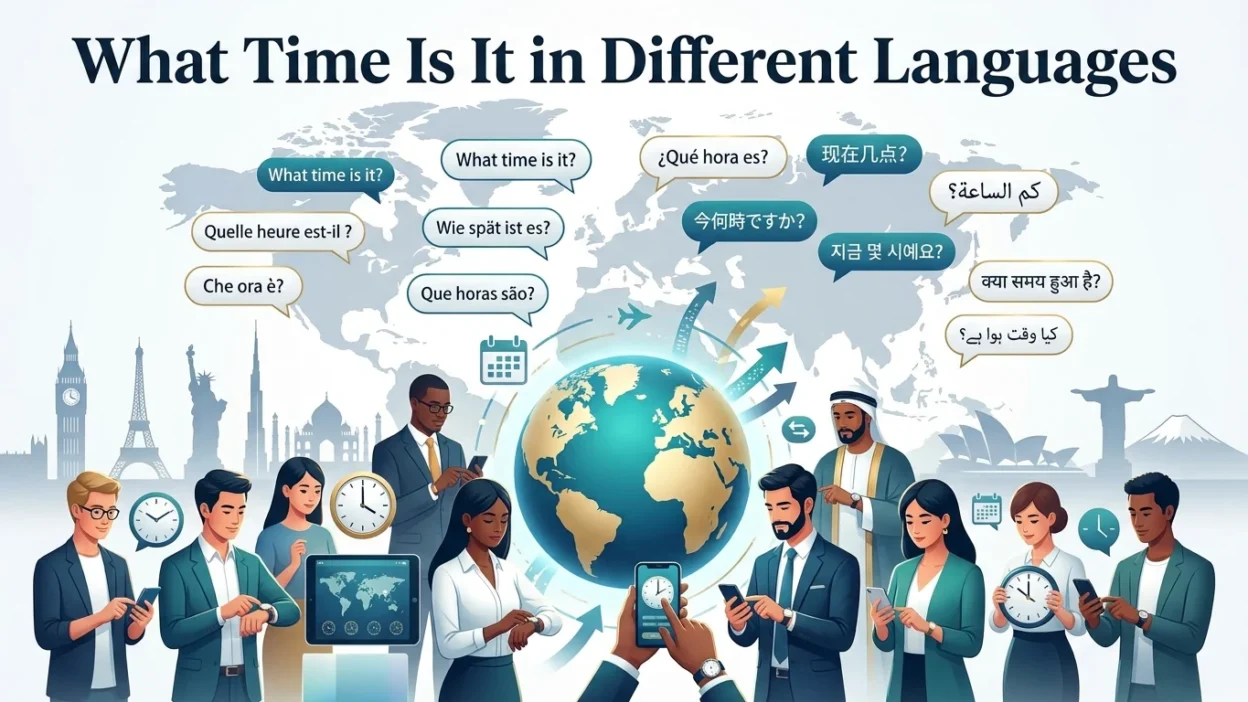
Learning what time is it in different languages is one of the most useful skills for travelers, language learners and anyone communicating with people from different cultures. Whether you’re asking for the time at a train station, airport, hotel or during a casual conversation, knowing this simple question helps you interact confidently and politely.
In this guide, you’ll discover what time is it in different languages with native spellings and easy English pronunciations. You’ll also learn when to use this question, why it is important and practical tips for asking the time naturally in different parts of the world.
Quick Answer
What time is it in different languages includes common questions used worldwide to ask for the current time. Learning these phrases improves everyday communication, makes traveling easier, and helps you interact confidently with native speakers.
What Time Is It in Different Languages Around the World
| Language | Native Word | Pronunciation |
|---|---|---|
| English | What time is it? | What Time Is It |
| Spanish | ¿Qué hora es? | Kay OR-ah Es |
| French | Quelle heure est-il ? | Kel Ur Ay-TEEL |
| German | Wie spät ist es? | Vee Shpayt Ist Es |
| Italian | Che ora è? | Kay OR-a Eh |
| Portuguese | Que horas são? | Keh OR-as Sow |
| Dutch | Hoe laat is het? | Hoo Laat Is Het |
| Swedish | Vad är klockan? | Vad Air KLOK-an |
| Norwegian | Hva er klokken? | Hva Air KLOK-en |
| Danish | Hvad er klokken? | Veth Air KLOK-en |
| Finnish | Mitä kello on? | Mee-ta Kel-lo On |
| Icelandic | Hvað er klukkan? | Kvath Air KLUK-an |
| Polish | Która jest godzina? | Ktoo-ra Yest God-ZEE-na |
| Czech | Kolik je hodin? | KO-lik Ye HO-din |
| Slovak | Koľko je hodín? | KOL-ko Ye Ho-deen |
| Hungarian | Mennyi az idő? | Men-nyi Az Ee-doe |
| Romanian | Cât este ceasul? | Kut ES-te Chea-sul |
| Greek | Τι ώρα είναι; | Ti OR-a EE-ne |
| Russian | Который час? | Ka-TO-riy Chas |
| Ukrainian | Котра година? | Ko-TRA Ho-DY-na |
| Bulgarian | Колко е часът? | KOL-ko E Cha-sut |
| Serbian | Колико је сати? | KO-li-ko Ye SA-ti |
| Croatian | Koliko je sati? | KO-li-ko Ye SA-ti |
| Turkish | Saat kaç? | Saat Kach |
| Arabic | كم الساعة؟ | Kam As-sa-ah |
| Hebrew | מה השעה? | Ma Ha-sha-ah |
| Persian | ساعت چند است؟ | Saa-at Chand Ast |
| Hindi | क्या समय हुआ है? | Kya Samay Hua Hai |
| Urdu | کیا وقت ہوا ہے؟ | Kya Waqt Hua Hai |
| Punjabi | ਕੀ ਸਮਾਂ ਹੋਇਆ ਹੈ? | Kee Sama Hoya Hai |
| Bengali | কয়টা বাজে? | Koy-ta Ba-je |
| Gujarati | કેટલા વાગ્યા છે? | Ket-la Vaag-ya Chhe |
| Marathi | किती वाजले? | Kiti Vaj-le |
| Tamil | மணி என்ன? | Mani Enna |
| Telugu | సమయం ఎంత? | Samayam Enta |
| Kannada | ಸಮಯ ಎಷ್ಟು? | Samaya Eshtu |
| Malayalam | സമയം എത്രയായി? | Samayam Ethra Aayi |
| Nepali | कति बज्यो? | Kati Bajyo |
| Sinhala | දැන් කීයද? | Dan Kee-ya-da |
| Thai | กี่โมงแล้ว | Gee Mong Laeo |
| Vietnamese | Mấy giờ rồi? | May Zoh Roy |
| Indonesian | Jam berapa? | Jam Be-ra-pa |
| Malay | Pukul berapa? | Poo-kul Be-ra-pa |
| Filipino | Anong oras na? | A-nong O-ras Na |
| Chinese (Mandarin) | 现在几点? | Xian Zai Ji Dian |
| Japanese | 今何時ですか? | Ima Nan-ji Desu Ka |
| Korean | 지금 몇 시예요? | Ji-geum Myeot Shi-ye-yo |
| Swahili | Saa ngapi? | Saa Nga-pi |
| Hawaiian | ʻEhia ka hola? | Eh-hee-a Ka Ho-la |
| Māori | He aha te taima? | He A-ha Te Tai-ma |
Why Learn “What Time Is It?” in Different Languages?
Learning what time is it in different languages helps you handle everyday situations with confidence. Whether you’re catching a train, attending a meeting, arriving at an appointment, or asking for directions, knowing how to ask the time makes communication easier. It is one of the most practical questions every language learner should know.
Understanding this phrase also improves your listening skills because native speakers often answer using local time expressions. By learning both the question and common responses, you’ll become more comfortable in real-life conversations and gain a better understanding of different languages and cultures.
Common Uses of “What Time Is It?” Around the World
People ask “What time is it?” in countless everyday situations. Whether you’re waiting for a bus, catching a flight, attending a business meeting, visiting a tourist attraction, or meeting friends, knowing how to ask the time helps you communicate clearly and confidently. It is one of the most practical phrases for travelers and language learners because it is useful in almost every country.
In many cultures, asking the time is considered a polite and normal way to start a brief conversation with a stranger. You may hear different responses depending on whether the country uses a 12-hour or 24-hour clock. Learning these local time expressions makes it easier to understand schedules, appointments, transportation timetables, and everyday conversations.
Pronunciation Tips for Beginners
Learning the pronunciation of what time is it in different languages is easier when you practice a few phrases at a time. Listen to native speakers through language-learning apps or online audio resources, then repeat each phrase slowly. Pay close attention to word stress, rhythm, and pronunciation rather than translating every word. Consistent practice helps you sound more natural and improves your listening skills.
You can also group similar languages together to make learning easier. For example, Spanish, Italian, Portuguese, and French share several pronunciation patterns, while Hindi, Urdu, and Punjabi have many familiar sounds. Flashcards, conversation practice, and daily repetition are excellent ways to remember these useful expressions.
Interesting Facts About Asking the Time
Although every language has a way to ask “What time is it?”, the wording often differs. Some languages literally ask “Which hour is it?”, while others ask “How many hours?” or “What does the clock say?” These differences reflect the unique grammar and structure of each language while expressing the same idea.
Another interesting fact is that many countries use the 24 hour clock in daily life, especially for transportation schedules, business, and official documents. Others commonly use the 12 hour clock with morning and evening indicators. Learning both systems helps you understand local time more accurately when traveling or communicating internationally.
Conclusion
Learning what time is it in different languages is an essential skill for travelers, students and anyone interested in global communication. This simple question helps you ask for the current time politely, understand schedules and interact more confidently with native speakers. Whether you’re exploring a new country, attending international events or studying a foreign language, these translations will help you communicate naturally and respectfully. Practice them regularly and you’ll find it much easier to navigate everyday conversations around the world.
Frequently Asked Questions
1. Why should I learn what time is it in different languages?
Learning this phrase helps you ask for the current time, understand schedules, communicate while traveling, and improve your everyday language skills. It is one of the most practical questions for beginners.
2. Which languages have the most commonly used expressions for asking the time?
Popular examples include ¿Qué hora es? (Spanish), Quelle heure est-il ? (French), Wie spät ist es? (German), Che ora è? (Italian), and 现在几点? (Chinese).
3. Can I use these questions while traveling?
Yes. Asking the time in the local language is a polite way to communicate at airports, train stations, hotels, restaurants, and tourist attractions. Most people appreciate the effort.
4. Do all countries use the same time format?
No. Some countries mainly use the 12 hour clock, while many others prefer the 24 hour clock, especially for transportation, business, and official schedules.
5. What is the easiest way to remember these translations?
Practice a few languages every day, repeat the phrases aloud, listen to native pronunciation and use flashcards or language learning apps. Regular practice improves both pronunciation and memory.