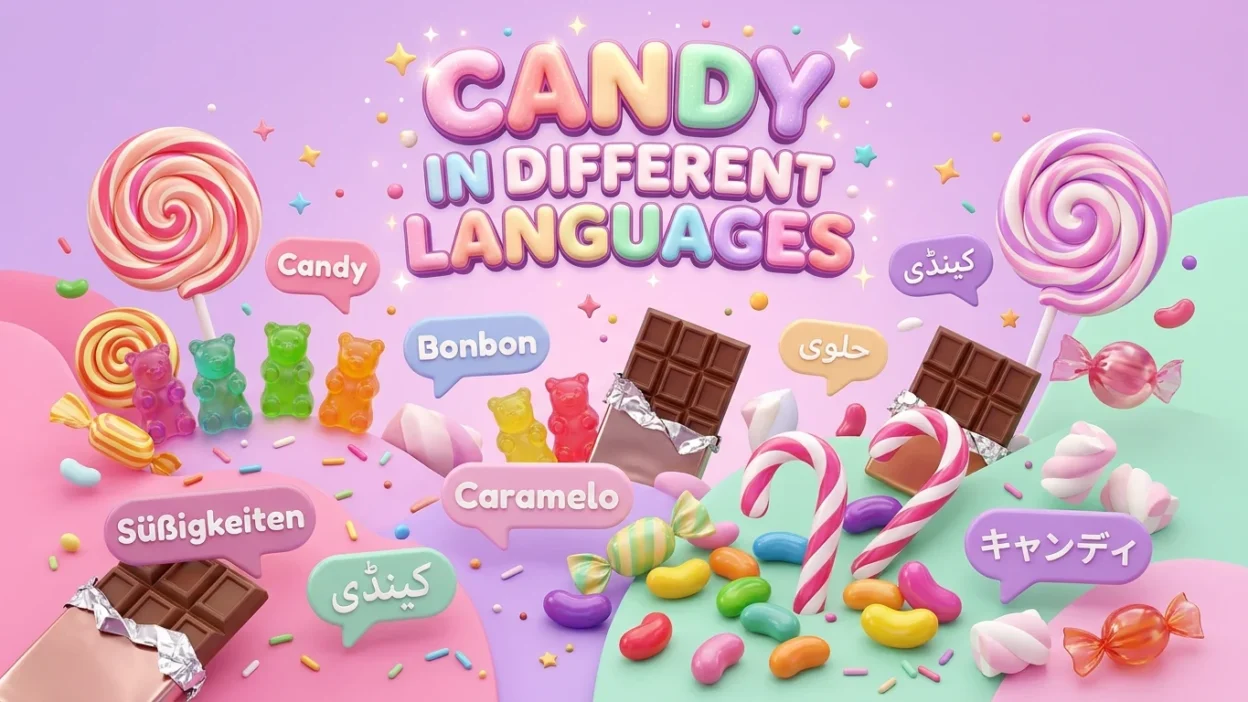
Candy is a popular sweet treat enjoyed by people of all ages across the world. Although its flavors, shapes, and ingredients vary, every culture has its own word for describing these delicious sweets. Learning candy in different languages is a fun way to explore vocabulary, discover cultural traditions, and understand how people talk about their favorite treats.
If you are learning a new language, preparing educational content, or simply curious about international words, exploring candy translations can be interesting and useful. From European languages to Asian and Middle Eastern languages, this guide introduces 50 translations with native spellings and easy English pronunciations.
Quick Answer
Candy has different names around the world. For example, it is called dulce in Spanish, bonbon in French, Süßigkeit in German, ame in Japanese, and tángguǒ in Mandarin Chinese.
Candy Around the World
| Language | Native Word | Pronunciation |
|---|---|---|
| English | Candy | KAN-dee |
| Spanish | Dulce | DOOL-seh |
| French | Bonbon | BON-bon |
| German | Süßigkeit | ZOOS-ikh-kite |
| Italian | Caramella | kah-rah-MEL-lah |
| Portuguese | Doce | DOH-see |
| Dutch | Snoep | SNOOP |
| Swedish | Godis | GOO-dis |
| Norwegian | Godteri | GOOD-teh-ree |
| Danish | Slik | SLEEK |
| Finnish | Karkki | KAR-kee |
| Polish | Cukierek | tsoo-KYEH-rek |
| Czech | Bonbon | BON-bon |
| Slovak | Cukrík | TSOO-kreek |
| Hungarian | Cukorka | TSOO-kor-kah |
| Romanian | Bomboană | bom-BOAH-nuh |
| Greek | Καραμέλα | kah-rah-MEH-lah |
| Russian | Конфета | kan-FYEH-tah |
| Ukrainian | Цукерка | tsoo-KER-kah |
| Turkish | Şekerleme | sheh-ker-leh-MEH |
| Arabic | حلوى | HAL-wah |
| Persian | آبنبات | AAB-na-baat |
| Urdu | ٹافی | TAA-fee |
| Hindi | मिठाई | mith-AI |
| Bengali | মিছরি | MICH-ree |
| Punjabi | ਟੌਫ਼ੀ | TAW-fee |
| Chinese | 糖果 | TAHNG-gwoh |
| Japanese | 飴 | AH-meh |
| Korean | 사탕 | sah-TAHNG |
| Thai | ลูกอม | look-om |
| Vietnamese | Kẹo | KEH-aw |
| Indonesian | Permen | PER-men |
| Malay | Gula-gula | GOO-lah GOO-lah |
| Filipino | Kendi | KEN-dee |
| Swahili | Pipi | PEE-pee |
| Afrikaans | Lekkergoed | LEK-ker-khoot |
| Irish | Milseáin | MIL-shawn |
| Welsh | Melysion | meh-LUH-syun |
| Icelandic | Sælgæti | SAIL-gai-tee |
| Croatian | Bombon | BOM-bon |
| Serbian | Бомбоне | BOM-boh-neh |
| Bulgarian | Бонбони | BOM-boh-nee |
| Hebrew | ממתק | mahm-TAHK |
| Nepali | मिठाई | mith-AI |
| Tamil | மிட்டாய் | MIT-tai |
| Telugu | మిఠాయి | mi-THAA-yee |
| Gujarati | મીઠાઈ | mee-THAA-ee |
| Marathi | मिठाई | mith-AI |
| Burmese | သကြားလုံး | tha-kyar-lone |
| Khmer | ស្ករគ្រាប់ | SKAW-kraap |
Note: Some languages use broader words for sweets or confectionery rather than an exact equivalent of the English word candy.
Why Learn Candy in Different Languages?
Learning the word for candy in other languages is a simple way to expand your vocabulary. Food-related words are useful because they appear in everyday conversations, shopping experiences, restaurants, and travel situations.
For language learners, familiar subjects make remembering new vocabulary easier. Candy is also a fun topic for children and beginners who want to practice speaking.
Knowing these translations can help you recognize sweet-related words on international packaging, menus, and product labels. It also introduces you to the different ways cultures describe their favorite treats.
Cultural Significance of Candy Around the World
Candy is more than just a sweet snack in many cultures. It often plays an important role in celebrations, festivals, family gatherings, and traditional events.
For example, sweets are commonly shared during holidays, weddings, birthdays, and religious celebrations. Different countries also have traditional confectionery made with local ingredients, such as honey, nuts, fruit, and sugar.
Understanding the local word for candy can help language learners appreciate these traditions. It also shows how food vocabulary reflects cultural identity and everyday life.
How to Pronounce Candy in Different Languages
Pronunciation is an important part of learning vocabulary. Even when two languages use similar-looking words, their sounds may be quite different.
Start by reading the pronunciation column in the table and saying each word slowly. Pay attention to unfamiliar sounds, syllables, and stress patterns.
Listening to native speakers can also improve your pronunciation. Practice a few words every day instead of trying to memorize all 50 translations at once. Repeating each word aloud can gradually improve your speaking confidence.
Different Types of Candy and Their Names
Candy comes in many varieties, and different languages may use separate words for particular types of sweets. Understanding these categories makes food vocabulary more useful.
Some popular types include chocolate candies, hard candies, gummies, lollipops, caramels, and chewy sweets. Each type has a different texture, flavor, and appearance.
For example, a lollipop is a hard candy served on a stick, while gummies are soft and chewy. Caramels are usually made with cooked sugar and dairy ingredients. Learning these related terms can help you describe your favorite sweets more accurately.
When to Use Candy-Related Words
Candy vocabulary can be useful in several everyday situations. You might use it when shopping in another country, ordering sweets, talking with international friends, or reading food packaging.
For example, knowing the local word for candy can help you ask where sweets are sold in a supermarket. It can also make conversations about favorite flavors and snacks easier.
Students can use these words in language exercises, vocabulary lists, and classroom activities. Travelers may also find them helpful when visiting local candy shops or exploring traditional desserts.
Easy Ways to Remember Candy Translations
Memorizing vocabulary becomes easier when you use simple learning techniques. Instead of studying all the words together, divide them into small groups based on language families or regions.
Try these practical methods:
- Use flashcards: Write the language on one side and its candy translation on the other.
- Practice daily: Learn five new words each day.
- Speak aloud: Repeat each translation several times.
- Create sentences: Use new vocabulary in short everyday sentences.
- Review regularly: Revisit previously learned words to improve long-term memory.
These techniques make learning enjoyable and help you remember international vocabulary more effectively.
Interesting Facts About Candy Around the World
Candy has an interesting history, and different countries have developed their own traditions of making and enjoying sweets.
Some cultures prefer fruit-flavored candies, while others are famous for chocolate, caramel, or traditional sugar-based treats. Ingredients and preparation methods often reflect local food traditions.
Another interesting fact is that the English word candy is not used everywhere. Many languages have completely different words for sweets, and some distinguish between individual candies and confectionery in general.
Exploring these differences makes international food vocabulary more exciting.
Benefits of Learning Food Words in Different Languages
Food vocabulary is one of the most practical categories for anyone learning a foreign language. It helps people communicate during travel, shopping, dining, and social activities.
Learning words such as candy, chocolate, cake, and dessert gives beginners a useful foundation for everyday conversations.
It can also improve cultural awareness by introducing learners to different eating habits and traditional foods. Children may find food vocabulary particularly interesting because it connects language learning with familiar objects.
Overall, learning food-related translations makes language practice more engaging, practical, and enjoyable.
Key Takeaways
- Candy has different names in languages around the world.
- Spanish uses dulce, French uses bonbon, and German uses Süßigkeit.
- Some languages use broader words for sweets and confectionery.
- Pronunciation practice helps improve vocabulary and speaking skills.
- Learning food words makes international communication easier.
Conclusion
Learning candy in different languages is a fun and practical way to explore international vocabulary and cultural traditions. From Spanish and French to Japanese and Arabic, every language offers a different way to describe sweet treats. The 50 translations in this guide can help students, travelers, and language enthusiasts expand their vocabulary. By practicing pronunciation, reviewing native spellings, and using these words in everyday conversations, you can make language learning more enjoyable while discovering how people around the world talk about their favorite sweets.
FAQs:
1. How do you say candy in different languages?
Candy has different translations depending on the language. Some common examples include dulce in Spanish, bonbon in French, caramella in Italian, süßigkeit in German, and sātāng in Korean. Some languages use general words for sweets rather than an exact translation.
2. What is the French word for candy?
The French word commonly used for candy is bonbon. It refers to a small sweet or confectionery treat. The word is also widely recognized in some other European languages. French candy includes many varieties of fruit-flavored sweets, chocolates, and traditional confectionery.
3. What is candy called in Spanish?
Candy is commonly called dulce in Spanish. The word can also refer to something sweet, depending on the context. In some Spanish-speaking countries, people use regional terms such as caramelo when referring to specific types of candy.
4. What is the Japanese word for candy?
The Japanese word for candy is commonly ame (飴). It generally refers to traditional hard candy and similar sweets. Japan has many popular varieties, including fruit-flavored candies and traditional sugar-based treats enjoyed by children and adults.
5. Why does candy have different names in different languages?
Candy has different names because languages develop independently and reflect local cultures, histories, and food traditions. Some countries have unique words for particular sweets, while others use broader terms for confectionery. These differences make international food vocabulary interesting to explore.