
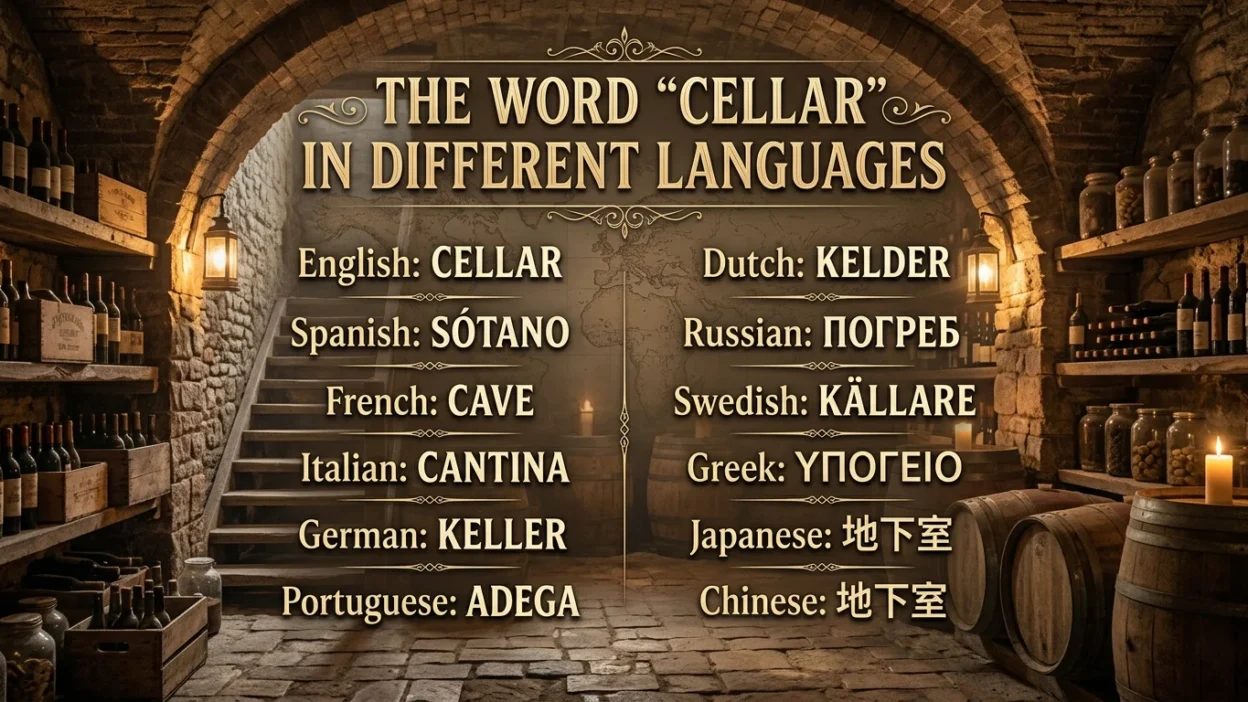
A cellar is a room or underground space commonly used for storing food, wine, beverages, and household supplies. The word has different translations across languages, reflecting regional traditions, architectural styles, and everyday lifestyles. Exploring the term cellar in different languages helps language learners understand how different cultures describe storage spaces and underground rooms.
Whether you are learning a new language, researching vocabulary, or simply curious about international words, discovering how people say cellar around the world is interesting and useful. This guide features 50 languages, native spellings, easy pronunciation guides, and fascinating facts about this everyday word.
Quick Answer
The word cellar has different translations around the world. Examples include Keller in German, cave in French, sótano in Spanish, cantina in Italian, and kelder in Dutch.
Cellar Around the World
The following table presents the word cellar in 50 languages, along with its native spelling and an easy English pronunciation guide.
| Language | Native Word | Pronunciation |
|---|---|---|
| English | Cellar | SEL-er |
| Spanish | Sótano | SOH-tah-noh |
| French | Cave | KAHV |
| German | Keller | KEL-er |
| Italian | Cantina | kan-TEE-nah |
| Portuguese | Adega | ah-DEH-gah |
| Dutch | Kelder | KEL-der |
| Russian | Подвал | pod-VAHL |
| Ukrainian | Підвал | pid-VAHL |
| Polish | Piwnica | pyv-NEE-tsah |
| Czech | Sklep | SKLEP |
| Slovak | Pivnica | PEEV-nee-tsah |
| Slovenian | Klet | KLET |
| Croatian | Podrum | POH-droom |
| Serbian | Подрум | POH-droom |
| Bulgarian | Мазе | MAH-zeh |
| Romanian | Pivniță | peev-NEE-tsuh |
| Hungarian | Pince | PEEN-tseh |
| Greek | Υπόγειο | ee-POH-yee-oh |
| Turkish | Bodrum | BOHD-room |
| Arabic | قبو | QAB-oo |
| Hebrew | מרתף | mar-TEF |
| Persian | زیرزمین | zee-reh-ZEEM |
| Urdu | تہہ خانہ | teh-KHAH-nah |
| Hindi | तहखाना | teh-KHAH-nah |
| Bengali | ভূগর্ভস্থ ঘর | bhoo-gor-bhostho ghor |
| Punjabi | ਤਹਿਖਾਨਾ | teh-KHAH-nah |
| Chinese (Mandarin) | 地窖 | dee-JYOW |
| Japanese | 地下室 | chee-kah-shitsu |
| Korean | 지하실 | jee-ha-shil |
| Vietnamese | Hầm | HUH-m |
| Thai | ห้องใต้ดิน | hong-tai-din |
| Indonesian | Ruang bawah tanah | roo-ang bah-wah tah-nah |
| Malay | Ruang bawah tanah | roo-ang bah-wah tah-nah |
| Filipino (Tagalog) | Silong | SEE-long |
| Swahili | Pishi | PEE-shee |
| Afrikaans | Kelder | KEL-der |
| Swedish | Källare | SHEL-ah-reh |
| Norwegian | Kjeller | SHEL-er |
| Danish | Kælder | KEL-der |
| Finnish | Kellari | KEL-lah-ree |
| Icelandic | Kjallari | KYAD-lah-ree |
| Estonian | Kelder | KEL-der |
| Latvian | Pagrabs | PAH-grabs |
| Lithuanian | Rūsys | ROO-sis |
| Irish | Cellar | SEL-er |
| Welsh | Seler | SEH-ler |
| Basque | Soto | SOH-toh |
| Catalan | Celler | seh-YER |
| Galician | Adega | ah-DEH-gah |
| Esperanto | Kelo | KEH-loh |
Note: Some languages use different words depending on whether cellar means an underground room, basement, wine-storage room, or general storage space. Pronunciations are simplified English-friendly approximations.
Why Learn Cellar in Different Languages?
Learning the word cellar in different languages is a simple way to expand your vocabulary and understand how people describe buildings and storage spaces. It can be especially helpful for travelers, language students, translators, and people interested in architecture.
Different languages sometimes use separate words for underground rooms, wine cellars, and basements. Understanding these differences helps you choose the correct expression in everyday conversations. It also makes reading foreign-language books, property descriptions, and cultural materials easier. Even learning one new word each day can gradually improve your language skills and introduce you to different ways of expressing familiar ideas.
Cultural Significance of Cellars Around the World
Cellars have played important roles in many cultures throughout history. In European countries, traditional cellars were commonly used to store wine, cheese, vegetables, and preserved foods. Their cooler temperatures helped protect food before modern refrigeration became widely available.
In other regions, underground rooms served as storage areas, shelters, or practical spaces for household supplies. The words used for these rooms often reflect local architecture and climate. For example, wine-producing regions may have specialized vocabulary for wine-storage spaces. These cultural differences make international cellar vocabulary more interesting than a simple translation list.
How to Pronounce Cellar in Different Languages
Pronunciation is an important part of learning foreign vocabulary. Although many cellar translations look different, practicing their sounds can make them easier to remember. Start with familiar European examples such as Keller, cave, cantina, and kelder.
Pay attention to unfamiliar consonants, vowel sounds, and syllable stress. Some languages have sounds that do not exist in English, so an English pronunciation guide can only provide an approximation. Listen to native speakers whenever possible and repeat each word slowly. Practicing a few translations regularly will help you develop better pronunciation and greater confidence when speaking another language.
Different Words for Cellar, Basement, and Wine Storage
The English word cellar can describe several types of underground or lower-level spaces. However, other languages may distinguish between a general basement, a wine cellar, and a food-storage room.
For example, Spanish uses sótano for a basement, while bodega can refer to a wine cellar or storage establishment depending on the region. French uses cave for an underground cellar, particularly one used for storage. Italian uses cantina for a cellar or storage room. Understanding these related expressions prevents confusion and helps you select vocabulary that matches the intended meaning.
Practical Uses of the Word Cellar
The word cellar appears in several everyday situations, particularly when discussing homes, architecture, food storage, and wine collections. Someone buying a house might ask whether the property has a cellar. A restaurant owner may discuss a wine cellar, while a homeowner might describe an underground storage room.
Knowing translations in other languages can help when traveling, communicating with international clients, or reading foreign property advertisements. It is also useful for students studying vocabulary related to buildings and household spaces. Learning words through practical examples makes them easier to understand and remember.
Interesting Facts About Cellars in Different Cultures
Cellars are closely connected to traditional food preservation and architecture. Before refrigerators became common, underground storage rooms helped families keep vegetables, fruits, dairy products, and other foods cool.
In wine-producing countries, cellars became especially important because controlled storage conditions help protect wine quality. Some historic European buildings still feature traditional stone cellars that have been used for generations. In colder regions, underground spaces also provided relatively stable temperatures throughout changing seasons. These historical and cultural uses explain why many languages have established vocabulary for cellars and similar storage spaces.
Easy Tips for Learning Cellar Translations
Learning 50 translations may seem challenging, but a simple study routine can make the process manageable. Begin by selecting five languages and learning their native words. Write each translation alongside its pronunciation and meaning.
Next, group similar languages together. For example, compare German Keller, Dutch kelder, Swedish källare, and Danish kælder. Recognizing similarities can make vocabulary easier to remember. Use flashcards, language-learning applications, and short daily practice sessions. You can also create simple sentences using each word. Regular repetition and practical examples will help you remember translations for longer.
Common Mistakes When Translating Cellar
One common mistake is assuming that every language has a single word that perfectly matches the English term cellar. In reality, some translations refer specifically to basements, while others describe wine-storage rooms or underground spaces.
Another mistake is ignoring regional differences. A word may have several meanings depending on the country or situation. Pronunciation can also cause confusion when learners rely entirely on English spelling patterns. To avoid these problems, check the context before choosing a translation. Understanding whether you mean a general storage room, basement, or wine cellar will help you communicate more accurately.
Benefits of Learning Vocabulary in Different Languages
Learning international vocabulary improves communication and develops a better understanding of other cultures. Even ordinary words such as cellar can reveal interesting differences in architecture, traditions, and daily life.
Exploring translations also helps learners recognize similarities between language families. For example, several European languages have words that share similar sounds or spelling patterns. This can make it easier to remember new vocabulary and identify connections between languages. Building a collection of everyday words is an effective way to improve reading, speaking, and translation skills while developing curiosity about the wider world.
Key Takeaways
- Cellar has different translations across languages, depending on cultural and regional usage.
- German uses Keller, French uses cave, and Italian uses cantina.
- Some languages distinguish between basements, underground rooms, and wine-storage spaces.
- Pronunciation guides help learners understand and practice unfamiliar vocabulary.
- Learning everyday words across 50 languages improves vocabulary and cultural awareness.
Conclusion
Exploring cellar in different languages reveals how different cultures describe underground rooms and traditional storage spaces. From Keller in German to cave in French and cantina in Italian, each translation offers a small insight into another language. Although the exact words and meanings can vary, they all help communicate familiar ideas about buildings and storage. Use the 50-language table as a reference, practice the pronunciations, and explore related vocabulary to strengthen your language skills. Learning everyday words is a rewarding way to discover the richness of languages around the world.
FAQs:
1. What is the word cellar in different languages?
Cellar has different translations depending on the language. Some common examples include Keller in German, cave in French, sótano in Spanish, cantina in Italian, kelder in Dutch, and podval in Russian. These words generally describe underground rooms or spaces used for storage.
2. How do you say cellar in French?
The French word for cellar is cave. It is commonly used for an underground storage room, including spaces where wine and other household products are kept. The pronunciation is approximately KAHV, with a short vowel sound.
3. What is cellar called in German?
Cellar is called Keller in German. The word generally refers to an underground room or basement used for storage and other household purposes. It is a common vocabulary word in German conversations about homes, buildings, and architecture.
4. Is cellar the same as basement in every language?
No, cellar and basement do not always have exactly the same meaning. A cellar is often an underground storage space, while a basement can be a larger lower-level area of a building. Some languages use one word for both, while others distinguish between them.
5. What is the difference between a wine cellar and a regular cellar?
A regular cellar is generally an underground storage space used for household supplies, food, or equipment. A wine cellar is specifically designed to store wine under suitable temperature and humidity conditions. Both may be located underground, but their purposes are different.

Olivia Riley is a passionate content administrator at Diflingo, where she manages and publishes high-quality articles focused on what to say in everyday conversations, special occasions, professional settings, and personal relationships. She ensures every guide is clear, practical, engaging, and helpful for readers.