
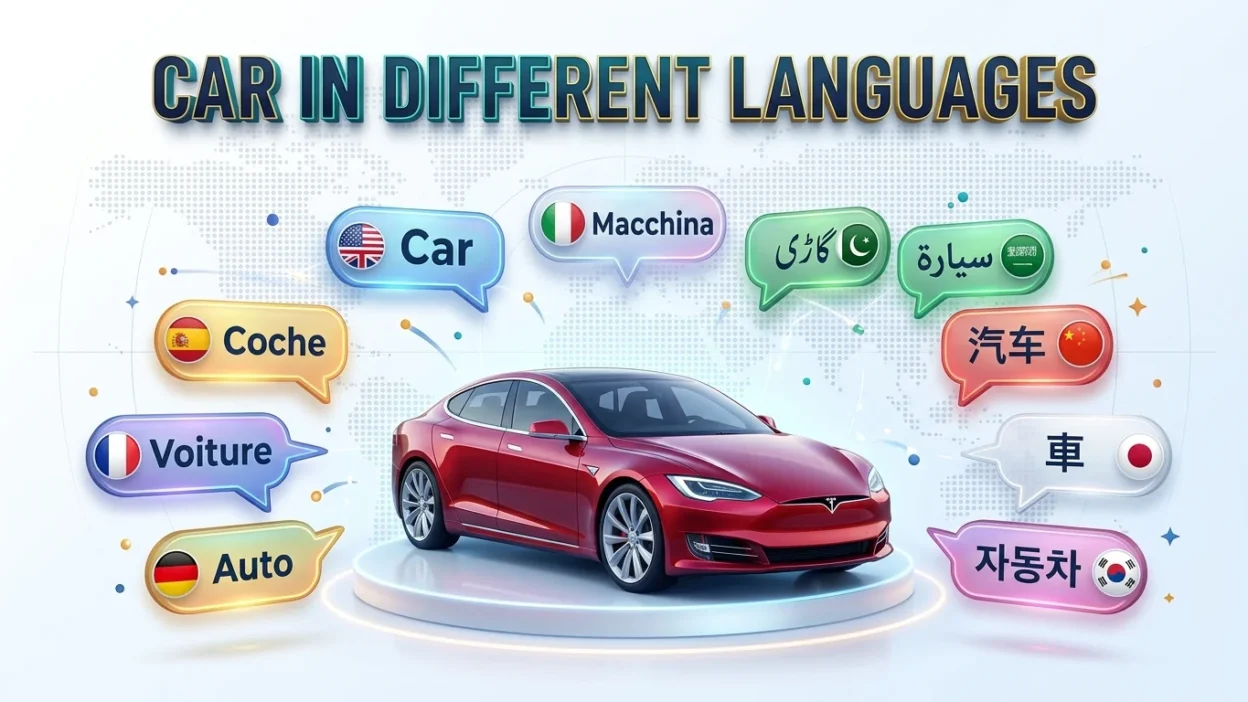
Learning car in different languages is a fun way to explore how people communicate around the world. Although a car is a common means of transportation, its name changes from one language to another. Some languages use words that sound familiar, while others have completely different terms.
If you are a student, language enthusiast, traveler, or curious learner, discovering these translations can help you expand your vocabulary. In this guide, you will find 50 translations of the word car, including native spellings and easy English pronunciations to make learning simple and enjoyable.
Quick Answer
The word car has different translations worldwide. For example, it is coche in Spanish, voiture in French, Auto in German, coche in Portuguese, and 車 (kuruma) in Japanese.
Car Around the World
Here are 50 translations of the word car in different languages, along with their native spellings and simple English pronunciation guides.
| Language | Native Word | Pronunciation |
|---|---|---|
| English | Car | Kahr |
| Spanish | Coche | Koh-cheh |
| French | Voiture | Vwah-tur |
| German | Auto | Ow-toh |
| Italian | Auto | Ow-toh |
| Portuguese | Carro | Kah-hoo |
| Dutch | Auto | Ow-toh |
| Russian | Машина | Mah-shee-nah |
| Arabic | سيارة | Say-yah-rah |
| Urdu | گاڑی | Gaa-ree |
| Hindi | कार | Kaar |
| Chinese (Mandarin) | 汽车 | Chee-chuh |
| Japanese | 車 | Koo-roo-mah |
| Korean | 자동차 | Jah-dong-cha |
| Turkish | Araba | Ah-rah-bah |
| Greek | Αυτοκίνητο | Af-toh-kee-nee-toh |
| Swedish | Bil | Beel |
| Norwegian | Bil | Beel |
| Danish | Bil | Beel |
| Finnish | Auto | Ow-toh |
| Polish | Samochód | Sah-moh-hoot |
| Czech | Auto | Ow-toh |
| Slovak | Auto | Ow-toh |
| Hungarian | Autó | Ow-toh |
| Romanian | Mașină | Mah-shee-nuh |
| Bulgarian | Кола | Koh-lah |
| Serbian | Аутомобил | Ow-toh-moh-beel |
| Croatian | Automobil | Ow-toh-moh-beel |
| Ukrainian | Автомобіль | Aw-toh-moh-beel |
| Hebrew | מכונית | Meh-kho-neet |
| Persian | ماشین | Mah-sheen |
| Bengali | গাড়ি | Gaa-ree |
| Punjabi | ਗੱਡੀ | Gud-dee |
| Tamil | கார் | Kaar |
| Telugu | కారు | Kaa-roo |
| Malayalam | കാർ | Kaar |
| Gujarati | કાર | Kaar |
| Marathi | गाडी | Gaa-dee |
| Nepali | गाडी | Gaa-dee |
| Indonesian | Mobil | Moh-beel |
| Malay | Kereta | Kuh-ray-tah |
| Thai | รถยนต์ | Rot-yon |
| Vietnamese | Xe hơi | Seh hoy |
| Filipino | Kotse | Koh-cheh |
| Swahili | Gari | Gah-ree |
| Afrikaans | Motor | Moh-tor |
| Irish | Carr | Kahr |
| Welsh | Car | Kahr |
| Icelandic | Bíll | Beetl |
| Latin | Currus | Koor-roos |
Why Do Different Languages Have Different Words for Car?
Languages develop through history, geography, and cultural exchange. As automobiles became popular around the world, different communities adopted words to describe them.
Some languages use words influenced by English or European languages, while others developed their own everyday terms. For example, German commonly uses Auto, while Arabic speakers use sayyara. These differences make vocabulary interesting and show how languages evolve over time.
Learning these variations also helps us understand how people describe the same object in different parts of the world.
Cultural Significance of Cars Around the World
Cars play an important role in everyday life across many cultures. In some countries, owning a car represents independence and convenience, while in others, it is considered a symbol of personal success.
The words people use for automobiles also reflect local language traditions. For instance, Japanese uses kuruma, while Spanish commonly uses coche.
Understanding these cultural differences makes language learning more meaningful. It also helps travelers communicate naturally when discussing transportation, driving, or everyday activities in another country.
How to Pronounce Car in Different Languages
Pronunciation is an important part of learning foreign vocabulary. Even when two languages use different words for the same object, practicing their sounds can make communication easier.
Start by listening to native speakers and repeating each word slowly. Pay attention to unfamiliar sounds, syllables, and accents.
For example, French voiture has a different sound from English car, while German Auto is relatively easy for English speakers to pronounce. Regular practice can improve your confidence and help you remember new vocabulary.
Common Words Related to Cars in Other Languages
Learning words related to cars can help you build a stronger transportation vocabulary. Instead of memorizing just one word, explore other terms that you might use in everyday conversations.
Some useful English words include:
- Car: A motor vehicle used for transportation.
- Driver: A person who operates a vehicle.
- Road: A path used by vehicles.
- Wheel: A circular part that helps a vehicle move.
- Engine: The part that provides power to a vehicle.
- Fuel: A substance used to operate an engine.
- Garage: A place where vehicles are stored or repaired.
- Traffic: Vehicles moving along roads.
These related words make it easier to discuss cars and transportation in different languages.
Practical Uses of Car Translations While Traveling
Knowing how to say car in another language can be helpful when visiting foreign countries. You may need this vocabulary when renting a vehicle, asking about transportation, or speaking with local drivers.
For example, knowing coche in Spanish or voiture in French can help you recognize common transportation conversations.
You can also use these words when reading road signs, understanding travel information, or communicating with people who speak another language. Even a small amount of vocabulary can make traveling more comfortable and enjoyable.
Easy Ways to Remember Car in Different Languages
Memorizing 50 foreign words may seem challenging, but a few simple learning techniques can make the process easier.
Try these practical methods:
- Learn five words daily: Divide the vocabulary into smaller groups instead of learning everything at once.
- Use flashcards: Write the language on one side and its English meaning on the other.
- Practice pronunciation: Repeat each word aloud several times.
- Group similar words: Notice how languages such as German, Dutch, and Finnish use Auto.
- Create sentences: Use each new word in a simple sentence to improve your memory.
Consistent practice will help you remember translations for longer.
Interesting Facts About the Word Car
The word car has an interesting history and several linguistic variations. English uses the short word car, but other languages often use completely different terms.
Here are some interesting facts:
- German, Italian, and Dutch commonly use the word Auto.
- Spanish uses coche in many regions.
- Japanese uses kuruma for a car.
- Arabic uses sayyara as a common word for car.
- Urdu and Hindi both have commonly used words derived from similar South Asian vocabulary.
- Several Scandinavian languages use the short word bil.
These similarities and differences show how vocabulary connects languages and cultures.
Common Mistakes When Learning Car Translations
One common mistake is assuming that every foreign language uses a word similar to English car. In reality, many languages have completely different vocabulary and pronunciation rules.
Another mistake is confusing formal and informal expressions. Some languages use one word in everyday conversations and another in technical or formal writing.
Learners should also avoid relying entirely on English pronunciation guides. These guides are helpful starting points, but they cannot represent every native sound perfectly. Listening to native speakers and practicing regularly will help you develop more accurate pronunciation.
Key Takeaways
- The word car has different translations in languages around the world.
- Spanish uses coche, French uses voiture, and German uses Auto.
- Learning native spellings helps improve foreign-language vocabulary.
- Pronunciation practice makes communication easier when traveling.
- Memorizing related transportation words creates a stronger vocabulary.
Conclusion
Learning car in different languages is an easy and interesting way to explore global vocabulary and cultural differences. From Spanish coche to French voiture and Japanese kuruma, every language offers its own expression for this popular vehicle. The 50 translations in this guide provide a useful starting point for students, travelers, and language enthusiasts. Practice the native spellings, learn their pronunciations, and explore related transportation vocabulary to improve your language skills and communicate more confidently with people worldwide.
FAQs:
1. How do you say car in 50 different languages?
Car has different names across the world. Examples include coche in Spanish, voiture in French, Auto in German, araba in Turkish, kuruma in Japanese, and gari in Swahili. Each language has its own spelling and pronunciation.
2. What is the French word for car?
The French word for car is voiture. It is commonly used in everyday conversations, written communication, and transportation-related discussions. Learning this word can help travelers communicate when renting vehicles or talking about transportation in French-speaking regions.
3. What is the Japanese word for car?
The Japanese word for car is 車, pronounced kuruma. It is a common everyday term used when discussing automobiles and transportation. Japanese also uses other expressions, such as jidōsha, which refers to an automobile.
4. What is the difference between car and automobile?
Car and automobile generally refer to the same type of motor vehicle used for personal transportation. Car is more common in everyday English, while automobile is often considered more formal. Both words describe vehicles designed to travel on roads.
5. Why should students learn car in different languages?
Students can improve their vocabulary, pronunciation, and cultural understanding by learning how different languages describe everyday objects. The word car is especially useful because transportation is a common topic in daily conversations, travel situations, and language-learning activities.