
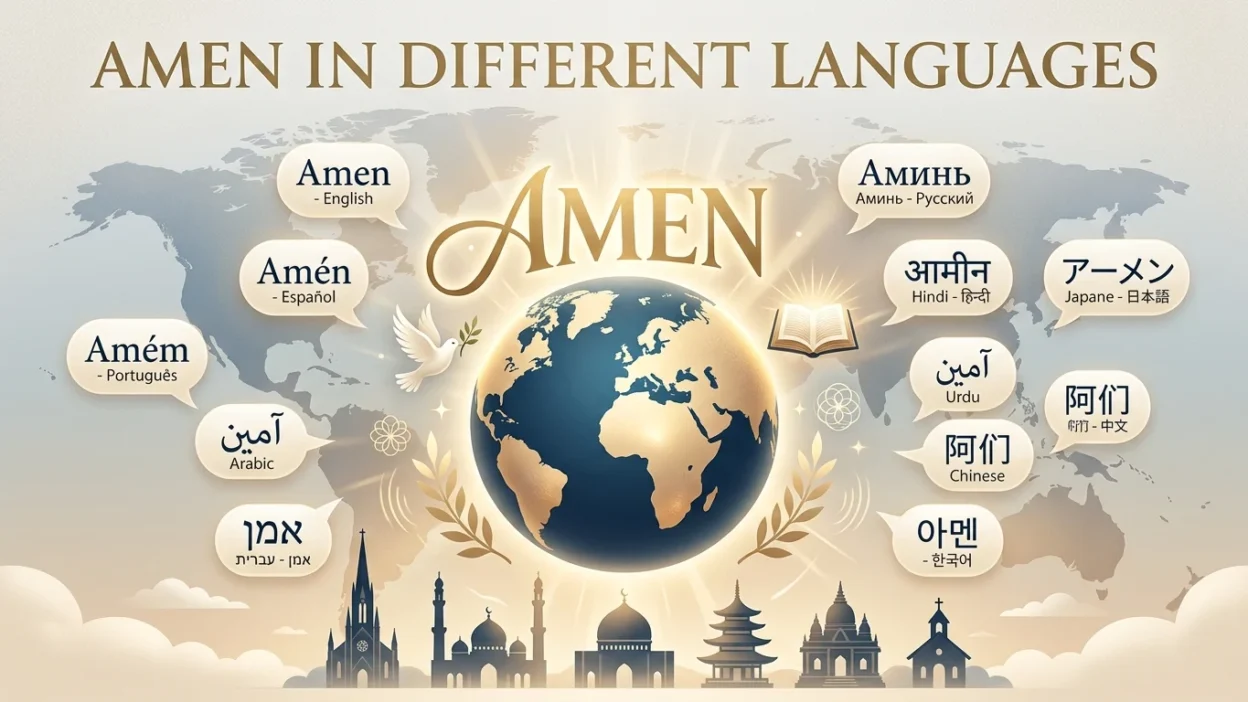
Learning amen in different languages is a meaningful way to explore religious traditions, languages and cultures from around the world. The word Amen is widely used in Christianity, Judaism and other faith traditions to express agreement, affirmation or the meaning of “so be it” or “truly.” Whether you’re studying languages, exploring world religions, traveling or simply curious about global expressions of faith, understanding how Amen is written and pronounced in different languages can deepen your cultural knowledge.
In this guide, you’ll discover amen in different languages with native spellings and easy English pronunciations. You’ll also learn why this word is important, when it is used and interesting facts about its history and meaning across different cultures.
Quick Answer
Amen in different languages includes the translations, spellings, and pronunciations used around the world to express agreement, affirmation, or conclude prayers. Learning these forms improves your cultural understanding and helps you recognize one of the world’s most widely spoken religious expressions.
Amen in Different Languages Around the World
| Language | Native Word | Pronunciation |
|---|---|---|
| English | Amen | Ah-men |
| Spanish | Amén | Ah-MEN |
| French | Amen | Ah-MEN |
| German | Amen | Ah-MEN |
| Italian | Amen | Ah-MEN |
| Portuguese | Amém | Ah-MENG |
| Dutch | Amen | Ah-MEN |
| Swedish | Amen | Ah-MEN |
| Norwegian | Amen | Ah-MEN |
| Danish | Amen | Ah-MEN |
| Finnish | Aamen | AA-men |
| Icelandic | Amen | Ah-MEN |
| Polish | Amen | Ah-MEN |
| Czech | Amen | Ah-MEN |
| Slovak | Amen | Ah-MEN |
| Hungarian | Ámen | AA-men |
| Romanian | Amin | Ah-MEEN |
| Greek | Αμήν | Ah-MEEN |
| Russian | Аминь | Ah-MEEN |
| Ukrainian | Амінь | Ah-MEEN |
| Bulgarian | Амин | Ah-MEEN |
| Serbian | Амин | Ah-MEEN |
| Croatian | Amen | Ah-MEN |
| Turkish | Amin | Ah-MEEN |
| Arabic | آمين | Aa-meen |
| Hebrew | אמן | Ah-MEN |
| Persian | آمین | Aa-meen |
| Hindi | आमीन | Aa-meen |
| Urdu | آمین | Aa-meen |
| Punjabi | ਆਮੀਨ | Aa-meen |
| Bengali | আমিন | Aa-meen |
| Gujarati | આમીન | Aa-meen |
| Marathi | आमेन | Aa-men |
| Tamil | ஆமென் | Aa-men |
| Telugu | ఆమేన్ | Aa-men |
| Kannada | ಆಮೆನ್ | Aa-men |
| Malayalam | ആമേൻ | Aa-men |
| Nepali | आमेन | Aa-men |
| Sinhala | ආමෙන් | Aa-men |
| Thai | อาเมน | Aa-men |
| Vietnamese | Amen | Ah-men |
| Indonesian | Amin | Aa-meen |
| Malay | Amin | Aa-meen |
| Filipino | Amen | Ah-men |
| Chinese (Mandarin) | 阿们 | A Men |
| Japanese | アーメン | Aa-men |
| Korean | 아멘 | A-men |
| Swahili | Amina | Aa-mee-na |
| Hawaiian | ʻĀmene | Aa-me-ne |
| Māori | Āmine | Aa-mee-ne |
Why Learn “Amen” in Different Languages?
Learning amen in different languages helps you better understand religious services, sacred texts, cultural traditions, and international communities. Because Amen is one of the world’s most widely recognized expressions of faith, you’ll hear it in churches, synagogues, prayer meetings, weddings, funerals, and many other religious gatherings across the globe.
Understanding how different languages pronounce and write Amen also provides insight into linguistic history. Although the pronunciation varies slightly, the meaning remains remarkably consistent across cultures, symbolizing agreement, hope, faith, and sincerity.
Common Uses of “Amen” Around the World
The word Amen is most commonly used at the end of prayers, blessings, and religious ceremonies. People say it to express agreement with a prayer, affirm a statement of faith, or show support for a blessing being offered. Whether in churches, synagogues, homes, schools, weddings, funerals, or community gatherings, Amen serves as a powerful expression of belief and unity.
In many cultures, Amen is also used outside formal religious settings. People may say it after hearing a statement they strongly agree with, using it as a way to express support, encouragement, or approval. This broader usage demonstrates how deeply the word has become embedded in everyday language and culture around the world.
Pronunciation Tips for Beginners
Learning the pronunciation of amen in different languages is relatively easy because the word remains similar across many cultures. Start by listening to native speakers through religious recordings, language-learning apps, or online pronunciation guides. Repeat each version slowly and pay attention to differences in vowel sounds and stress patterns.
Some languages pronounce it as “Ah-men,” while others use “Aa-meen” or “Ah-meen.” Practicing these slight variations will help you recognize the word in different settings. Repetition, listening exercises, and speaking aloud are effective ways to improve pronunciation and confidence.
Interesting Facts About Amen Around the World
The word Amen has ancient origins dating back thousands of years. It comes from a Hebrew root meaning truth, certainty, faithfulness, or agreement. From Hebrew, the word spread into Greek, Latin, and eventually hundreds of languages around the world while maintaining nearly the same meaning.
One fascinating aspect of Amen is its remarkable consistency across cultures. While many religious terms change significantly when translated, Amen has remained recognizable in most languages. This makes it one of the most universal words in human history, spoken by millions of people every day in countless religious traditions and languages.
Conclusion
Learning amen in different languages offers a unique opportunity to explore language, culture and faith traditions from around the world. Despite differences in spelling and pronunciation, the meaning of Amen remains remarkably consistent, symbolizing agreement, sincerity, hope and belief. Whether you’re studying languages, learning about world religions or participating in international communities, understanding how Amen is expressed across cultures helps deepen your appreciation for one of humanity’s most enduring and meaningful words.
Frequently Asked Questions
1. What does Amen mean?
Amen generally means “so be it,” “truly,” or “let it be so.” It is used to express agreement, affirmation, faith, and support for a prayer or statement.
2. Is Amen used in different religions?
Yes. Amen is commonly used in Christianity and Judaism and appears in several other religious traditions as a word of affirmation and agreement.
3. Why is Amen similar in many languages?
The word has ancient Hebrew origins and spread through religious texts and traditions. As a result, many languages adopted a similar form while preserving its original meaning.
4. Can Amen be used outside religious settings?
Yes. In many cultures, people use Amen informally to show strong agreement with a statement, opinion, or message.
5. What is the easiest way to learn Amen in different languages?
Practice listening to native speakers, repeat the pronunciations aloud, and focus on common pronunciation patterns such as “Ah-men” and “Aa-meen.”

Olivia Riley is a passionate content administrator at Diflingo, where she manages and publishes high-quality articles focused on what to say in everyday conversations, special occasions, professional settings, and personal relationships. She ensures every guide is clear, practical, engaging, and helpful for readers.