The word curly in different languages is interesting for anyone who enjoys learning vocabulary, exploring cultures, or understanding how people describe hair and appearance around the world. Although the meaning remains similar, every language has its own spelling, pronunciation, and way of expressing the word.
Learning how to say curly in different languages can help you expand your vocabulary and communicate with people from different backgrounds. Whether you are describing curly hair, learning a new language, or creating multilingual content, this guide introduces 50 translations with easy pronunciation tips.
Quick Answer
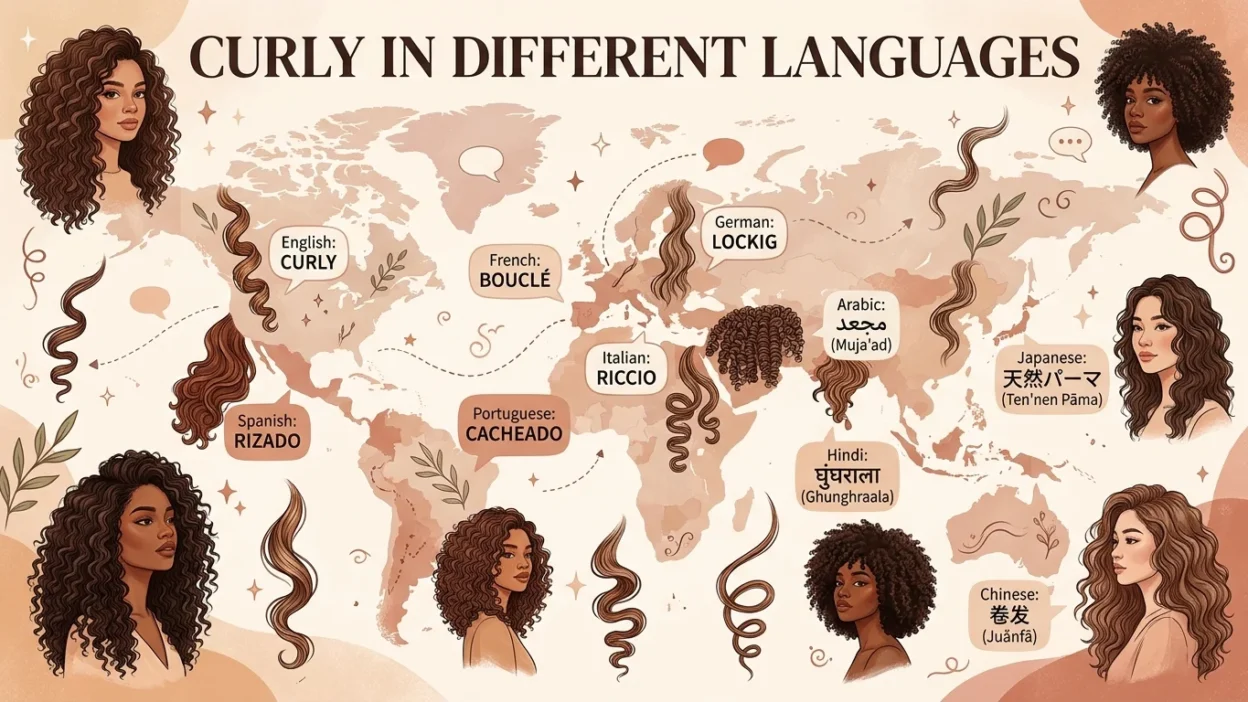
The word “curly” describes something that forms curls, twists, or rounded shapes. In different languages, it has various translations, such as rizado in Spanish, bouclé in French, and lockig in German.
Curly Around the World
The following table shows how to say “curly” in 50 languages. The translations generally refer to curly hair or a curled appearance. Some languages use different grammatical forms depending on context.
| Language | Native Word | Pronunciation |
|---|---|---|
| English | Curly | KUR-lee |
| Spanish | Rizado | ree-SAH-doh |
| French | Bouclé | boo-KLAY |
| German | Lockig | LOH-khig |
| Italian | Riccio | REE-cho |
| Portuguese | Cacheado | kah-shee-AH-doo |
| Dutch | Krullend | KRUL-lent |
| Swedish | Lockig | LOH-kig |
| Norwegian | Krøllete | KRUR-leh-teh |
| Danish | Krøllet | KRUR-let |
| Finnish | Kihara | KEE-hah-rah |
| Icelandic | Hrokkin | HROK-in |
| Polish | Kręcony | kren-TSOH-nih |
| Czech | Kudrnatý | KOO-dur-nah-tee |
| Slovak | Kučeravý | KOO-cheh-rah-vee |
| Russian | Кудрявый | koo-DREE-vuh-y |
| Ukrainian | Кучерявий | koo-cheh-RYAH-viy |
| Bulgarian | Къдрав | KUH-drav |
| Greek | Σγουρός | sgoo-ROS |
| Romanian | Creț | KRETZ |
| Hungarian | Göndör | GUN-dur |
| Turkish | Kıvırcık | kuh-vur-JUK |
| Arabic | مُجَعَّد | moo-JAH-ad |
| Persian | فرفری | fer-FER-ee |
| Urdu | گھنگریالے | ghun-gree-AH-lay |
| Hindi | घुंघराले | ghun-ghoo-RAH-lay |
| Bengali | কোঁকড়ানো | kon-kor-AH-no |
| Punjabi | ਘੁੰਗਰਾਲੇ | ghung-rah-LAY |
| Gujarati | વાંકડિયા | vaan-kuh-DEE-yah |
| Tamil | சுருட்டையான | soo-roo-TTAI-yah-na |
| Telugu | గిరజాల | gee-rah-JAH-la |
| Kannada | ಸುರುಳಿಯಾದ | soo-roo-lee-YAH-dah |
| Malayalam | ചുരുണ്ട | choo-RUN-dah |
| Chinese (Mandarin) | 卷曲的 | juǎn qū de |
| Japanese | 巻き毛の | makige no |
| Korean | 곱슬곱슬한 | gop-seul-gop-seul-han |
| Vietnamese | Xoăn | swahn |
| Thai | หยิก | yik |
| Indonesian | Keriting | keh-REE-ting |
| Malay | Kerinting | keh-RIN-ting |
| Filipino | Kulot | KOO-lot |
| Swahili | Ya kujikunja | yah koo-jee-KOON-jah |
| Amharic | ጠምዛዛ | tem-ZAH-zah |
| Hebrew | מתולתל | meh-too-lah-TEL |
| Irish | Catach | KAH-takh |
| Welsh | Cyrliog | kur-LEE-og |
| Basque | Kizkurra | kees-KOOR-rah |
| Catalan | Arrissat | ah-ree-SAT |
| Croatian | Kovrčav | KOVR-chav |
| Serbian | Коврџав | KOVR-jav |
Why Learn Curly in Different Languages?
Learning how to say curly in different languages helps you understand how people describe physical appearances across cultures. It is especially useful when discussing hairstyles, fashion, beauty, and personal appearance.
Multilingual vocabulary also makes communication easier when traveling or interacting with people from different countries. For language learners, a simple descriptive word like curly provides an opportunity to practice pronunciation, spelling, and sentence construction.
It can also improve your understanding of related vocabulary, including straight, wavy, thick, and short hair. These everyday words are practical additions to any language-learning routine.
Cultural Significance of Curly Hair Around the World
Curly hair has different cultural meanings and associations around the world. In some communities, natural curls are celebrated as an important part of personal identity, beauty, and heritage.
Different cultures also have unique hairstyles, haircare traditions, and styling techniques. Some people prefer natural curls, while others use products and tools to create defined curls.
Understanding the word curly in different languages gives learners an opportunity to explore these cultural differences. It also reminds us that beauty standards and personal preferences vary between individuals and communities.
How to Pronounce Curly in Different Languages
Pronunciation is an important part of learning foreign vocabulary. Even when two languages use similar-looking words, their sounds and stress patterns may be different.
For example, Spanish uses a clear pronunciation for rizado, while German lockig includes a sound that may be unfamiliar to English speakers. Mandarin uses tones, which means the pitch of your voice helps communicate the correct meaning.
Start by listening to native speakers and repeating each word slowly. Practice difficult sounds separately before using the complete word in everyday sentences.
Different Ways to Describe Curly Hair
The word curly is part of a larger vocabulary used to describe hair texture and appearance. Learning related expressions can help you communicate more naturally in another language.
Common English descriptions include curly hair, naturally curly hair, loose curls, tight curls, soft curls, and thick curls. Some languages use different adjectives or grammatical structures to express these descriptions.
Understanding related words also helps when visiting a hair salon abroad. You can explain your preferred hairstyle more clearly and understand the descriptions provided by a hairstylist.
Practical Uses of the Word Curly
The word curly appears in everyday conversations, beauty discussions, fashion descriptions, and personal introductions. Knowing its translation can make communication easier in different situations.
For example, you might describe your own hair, ask someone about their hairstyle, or explain the type of haircut you want. The word can also describe objects and shapes that have a curved or twisted appearance.
However, translations depend on context. A word used for curly hair may not always be the most natural choice when describing curly patterns, shapes, or decorative designs.
Easy Tips for Learning Curly in Other Languages
Learning vocabulary becomes easier when you use simple and consistent study methods. Instead of memorizing all 50 translations at once, begin with five languages and gradually increase your list.
Write each native word alongside its English meaning and pronunciation. Read the words aloud several times and try to use them in short sentences.
You can also create vocabulary flashcards and review them regularly. Comparing similar words across languages helps you recognize patterns and remember unfamiliar expressions more effectively.
Interesting Facts About Curly Hair and Language
Curly hair is described differently across the world’s languages, but many translations are connected to the idea of twisting, curling, or forming rounded shapes.
Some languages use a single adjective, while others may require a longer expression depending on the sentence. Grammar can also change a word according to gender, number, or context.
Another interesting fact is that the same word may describe both naturally curly hair and hair styled into curls in certain situations. Understanding these differences makes multilingual vocabulary more useful and accurate.
Common Mistakes When Translating Curly
One common mistake is assuming that every translation of curly works in exactly the same situations. A word that naturally describes someone’s hair might sound unusual when used for a curled ribbon or decorative pattern.
Another mistake is ignoring grammatical differences. Some languages change adjectives depending on the noun they describe.
Pronunciation is equally important. Reading a foreign word using English sound patterns can produce an incorrect result. Always consider the language’s natural pronunciation rules and the context in which you plan to use the word.
Benefits of Learning Descriptive Words in Multiple Languages
Learning descriptive vocabulary offers several advantages for language learners. Words such as curly, straight, wavy, soft, and thick help you explain appearances and everyday objects more accurately.
These expressions are also useful for travel, social conversations, language examinations, and professional situations involving fashion or beauty.
Comparing translations across different languages can improve memory and develop a better understanding of grammar. It also encourages curiosity about other cultures and their communication styles.
Even learning a few descriptive words every day can gradually build a stronger multilingual vocabulary.
Key Takeaways
- Curly describes hair or other things that form curls or rounded shapes.
- Different languages have unique translations and pronunciation patterns for curly.
- Spanish, French, German, Urdu, and Arabic offer useful examples of multilingual vocabulary.
- Context and grammar matter when translating descriptive words.
- Regular pronunciation practice makes learning foreign vocabulary easier.
Conclusion
Learning curly in different languages is a simple and enjoyable way to expand your vocabulary and discover linguistic diversity. From Spanish rizado to German lockig and Urdu گھنگریالے, each language offers its own expression for describing curls. Understanding these translations can help with everyday conversations, travel, beauty discussions, and language studies. Practice the native spellings, learn their pronunciations, and explore related descriptive words. With regular practice, you can confidently use this useful vocabulary when communicating with people from different linguistic backgrounds.
FAQs:
1. How do you say curly in Spanish?
Curly in Spanish is generally translated as rizado when describing hair. It is a common descriptive word used in everyday conversations about hairstyles and appearance. Depending on grammatical gender and number, the word can change to rizada, rizados, or rizadas.
2. What is the Urdu word for curly?
The Urdu word for curly is گھنگریالے (ghungriyalay), commonly used to describe curly hair. It is a useful descriptive expression in everyday conversations about hairstyles and physical appearance. The exact grammatical form may vary depending on the sentence.
3. How do you say curly in French?
In French, curly hair is commonly described as cheveux bouclés. The adjective bouclé means curled or curly. French grammar changes the form of adjectives according to gender and number, so the correct expression depends on the noun being described.
4. What is the difference between curly and wavy hair?
Curly hair forms visible loops, spirals, or ringlets, while wavy hair usually forms softer S-shaped patterns. Curly hair often has more defined bends than wavy hair. Both textures are natural and can vary significantly between individuals.
5. Why should I learn curly in different languages?
Learning curly in different languages expands your vocabulary and improves communication about hairstyles, beauty, and personal appearance. It is also useful for travelers, students, translators, and language enthusiasts who want to understand everyday descriptive expressions in different cultures.

Olivia Riley is a passionate content administrator at Diflingo, where she manages and publishes high-quality articles focused on what to say in everyday conversations, special occasions, professional settings, and personal relationships. She ensures every guide is clear, practical, engaging, and helpful for readers.