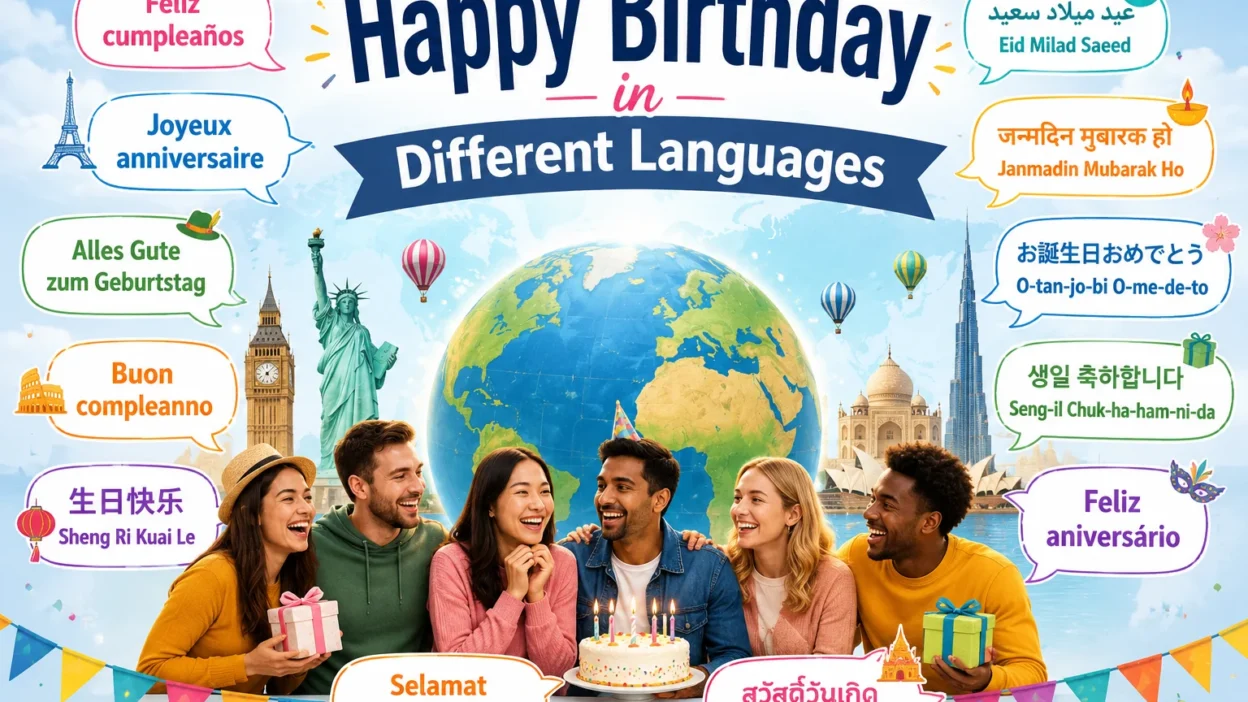
Learning happy birthday in different languages is a wonderful way to celebrate birthdays while connecting with people from different cultures. Whether you’re traveling, sending birthday wishes to international friends, writing greeting cards or simply learning new languages, knowing how to say “Happy Birthday” in someone’s native language makes your message more thoughtful and memorable.
In this guide, you’ll discover happy birthday in different languages with native spellings and easy English pronunciations. You’ll also learn why birthday greetings matter, when to use them and practical tips for remembering these festive expressions from around the world.
Quick Answer
Happy birthday in different languages includes joyful greetings used worldwide to celebrate someone’s special day. Learning these expressions helps you share warm wishes, appreciate different cultures, and make birthdays even more meaningful.
Happy Birthday in Different Languages Around the World
| Language | Native Word | Pronunciation |
|---|---|---|
| English | Happy Birthday | Happy Birthday |
| Spanish | Feliz cumpleaños | Feh-LEES Coom-play-AN-yos |
| French | Joyeux anniversaire | Zhwa-YUH Za-nee-ver-SAIRE |
| German | Alles Gute zum Geburtstag | AH-les GOO-tuh Tsoom Ge-BURTS-tag |
| Italian | Buon compleanno | Bwon Com-ple-AN-no |
| Portuguese | Feliz aniversário | Feh-LEES A-ni-ver-SA-rio |
| Dutch | Fijne verjaardag | FINE-uh Ver-YAAR-dakh |
| Swedish | Grattis på födelsedagen | GRAT-is Poe FER-del-se-da-gen |
| Norwegian | Gratulerer med dagen | Gra-tu-LE-rer Meh DA-gen |
| Danish | Tillykke med fødselsdagen | Ti-LOO-ke Meh FER-sels-da-gen |
| Finnish | Hyvää syntymäpäivää | HUU-vaa Syn-tu-ma Pai-va |
| Icelandic | Til hamingju með afmælið | Til Ha-ming-yu Meth Av-my-lith |
| Polish | Wszystkiego najlepszego | Fshist-KYE-go Nai-LEP-she-go |
| Czech | Všechno nejlepší | FSHEKH-no Nai-LEP-shee |
| Slovak | Všetko najlepšie | FSHET-ko Nai-LEP-shee |
| Hungarian | Boldog születésnapot | BOL-dog Su-le-teesh-na-pot |
| Romanian | La mulți ani | La MOOLTS Ani |
| Greek | Χρόνια πολλά | HRO-nia Po-LA |
| Russian | С днём рождения | S Dnyom Razh-DE-ni-ya |
| Ukrainian | З днем народження | Z Dnem Na-ROD-zhen-nya |
| Bulgarian | Честит рожден ден | Ches-TIT Roj-DEN Den |
| Serbian | Срећан рођендан | SRE-chan RO-djen-dan |
| Croatian | Sretan rođendan | SRE-tan Ro-djen-dan |
| Turkish | Doğum günün kutlu olsun | Do-oom Goo-noon Koot-lo Ol-soon |
| Arabic | عيد ميلاد سعيد | Eid Milad Saeed |
| Hebrew | יום הולדת שמח | Yom Hu-le-det Sa-me-ach |
| Persian | تولدت مبارک | Tavallodet Mobarak |
| Hindi | जन्मदिन मुबारक हो | Janmadin Mubarak Ho |
| Urdu | سالگرہ مبارک ہو | Saalgirah Mubarak Ho |
| Punjabi | ਜਨਮਦਿਨ ਮੁਬਾਰਕ | Janamdin Mubarak |
| Bengali | শুভ জন্মদিন | Shubho Jonmodin |
| Gujarati | જન્મદિવસ મુબારક | Janmadivas Mubarak |
| Marathi | वाढदिवसाच्या शुभेच्छा | Vadhdivsachya Shubhechha |
| Tamil | இனிய பிறந்தநாள் வாழ்த்துகள் | Iniya Piranthanaal Vaazhthukkal |
| Telugu | పుట్టినరోజు శుభాకాంక్షలు | Puttinaroju Shubhakankshalu |
| Kannada | ಹುಟ್ಟುಹಬ್ಬದ ಶುಭಾಶಯಗಳು | Huttu-habbada Shubhashayagalu |
| Malayalam | ജന്മദിനാശംസകൾ | Janmadinashamsakal |
| Nepali | जन्मदिनको शुभकामना | Janmadinko Shubhakamana |
| Sinhala | සුභ උපන්දිනයක් | Suba Upan Dinayak |
| Thai | สุขสันต์วันเกิด | Sook-san Wan Gert |
| Vietnamese | Chúc mừng sinh nhật | Chook Mung Sinh Nhat |
| Indonesian | Selamat ulang tahun | Se-la-mat Oo-lang Ta-hun |
| Malay | Selamat Hari Jadi | Se-la-mat Ha-ri Ja-di |
| Filipino | Maligayang Kaarawan | Ma-li-ga-yang Ka-a-ra-wan |
| Chinese (Mandarin) | 生日快乐 | Sheng Ri Kuai Le |
| Japanese | お誕生日おめでとう | O-tan-jo-bi O-me-de-to |
| Korean | 생일 축하합니다 | Seng-il Chuk-ha-ham-ni-da |
| Swahili | Heri ya Kuzaliwa | He-ri Ya Ku-za-li-wa |
| Hawaiian | Hauʻoli Lā Hānau | How-o-lee La Ha-now |
| Māori | Hari Huritau | Ha-ri Hu-ri-tau |
Why Learn “Happy Birthday” in Different Languages?
Learning happy birthday in different languages is a thoughtful way to celebrate someone’s special day while showing appreciation for their culture. A birthday greeting in a person’s native language often feels more personal and memorable than a standard message. It demonstrates kindness, respect, and genuine effort, making celebrations even more meaningful.
These greetings are useful for travelers, students, teachers, businesses, and anyone with international friends or family. Whether you’re sending a text message, writing a greeting card, posting on social media, or celebrating in person, using the local expression helps create a stronger emotional connection.
Common Uses of “Happy Birthday” Around the World
Birthday greetings are exchanged in many ways across different cultures. People commonly say Happy Birthday during family gatherings, birthday parties, workplace celebrations, school events, and community functions. These wishes are also shared through greeting cards, phone calls, video messages, emails, and social media posts.
In many countries, birthday greetings are accompanied by gifts, cakes, candles, songs, and special traditions unique to each culture. Learning the local greeting allows you to participate more naturally in these celebrations and makes your wishes feel sincere and culturally appropriate.
Pronunciation Tips for Beginners
Learning the pronunciation of happy birthday in different languages is easier than memorizing every translation at once. Start by listening to native speakers through language-learning apps or online pronunciation guides. Repeat each greeting slowly and focus on the rhythm, stress, and sounds rather than translating every individual word. Speaking the phrases aloud every day helps improve both your pronunciation and confidence.
It also helps to learn similar languages together. For example, Spanish, Italian, Portuguese, and French share several pronunciation patterns, making them easier to remember as a group. Creating flashcards, practicing with friends, and using birthday greetings in real conversations are simple ways to remember these expressions naturally.
Interesting Facts About Birthday Greetings
Birthday greetings vary greatly across cultures. While many countries simply wish someone a happy birthday, others include blessings for health, happiness, long life, or prosperity. In some languages, the greeting literally translates to “Congratulations on your birthday,” while others wish joy and success for the coming year.
Another interesting fact is that birthday songs are not the same everywhere. Although the English version of “Happy Birthday to You” is famous worldwide, many countries have their own traditional birthday songs and customs. Learning these greetings not only improves your language skills but also helps you appreciate the unique traditions that make birthdays special around the world.
Conclusion
Learning happy birthday in different languages is a fun and meaningful way to celebrate people from different cultures. Whether you’re wishing a friend, family member, colleague or someone you meet while traveling, using their native language makes your greeting more thoughtful and memorable. These translations help strengthen relationships, show cultural respect and make every birthday celebration more personal. Practice a few greetings regularly and you’ll always have the perfect birthday wish ready for people around the world.
Frequently Asked Questions
1. Why should I learn happy birthday in different languages?
Learning birthday greetings helps you celebrate people from different cultures in a thoughtful way. It improves communication, shows respect, and makes your birthday wishes feel more personal and meaningful.
2. Which languages have the most commonly used happy birthday greetings?
Some of the best-known greetings include Feliz cumpleaños (Spanish), Joyeux anniversaire (French), Buon compleanno (Italian), Alles Gute zum Geburtstag (German), and 生日快乐 (Chinese). These expressions are widely recognized across the world.
3. Can I use these birthday greetings while traveling?
Yes. Using the local birthday greeting is a kind gesture that is appreciated in most countries. It helps you connect with local people and participate naturally in birthday celebrations.
4. Are birthday greetings the same in every language?
No. While the meaning is similar, many languages use different wording, grammar, or cultural expressions. Some greetings wish happiness, while others focus on health, success, or long life.
5. What is the easiest way to remember happy birthday in different languages?
Practice a few greetings each day, repeat them aloud, and group similar languages together. Flashcards, language-learning apps, and listening to native speakers are excellent ways to improve both pronunciation and memory.