
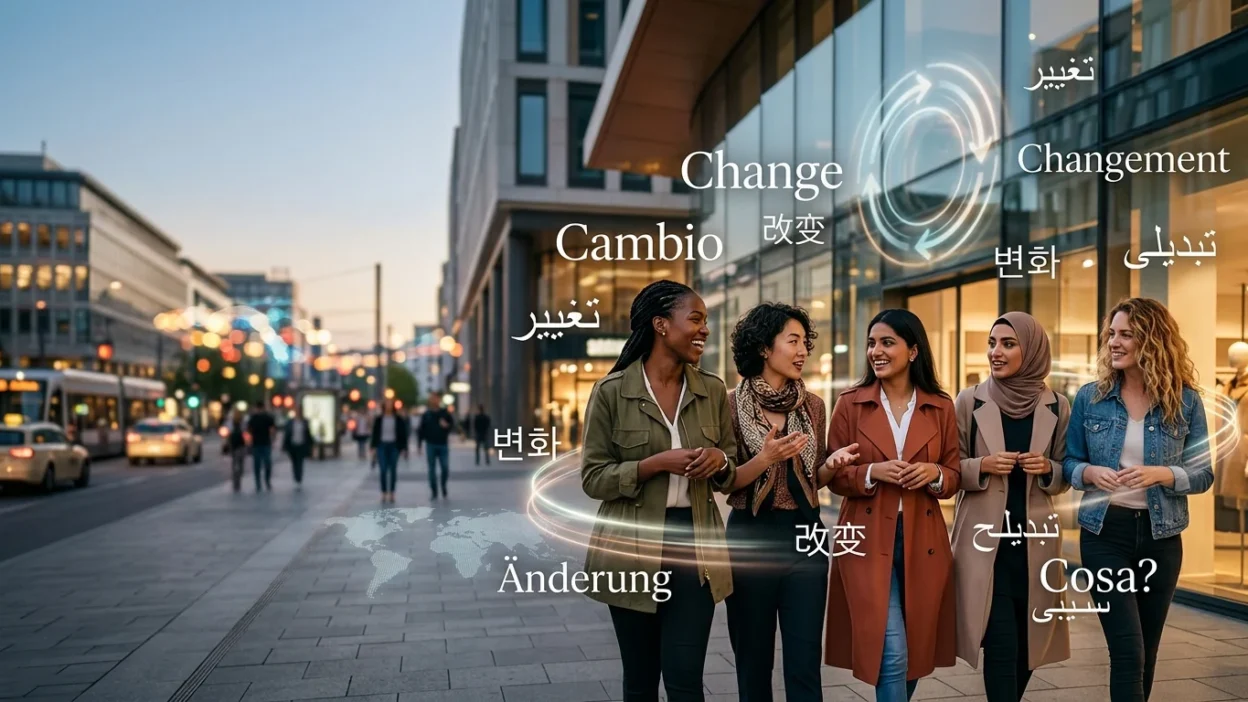
The word change in different languages is useful for anyone interested in vocabulary, translation, travel or global communication. “Change” can describe replacing something, becoming different, modifying a situation, or exchanging money, so its exact translation depends on context.
Learning change in different languages helps you understand how different cultures express transformation and modification. From Spanish and French to Arabic, Hindi, Chinese and Japanese, each language offers a unique word or expression. In this guide, you’ll discover 50 translations with native spellings and easy to read pronunciations, followed by useful explanations about meaning, usage and related vocabulary.
Quick Answer
“Change” has different translations worldwide. Examples include cambio in Spanish, changement in French, Änderung in German, cambiamento in Italian, تغيير (taghyīr) in Arabic, 改变 (gǎibiàn) in Chinese and 変化 (henka) in Japanese.
Change in Different Languages Around the World
| Language | Native Word | Pronunciation |
|---|---|---|
| English | Change | chaynj |
| Spanish | Cambio | KAM-byoh |
| French | Changement | shonj-MON |
| German | Änderung | EN-duh-roong |
| Italian | Cambiamento | kam-bya-MEN-toh |
| Portuguese | Mudança | moo-DAN-sah |
| Dutch | Verandering | veh-ran-DAIR-ing |
| Swedish | Förändring | fur-EN-dring |
| Norwegian | Forandring | foo-RAN-dring |
| Danish | Forandring | foo-RAN-dring |
| Finnish | Muutos | MOO-tos |
| Icelandic | Breyting | BRAY-ting |
| Polish | Zmiana | ZMYAH-na |
| Czech | Změna | ZMYEH-na |
| Slovak | Zmena | ZMEH-na |
| Hungarian | Változás | VAAL-toh-zash |
| Romanian | Schimbare | skeem-BA-reh |
| Russian | Изменение | iz-meh-NYEH-nee-yeh |
| Ukrainian | Зміна | ZMEE-na |
| Bulgarian | Промяна | pro-MYA-na |
| Greek | Αλλαγή | al-la-GHEE |
| Turkish | Değişim | day-ee-SHEEM |
| Arabic | تغيير | tagh-YEER |
| Hebrew | שינוי | shee-NOO-ee |
| Persian | تغییر | tagh-YEER |
| Urdu | تبدیلی | tab-DEE-lee |
| Hindi | परिवर्तन | par-ee-VAR-tan |
| Bengali | পরিবর্তন | por-ee-BOR-ton |
| Punjabi | ਤਬਦੀਲੀ | tab-DEE-lee |
| Gujarati | ફેરફાર | fayr-FAAR |
| Marathi | बदल | ba-DAL |
| Tamil | மாற்றம் | MAAT-ram |
| Telugu | మార్పు | MAAR-poo |
| Kannada | ಬದಲಾವಣೆ | ba-da-LAA-va-neh |
| Malayalam | മാറ്റം | MAA-tam |
| Sinhala | වෙනස්කම | veh-NAS-ka-ma |
| Chinese | 改变 | gǎi-biàn |
| Japanese | 変化 | hen-ka |
| Korean | 변화 | byeon-hwa |
| Thai | เปลี่ยนแปลง | bplìan-bplàaeng |
| Vietnamese | Thay đổi | tie DOY |
| Indonesian | Perubahan | peh-roo-BA-han |
| Malay | Perubahan | peh-roo-BA-han |
| Filipino | Pagbabago | pag-ba-BA-go |
| Swahili | Mabadiliko | ma-ba-dee-LEE-ko |
| Zulu | Ushintsho | oo-SHEENT-shoh |
| Afrikaans | Verandering | feh-RAN-deh-ring |
| Esperanto | Ŝanĝo | SHAN-joh |
| Latin | Mutatio | moo-TAH-tee-oh |
| Albanian | Ndryshim | NDRI-shim |
| Serbian | Промена | pro-MEH-na |
| Croatian | Promjena | pro-MYEH-na |
Why Learn Change in Different Languages?
Learning change in different languages can expand your vocabulary and help you communicate ideas about transformation, development and adjustment. The concept of change appears in everyday conversations, business, education, technology, relationships, travel and personal development.
For language learners, it is especially useful because “change” is a versatile word. You might talk about changing plans, changing clothes, changing jobs, changing money or changes happening in society.
Learning this word in multiple languages also helps you understand how context affects translation. A single English word may require different expressions depending on whether you mean transformation, replacement, exchange or modification.
Different Meanings of the Word Change
The English word change has several meanings, which is why translations can vary. As a noun, it can describe a difference or transformation, as in “a major change.” As a verb, it can mean to make something different, such as “change the color.”
“Change” can also mean exchanging money, particularly when traveling. In another context, it can refer to coins received after paying for something.
Because of these different meanings, learners should avoid assuming that one foreign language word always covers every use of the English word. Context is essential for accurate translation.
How to Pronounce Change in Different Languages
Pronunciation varies greatly among languages. Some translations are short, while others contain several syllables and sounds that may be unfamiliar to English speakers.
For example, Spanish cambio is pronounced differently from French changement, while Arabic تغيير and Japanese 変化 have completely different sound patterns.
A good pronunciation strategy is to learn the word slowly and repeat it several times. Break longer words into syllables, listen carefully to native pronunciation, and practice saying the word inside a short sentence.
Remember that English-style pronunciation guides are approximations rather than exact representations of native speech.
Change in Everyday Conversations
People talk about change constantly. You might discuss a change in weather, a change of plans, a new hairstyle, changing your schedule, or changes in your neighborhood.
This makes “change” an important vocabulary word for beginners and advanced language learners alike. Once you learn the basic translation, practice combining it with common nouns and verbs.
For example, useful phrases include “change the plan,” “change your mind,” “a big change,” “change over time,” and “change the color.”
Learning phrases instead of isolated words can help you communicate more naturally.
Change in Business and Professional Language
Change is also an important concept in professional communication. Businesses frequently discuss organizational changes, market changes, policy changes, technological developments, and changes in customer behavior.
Understanding the local word for change can therefore be useful for students, professionals, entrepreneurs, and international workers.
In business settings, the word may appear in reports, presentations, meetings, emails, and strategic plans. Depending on the language, there may also be formal and informal expressions for different types of change.
When translating professional content, always consider the intended meaning and tone rather than choosing a translation based solely on a dictionary entry.
Change in Culture and Society
Languages evolve as societies change. New technologies, social trends, migration, media, and international communication can all influence vocabulary and expressions.
The concept of change itself is therefore closely connected to language development. Words may gain new meanings, become less common, or be replaced by newer expressions.
Different cultures may also have distinct ways of discussing social change. Some expressions emphasize progress, while others focus on transformation, adaptation, or continuity.
Studying the word “change” across languages provides a small but interesting window into how people describe a changing world.
Change in Personal Development
The word change is frequently associated with personal growth. People talk about changing habits, changing careers, changing lifestyles, and becoming a different version of themselves.
For language learners, this provides an excellent opportunity to practice vocabulary through meaningful sentences. Instead of memorizing a translation alone, try using it in statements about your own goals or experiences.
For example, you could practice phrases equivalent to “I want to change,” “Things have changed,” or “Change takes time.”
Connecting vocabulary with real-life concepts can make new words easier to remember.
Common Words Related to Change
Once you learn change in different languages, expand your vocabulary with related terms such as difference, transformation, development, improvement, adjustment, replacement, modification, transition, growth, and adaptation.
These words do not always mean exactly the same thing. A transformation may suggest a significant change, while an adjustment may describe a smaller modification.
Learning these distinctions can improve your ability to express ideas precisely. It is particularly valuable for advanced learners who want to move beyond basic vocabulary and communicate more naturally.
Common Mistakes When Translating Change
One of the most common mistakes is translating “change” without considering its context. The word used for a general transformation may not be appropriate when talking about money, clothing, schedules, or physical objects.
Another mistake is relying entirely on pronunciation guides. These guides make vocabulary easier to approach but cannot capture every sound or tone of a language.
Learners should also pay attention to grammar. In some languages, the form of the word may change depending on whether it is used as a noun, verb, adjective, or part of a particular expression.
Context, grammar and pronunciation all matter.
Easy Ways to Remember Change Translations
A simple way to remember vocabulary is to connect each word with a visual or situation. Imagine changing clothes, changing a plan, or watching a changing landscape while practicing the translation.
You can also create flashcards and group similar languages together. Spanish cambio, Italian cambiamento, and Portuguese mudança provide interesting comparisons between Romance languages.
Practice one group of words at a time rather than attempting to memorize all 50 immediately. Repetition over several days is generally more effective than studying everything in one session.
Short sentences can make the vocabulary even easier to recall.
Interesting Facts About the Word Change
“Change” is one of those English words that can function in several grammatical roles. It can be a noun, verb, and part of many common expressions.
The idea of change is also universal. Every society experiences changes in technology, culture, environment, language, and daily life.
Interestingly, languages may divide the concept into several different words rather than using one broad term. This is why translation requires more than simply replacing one dictionary word with another.
Understanding these distinctions helps language learners develop more accurate and natural communication skills.
Key Takeaways
- Change has many translations depending on the language and context.
- Spanish uses cambio, French uses changement and German uses Änderung.
- Arabic and Persian use تغيير, while Chinese uses 改变.
- The English word “change” can refer to transformation, replacement, exchange or modification.
- Context and pronunciation are essential when learning translations.
Conclusion
Learning change in different languages is a practical way to expand your vocabulary and understand how different cultures describe transformation. The translations range from familiar forms such as Spanish cambio to completely different expressions such as Japanese 変化 and Chinese 改变. Because “change” has several meanings in English, understanding context is particularly important when translating it.
Whether you are learning a language, traveling internationally, studying culture or improving your communication skills, these 50 translations provide a useful foundation. Practice each word with simple phrases to make the vocabulary easier to remember and use naturally.
Frequently Asked Questions
1. What is change in different languages?
“Change” has many translations around the world. Examples include cambio in Spanish, changement in French, Änderung in German, cambiamento in Italian, تغيير in Arabic, 改变 in Chinese, and 変化 in Japanese. The correct translation depends on the meaning and grammatical context.
2. How do you say change in Spanish?
The common Spanish word for “change” is cambio, pronounced approximately “KAM-byoh.” It can describe a change or transformation and is also used in contexts involving exchange. Spanish uses different grammatical forms depending on whether the word functions as a noun or verb.
3. What is change in Japanese?
A common Japanese word for “change” is 変化 (henka), pronounced approximately “hen kah.” It generally refers to a change, variation, or transformation. Other Japanese expressions may be used depending on whether you mean changing something, replacing something or making an adjustment.
4. What is change in Chinese?
In Mandarin Chinese, 改变 (gǎibiàn) commonly means “to change” or “to alter.” The pronunciation is approximately “guy-byen,” although Mandarin tones are important for accurate pronunciation. Chinese has additional words for specific meanings of change, so context should always be considered.
5. Why learn change in different languages?
Learning “change” in different languages helps build practical vocabulary for everyday conversations, travel, business, education, and cultural discussions. Because change is a common concept, knowing its translation can help learners describe plans, habits, transformations, development and many other situations more naturally.