
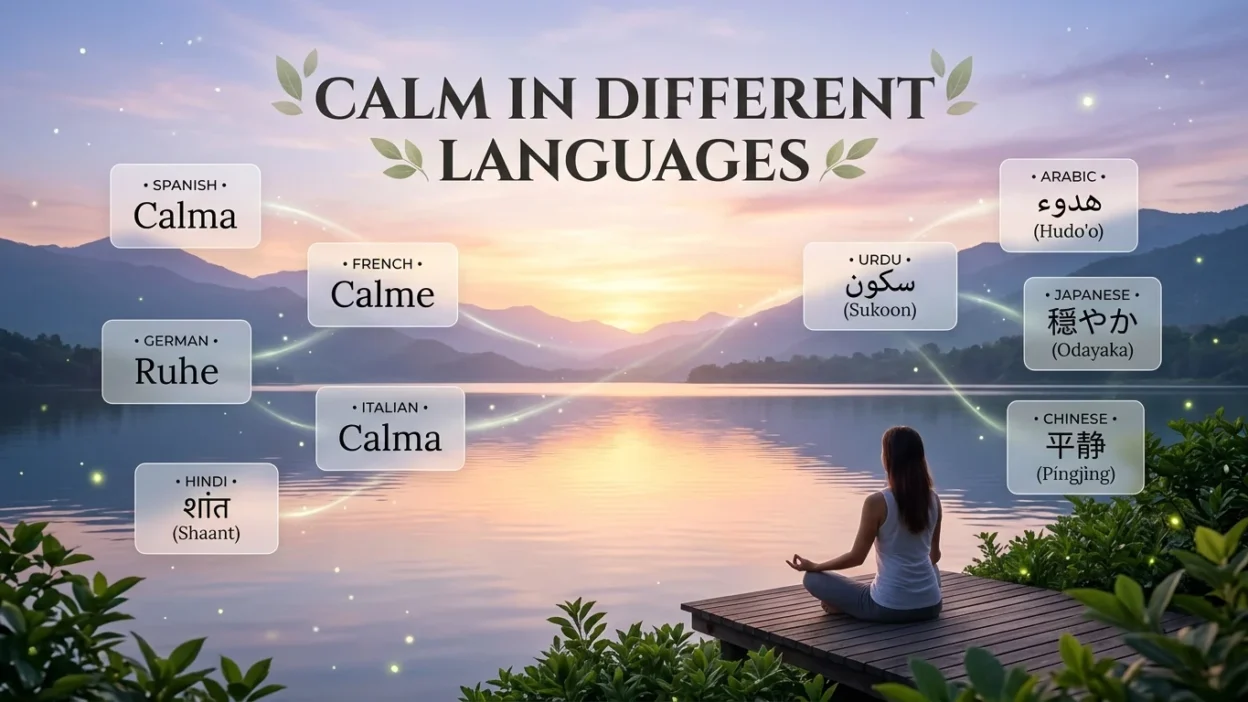
The word calm describes a peaceful state of mind, a quiet environment, or freedom from stress and excitement. People use it to express relaxation, emotional balance, and inner peace. Although the meaning remains similar, every language has its own beautiful way of expressing this feeling.
Learning calm in different languages helps you understand how cultures describe peace, patience, and emotional stability. Whether you are learning a new language, exploring international vocabulary, or looking for meaningful words, these translations will help you discover how people around the world express calmness.
Quick Answer
The word calm has different translations around the world. Examples include calme in French, calma in Spanish, ruhig in German, 穏やか in Japanese, and शांत in Hindi.
Calm Around the World
The following table presents 50 translations of calm in different languages, along with native spellings and simple English pronunciation guides.
| Language | Native Word | Pronunciation |
|---|---|---|
| English | Calm | Kahm |
| Spanish | Calma | KAHL-mah |
| French | Calme | Kahlm |
| German | Ruhig | ROO-ikh |
| Italian | Calmo | KAHL-moh |
| Portuguese | Calmo | KAHL-moo |
| Dutch | Kalm | Kahlm |
| Swedish | Lugn | Loong |
| Norwegian | Rolig | ROO-lig |
| Danish | Rolig | ROH-lee |
| Finnish | Rauhallinen | ROW-hahl-lee-nen |
| Icelandic | Rólegur | ROH-leh-gur |
| Polish | Spokojny | spoh-KOY-nih |
| Czech | Klidný | KLEED-nee |
| Slovak | Pokojný | POH-koy-nee |
| Russian | Спокойный | spa-KOY-ny |
| Ukrainian | Спокійний | spo-KEE-nee |
| Greek | Ήρεμος | EE-reh-mos |
| Turkish | Sakin | SAH-kin |
| Arabic | هادئ | HAA-dee |
| Persian | آرام | aa-RAAM |
| Hebrew | רגוע | rah-GOO-ah |
| Hindi | शांत | SHAANT |
| Urdu | پُرسکون | pur-sukoon |
| Bengali | শান্ত | SHAANTO |
| Punjabi | ਸ਼ਾਂਤ | SHAANT |
| Gujarati | શાંત | SHAANT |
| Marathi | शांत | SHAANT |
| Tamil | அமைதியான | uh-MAI-thi-yaa-na |
| Telugu | ప్రశాంతమైన | pruh-SHAAN-tha-mai-na |
| Kannada | ಶಾಂತ | SHAAN-tha |
| Malayalam | ശാന്തമായ | SHAAN-tha-maa-ya |
| Chinese (Mandarin) | 平静 | PING-jing |
| Japanese | 穏やか | oh-dah-yah-kah |
| Korean | 차분한 | cha-boon-han |
| Thai | สงบ | sa-NGOP |
| Vietnamese | Bình tĩnh | bing ting |
| Indonesian | Tenang | tuh-NAHNG |
| Malay | Tenang | tuh-NAHNG |
| Filipino | Kalmado | kal-MAH-doh |
| Swahili | Tulivu | too-LEE-voo |
| Amharic | शांत | SHANT |
| Afrikaans | Kalm | Kahlm |
| Romanian | Calm | Kahlm |
| Hungarian | Nyugodt | NYOO-got |
| Croatian | Miran | MEE-rahn |
| Serbian | Миран | MEE-rahn |
| Bulgarian | Спокоен | spo-KO-yen |
| Slovenian | Miren | MEE-ren |
| Irish | Socair | SUH-kir |
Note: Some languages use different forms depending on whether calm describes a person, an environment, or a state of mind. Pronunciations are approximate English learning guides.
1. Why Learn the Word Calm in Different Languages?
Learning the word calm in different languages expands your vocabulary and helps you communicate with people from different backgrounds. It is especially useful when discussing emotions, relaxation, and peaceful surroundings.
The word also appears in everyday conversations, books, travel experiences, and motivational messages. Knowing its translations allows you to understand international expressions more easily.
Whether you are studying a foreign language or simply exploring interesting vocabulary, these words offer a simple way to appreciate how people describe peaceful feelings.
2. Cultural Significance of Calm Around the World
Calmness has an important place in many cultures. Some societies associate it with patience, while others connect it with emotional strength, mindfulness, and self-control.
In Japanese culture, peaceful behavior and harmony are often valued in social situations. Similarly, many South Asian traditions emphasize patience and maintaining balance during difficult moments.
Different languages express these ideas through their own vocabulary. Understanding these cultural differences makes language learning more meaningful and helps you appreciate how people communicate emotions across the world.
3. How to Pronounce Calm in Different Languages
Pronunciation is an important part of learning foreign vocabulary. Even when two words share a similar meaning, their sounds can be completely different.
For example, French uses a short pronunciation for calme, while Spanish calma has two clear syllables. German ruhig includes a sound that may be unfamiliar to English speakers.
To improve your pronunciation:
- Listen to native speakers whenever possible.
- Practice each word slowly.
- Divide longer words into syllables.
- Repeat words in complete sentences.
- Pay attention to unfamiliar vowel and consonant sounds.
Regular practice makes foreign vocabulary easier to remember.
4. Related Words That Express Peace and Tranquility
Calmness is connected to several other emotions and feelings. Learning related vocabulary helps you express yourself more naturally.
Some useful English words include:
- Peaceful: Free from disturbance or conflict.
- Relaxed: Feeling comfortable without tension.
- Serene: Quiet, peaceful, and undisturbed.
- Gentle: Soft, kind, and not aggressive.
- Quiet: Making little or no noise.
- Patient: Able to accept difficulties without becoming upset.
- Composed: Emotionally controlled and balanced.
- Tranquil: Completely peaceful and calm.
These words are useful for describing people, places, emotions, and everyday experiences.
5. Practical Uses of Calm in Everyday Conversations
The word calm can be used in many everyday situations. You might use it to describe a peaceful person, encourage someone during a stressful situation, or explain the atmosphere of a quiet place.
Here are some common examples:
- Please stay calm during the meeting.
- The ocean looks calm today.
- I feel calm after meditation.
- She remained calm during the difficult situation.
- This room has a peaceful and calm atmosphere.
- Take a deep breath and stay calm.
Learning equivalent expressions in other languages helps you communicate these feelings when traveling or speaking with international friends.
6. Easy Tips for Learning Calm in Multiple Languages
Learning vocabulary becomes easier when you use simple and consistent techniques. Instead of memorizing all translations at once, focus on a few languages each day.
Try these methods:
- Create flashcards: Write the language on one side and its translation on the other.
- Practice daily: Spend five minutes reviewing new words.
- Listen carefully: Use native-language audio to understand pronunciation.
- Write examples: Create simple sentences using each translation.
- Group similar words: Learn vocabulary from related language families.
- Review regularly: Repeat older words to improve long-term memory.
These techniques can make language learning enjoyable and effective.
7. Interesting Facts About the Word Calm
The word calm has several interesting features in the English language. It is commonly used as both an adjective and a noun, while its related forms include calmly and calmness.
Another interesting fact is that the letter L is silent in the standard English pronunciation of calm. This makes it different from how some beginners might initially read the word.
Across languages, the idea of calmness can describe nature, emotions, conversations, and personal behavior. A single concept can therefore have many different linguistic and cultural expressions.
8. Common Mistakes When Learning Translations of Calm
One common mistake is assuming that every language has one translation that works in every situation. In reality, vocabulary changes according to grammar and context.
For example, a word describing a calm person may have a different grammatical form from a word describing calm weather.
Other mistakes include:
- Ignoring masculine and feminine forms.
- Using informal expressions in formal situations.
- Pronouncing unfamiliar sounds incorrectly.
- Confusing calm with silence.
- Translating words without understanding their context.
To avoid these problems, learn complete example sentences rather than memorizing individual translations alone.
9. When Should You Use the Word Calm?
You can use calm whenever you want to describe a peaceful feeling, a relaxed person, or an environment without disturbance.
In personal conversations, it can encourage someone to control their emotions. In writing, it can describe peaceful scenery, comfortable surroundings, or a relaxed atmosphere.
The word is also useful in professional communication. For example, remaining calm during an important meeting can help people communicate clearly and handle challenges.
Understanding its translations makes these expressions more accessible when communicating with people who speak other languages.
Key Takeaways
- Calm describes peace, relaxation, and emotional balance.
- Different languages have unique translations for calmness.
- Pronunciation varies depending on the language.
- Calm can describe people, emotions, weather, and environments.
- Learning foreign translations improves vocabulary and cross-cultural communication.
FAQs:
1. What is the word calm in different languages?
Calm has several translations depending on the language. Examples include calma in Spanish, calme in French, ruhig in German, tenang in Indonesian, and शांत in Hindi. These words generally describe peace, relaxation, or a quiet state of mind.
2. What is calm called in French?
The French word for calm is calme. It can describe a peaceful person, a quiet environment, or a relaxed situation. French speakers use this word in everyday conversations, particularly when talking about emotions, behavior, and surroundings.
3. What is the Urdu word for calm?
The Urdu word for calm is پُرسکون (pur-sukoon). It describes someone who feels peaceful, relaxed, or free from worry. Another related word is پُرسکونی, which refers to peacefulness or tranquility.
4. What is the difference between calm and peaceful?
Calm generally describes a state without excitement, nervousness, or disturbance. Peaceful often refers to freedom from conflict, noise, or trouble. Although these words are closely related, calm can describe emotional control, while peaceful often emphasizes harmony and quiet surroundings.
5. Why is learning calm in different languages useful?
Learning calm in different languages helps expand vocabulary and improve communication. It also introduces you to cultural expressions related to patience, relaxation, and emotional balance. These translations can be useful for students, travelers, language enthusiasts, and people interested in international communication. Conclusion:
Exploring calm in different languages reveals how people around the world express peace, relaxation, and emotional balance. From Spanish calma to Japanese 穏やか and Urdu پُرسکون, every language offers a unique way to describe tranquility. Learning these translations can improve your vocabulary, support language studies, and make international communication easier. Practice a few words every day, listen to native pronunciations, and use them in simple sentences. With regular practice, you can understand and express the meaning of calm across different cultures.