
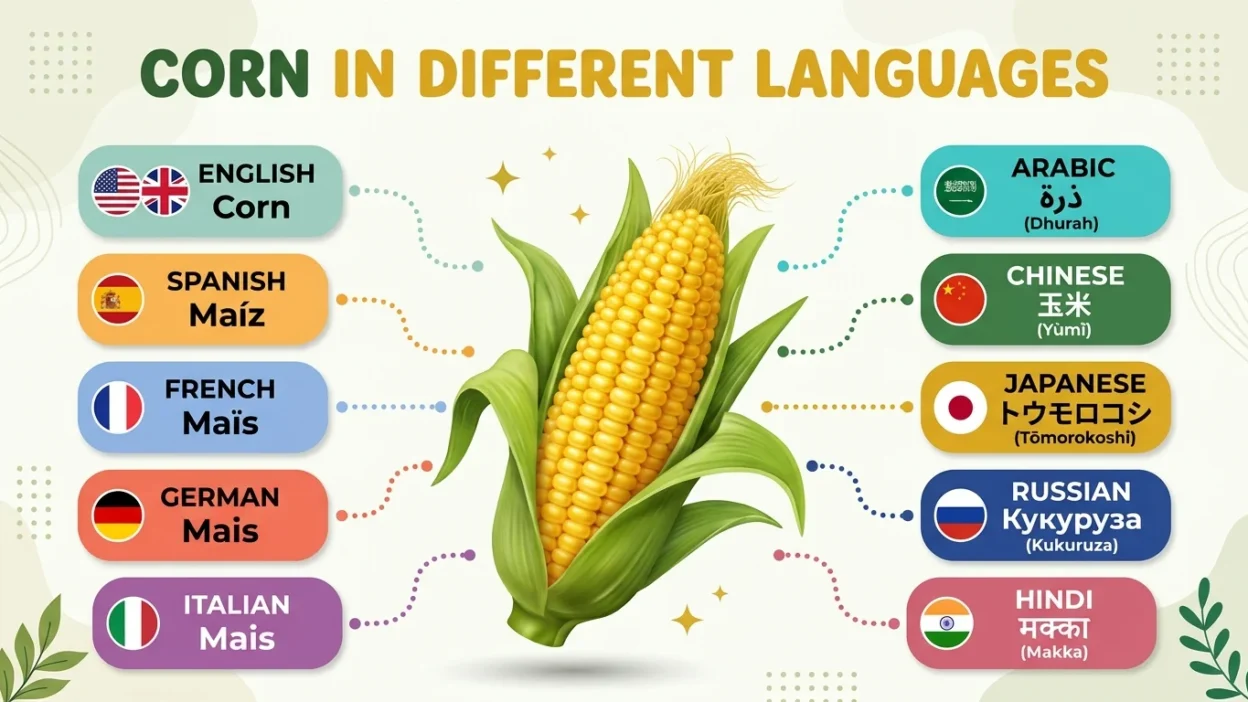
Corn is one of the world’s most popular crops, enjoyed in many forms, including sweet corn, popcorn, cornmeal, and corn on the cob. Different countries have their own names for this versatile food, making it interesting to explore how people describe it in their native languages.
Learning corn in different languages is useful for travelers, students, food lovers, language learners, and anyone interested in global cultures. From English and Spanish to Japanese and Arabic, this guide explores 50 languages, their native words, and simple pronunciation guides to help you understand and use each translation.
Quick Answer
The word for corn varies across languages. For example, it is maíz in Spanish, mais in French, Mais in German, とうもろこし in Japanese, and 玉米 in Chinese.
Corn Around the World
Here are 50 translations of corn in different languages, along with their native spellings and easy English pronunciations.
| Language | Native Word | Pronunciation |
|---|---|---|
| English | Corn | KORN |
| Spanish | Maíz | Mah-EES |
| French | Maïs | Mah-EES |
| German | Mais | MYCE |
| Italian | Mais | MYCE |
| Portuguese | Milho | MEEL-yoo |
| Dutch | Maïs | MYCE |
| Russian | Кукуруза | Koo-koo-ROO-zah |
| Ukrainian | Кукурудза | Koo-koo-ROOD-zah |
| Polish | Kukurydza | Koo-koo-RID-zah |
| Turkish | Mısır | Muh-SUHR |
| Arabic | ذرة | DUR-rah |
| Persian | ذرت | ZOR-rat |
| Urdu | مکئی | Mak-KAI |
| Hindi | मक्का | Mak-KAH |
| Bengali | ভুট্টা | BHOOT-tah |
| Punjabi | ਮੱਕੀ | Mak-KEE |
| Gujarati | મકાઈ | Muh-KAI |
| Marathi | मका | Muh-KAH |
| Tamil | மக்காச்சோளம் | Mak-KAA-cho-lam |
| Telugu | మొక్కజొన్న | Mok-ka-JON-na |
| Kannada | ಜೋಳ | JOH-lah |
| Malayalam | ചോളം | CHOH-lam |
| Chinese (Mandarin) | 玉米 | YOO-mee |
| Japanese | とうもろこし | Toh-moh-roh-koh-shee |
| Korean | 옥수수 | Ok-soo-soo |
| Vietnamese | Ngô | NGUH |
| Thai | ข้าวโพด | Khao-phoht |
| Indonesian | Jagung | Jah-goong |
| Malay | Jagung | Jah-goong |
| Filipino | Mais | MAH-ees |
| Swahili | Mahindi | Mah-HIN-dee |
| Amharic | በቆሎ | Beh-KOH-lo |
| Yoruba | Agbado | Ag-BAH-doh |
| Igbo | Ọka | AW-kah |
| Zulu | Ummbila | OOM-bee-lah |
| Afrikaans | Mielies | MEE-lees |
| Greek | Καλαμπόκι | Kah-lah-MBOH-kee |
| Hebrew | תירס | TEE-res |
| Romanian | Porumb | Poh-ROOMB |
| Hungarian | Kukorica | Koo-KOH-ree-tsah |
| Czech | Kukuřice | Koo-koo-RZHEE-tseh |
| Slovak | Kukurica | Koo-koo-REET-sah |
| Swedish | Majs | MYCE |
| Norwegian | Mais | MYCE |
| Danish | Majs | MYCE |
| Finnish | Maissi | MY-ssee |
| Icelandic | Maís | MYCE |
| Irish | Arbhar Indiach | AR-wur IN-dee-akh |
| Welsh | Ŷd | EED |
Note: Pronunciations are approximate English-friendly guides. Some words can have regional variations, and certain languages use different terms depending on the type of corn.
1. Why Learn Corn in Different Languages?
Learning food vocabulary is an easy and enjoyable way to improve language skills. Corn is a common ingredient in meals around the world, so knowing its name can help you communicate when shopping, cooking, or traveling.
Exploring different translations also introduces you to new sounds, writing systems, and cultural expressions. For students, it provides useful vocabulary practice, while food enthusiasts can discover how different communities describe familiar ingredients.
2. Cultural Significance of Corn Around the World
Corn has an important place in the history and traditions of many communities. In Mexico and Central America, maize has been a staple crop for thousands of years and remains central to traditional foods such as tortillas and tamales.
In other regions, corn is used to prepare porridge, bread, snacks, and traditional meals. Its importance extends beyond cooking because farming traditions, festivals, and local economies often revolve around this valuable crop.
3. How to Pronounce Corn in Different Languages
Pronunciation can change significantly from one language to another. Some translations sound similar to English, while others contain unfamiliar consonants, vowels, or syllable patterns.
For example, Spanish uses maíz, while Portuguese uses milho. Japanese uses a longer word with several syllables, whereas Mandarin Chinese uses two characters.
A helpful way to practice is to read each native word slowly, divide it into syllables, and repeat it several times. Listening to native speakers can also improve pronunciation accuracy.
4. Different Types of Corn and Their Names
Corn comes in several varieties, each with its own characteristics and culinary uses. Sweet corn is commonly eaten fresh, boiled, grilled, or steamed. Popcorn is a special variety that expands when heated.
Field corn is mainly grown for animal feed, cornmeal, and industrial products. Dent corn and flint corn are also important agricultural varieties.
Understanding these differences is useful because the general word for corn may not always describe a particular variety or food product accurately.
5. Popular Foods Made From Corn Worldwide
Corn is a versatile ingredient that appears in traditional and modern dishes across many countries. In Mexico, tortillas and tamales are popular foods made from maize.
In the United States, people enjoy popcorn, cornbread, and grilled corn on the cob. Italian cuisine includes polenta, a dish prepared using cornmeal.
Other cultures prepare corn porridge, steamed corn cakes, soups, and savory snacks. These dishes demonstrate how one agricultural crop can become part of many different food traditions.
6. Interesting Facts About Corn
Corn has a fascinating history and several surprising characteristics. It was domesticated thousands of years ago in what is now Mexico and gradually spread to other parts of the world.
Each corn plant can produce one or more ears, with hundreds of kernels on a single ear. Corn is also used beyond food production, including animal feed, starch, ethanol, and biodegradable materials.
Another interesting fact is that popcorn kernels contain moisture inside their hard outer shells, allowing them to pop when heated.
7. Common Mistakes When Learning Corn Translations
One common mistake is assuming that every language uses a word that directly resembles the English term. In reality, translations can have completely different spellings and sounds.
Another mistake is confusing corn with other grains or crops. Some languages also use different words for maize, sweet corn, and cornmeal.
Pronunciation is another challenge, especially when learning languages with unfamiliar writing systems. Avoid relying entirely on English spelling to understand foreign words. Instead, practice the native spelling and pronunciation together.
8. Easy Ways to Remember Corn in Different Languages
Memorizing food vocabulary becomes easier when you connect words with familiar objects and everyday activities. Start by learning five translations at a time instead of trying to remember all 50 immediately.
Create flashcards with the English word on one side and its foreign translation on the other. You can also label food pictures and practice saying each word aloud.
Grouping similar words together, writing short sentences, and reviewing vocabulary regularly will help you remember translations for longer.
9. Benefits of Learning Food Words in Multiple Languages
Learning food vocabulary offers practical benefits for communication and cultural understanding. It helps travelers recognize ingredients on menus, ask questions in markets, and communicate with local people.
Students can improve their vocabulary, spelling, and pronunciation by exploring familiar foods in other languages. Food-related words are also useful for international cooking, recipes, and cultural research.
Learning simple translations such as corn, rice, bread, and milk creates a strong foundation for understanding everyday conversations in different languages.
Key Takeaways
- Corn has different names and pronunciations across languages and cultures.
- Spanish uses maíz, French uses maïs, and German uses Mais.
- Corn is an important agricultural crop with historical and cultural significance.
- Different varieties include sweet corn, popcorn, dent corn, and flint corn.
- Practicing native spellings and pronunciations makes learning food vocabulary easier.
Conclusion
Exploring corn in different languages is a simple way to discover how cultures describe and enjoy one of the world’s most important crops. From maíz in Spanish to とうもろこし in Japanese, every translation offers an opportunity to learn something new. Understanding these words can improve your vocabulary, support international communication, and make traveling or exploring global recipes more enjoyable. Whether you are a student, traveler, or food enthusiast, learning these 50 translations is a useful step toward understanding languages and cultures around the world.
FAQs:
1. What is corn called in Spanish?
Corn is called maíz in Spanish. It is widely used throughout Spanish-speaking countries, particularly in traditional dishes such as tortillas, tamales, and arepas. The word is commonly used when discussing maize as a crop or food ingredient.
2. What is the Japanese word for corn?
The Japanese word for corn is とうもろこし (tōmorokoshi). It is commonly used for sweet corn and other varieties. Corn is enjoyed in Japan in soups, grilled dishes, snacks, and as a topping for popular foods.
3. What is corn called in French?
Corn is called maïs in French. This word is used in France and other French-speaking regions. It can refer to the agricultural crop as well as the edible kernels commonly used in salads, soups, and other recipes.
4. What is corn called in Hindi and Urdu?
Corn is commonly called makka (मक्का) in Hindi and makai (مکئی) in Urdu. Both terms refer to maize, a popular crop used in traditional meals, flour, bread, and other food preparations across South Asia.
5. Which countries use corn as a staple food?
Mexico, Guatemala, several African countries, and parts of South America rely heavily on corn as a staple food. It is used to prepare tortillas, porridge, bread, and many traditional dishes, making it an important part of everyday diets.