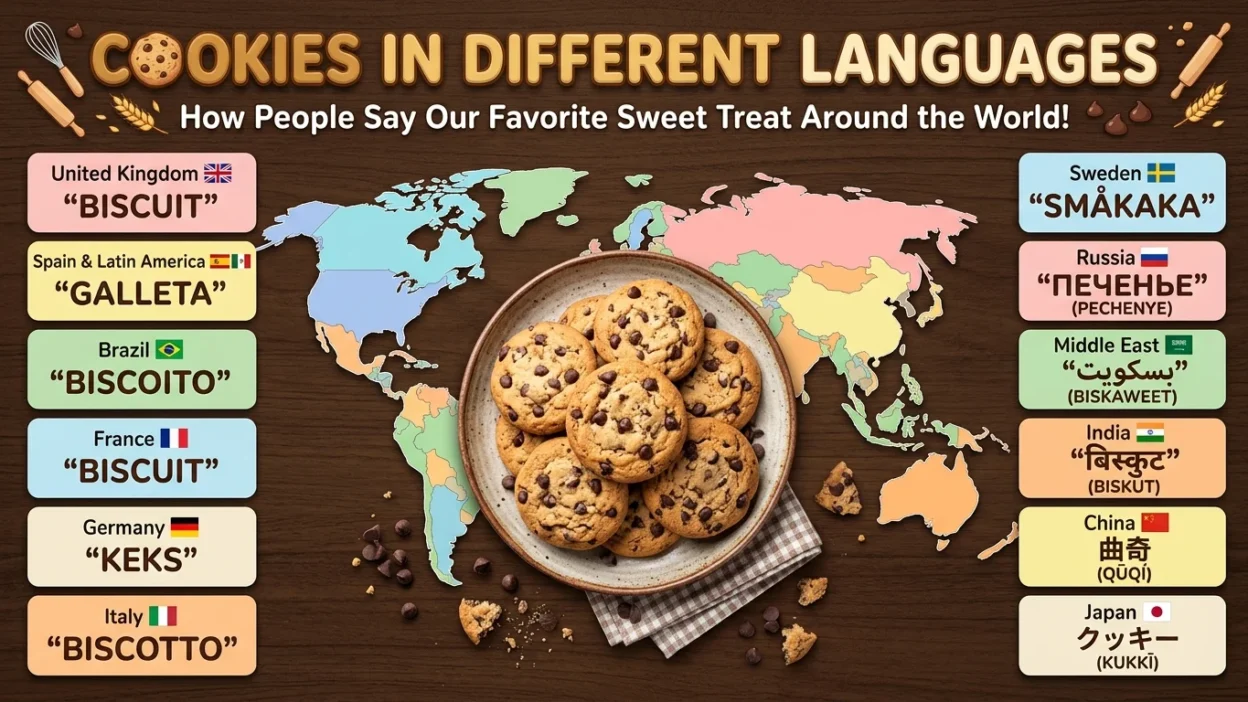
Cookies are a popular sweet treat enjoyed by people of all ages. From crunchy chocolate chip cookies to soft, buttery biscuits, every culture has its own way of making and enjoying these delicious snacks. Learning how to say cookies in different languages is a fun way to explore food vocabulary and discover cultural differences.
If you are traveling, learning a new language, or simply curious about international food names, knowing these translations can be helpful. In this guide, you will discover how people around the world say cookies in their native languages, along with easy pronunciations and interesting facts.
Quick Answer
Cookies are called different names around the world. Common translations include galletas in Spanish, biscuits in French, Kekse in German, biscotti in Italian, and kukis in Indonesian.
Cookies in Different Languages Around the World
Here are 50 translations of the word cookies in different languages, including native spellings and simple English pronunciations.
| Language | Native Word | Pronunciation |
|---|---|---|
| Spanish | Galletas | gah-YEH-tahs |
| French | Biscuits | bis-KWEE |
| German | Kekse | KEK-suh |
| Italian | Biscotti | bee-SKOT-tee |
| Portuguese | Biscoitos | bees-KOY-toos |
| Dutch | Koekjes | KOOK-yuhs |
| Swedish | Kakor | KAH-kor |
| Norwegian | Kjeks | SHEKS |
| Danish | Småkager | SMOH-kay-er |
| Finnish | Keksit | KEK-sit |
| Polish | Ciasteczka | chah-STECH-kah |
| Russian | Печенье | pee-CHEHN-yeh |
| Ukrainian | Печиво | peh-CHEE-vo |
| Greek | Μπισκότα | bees-KOH-tah |
| Turkish | Kurabiyeler | koo-rah-bee-YEH-ler |
| Arabic | بسكويت | bis-KWEET |
| Urdu | بسکٹ | BIS-kut |
| Hindi | कुकीज़ | KOO-keez |
| Bengali | কুকিজ | KOO-keez |
| Punjabi | ਬਿਸਕੁਟ | BIS-kut |
| Chinese (Mandarin) | 饼干 | bǐng gān |
| Japanese | クッキー | KUKKĪ |
| Korean | 쿠키 | KU-ki |
| Thai | คุกกี้ | KHU-KKI |
| Vietnamese | Bánh quy | BANH kwee |
| Indonesian | Kue kering | KOO-eh kuh-RING |
| Malay | Biskut | BIS-kut |
| Filipino | Biskwit | bis-KWEET |
| Swahili | Biskuti | bis-KOO-tee |
| Amharic | ብስኩት | bis-KOOT |
| Hebrew | עוגיות | oo-gee-YOT |
| Persian | بیسکویت | bis-KWEET |
| Pashto | بسکټ | bis-KUT |
| Kurdish (Sorani) | بسکویت | bis-KWIT |
| Romanian | Biscuiți | bis-KWITS |
| Hungarian | Kekszek | KEK-sek |
| Czech | Sušenky | SOO-shen-kee |
| Slovak | Sušienky | SOO-shyen-kee |
| Croatian | Keksi | KEK-see |
| Serbian | Колачићи | koh-LAH-chee-chee |
| Bulgarian | Бисквити | bis-KVEE-tee |
| Lithuanian | Sausainiai | sow-SAI-nyai |
| Latvian | Cepumi | TSEH-poo-mee |
| Estonian | Küpsised | KÜP-see-sed |
| Icelandic | Smákökur | SMOW-kur |
| Irish | Fianáin | fee-uh-NAWN |
| Welsh | Bisgedi | bis-GEH-dee |
| Afrikaans | Koekies | KOO-kees |
| Albanian | Biskota | bis-KOH-tah |
| Georgian | ორცხობილა | orts-kho-BEE-lah |
Note: Some languages use a general word for biscuits or sweet baked snacks rather than the exact English category of cookies. Pronunciations are simplified learning guides.
Why Learn Cookies in Different Languages?
Learning food vocabulary is one of the easiest ways to improve your language skills. Cookies are familiar treats, making them useful words for beginners who want to practice everyday conversations.
Knowing how to say cookies in different languages can also help when reading international menus, shopping in foreign countries, or discussing traditional desserts. It introduces you to new vocabulary while helping you understand how different cultures describe similar foods.
Cultural Significance of Cookies Around the World
Cookies have an important place in many food traditions. In some countries, people prepare special cookies during holidays, family gatherings, weddings, and religious celebrations.
For example, Italian biscotti are traditionally enjoyed with coffee, while German Christmas cookies are popular during the holiday season. Middle Eastern communities also prepare different varieties of sweet biscuits and cookies for celebrations.
These traditions show that cookies are more than everyday snacks. They represent hospitality, family connections, and cultural identity in many parts of the world.
How to Pronounce Cookie Names Correctly
Pronunciation is an important part of learning food vocabulary. Even when two languages use similar words for cookies, their sounds and accents may differ.
Start by reading the pronunciation column in the table and repeating each word slowly. Pay attention to unfamiliar sounds, vowel combinations, and syllable stress.
You can improve your pronunciation by listening to native speakers, practicing short words daily, and repeating complete sentences. Remember that pronunciation guides are approximate because English spelling cannot represent every sound in another language perfectly.
Different Types of Cookies and Their Names
Cookies come in countless shapes, flavors, and textures. Some are soft and chewy, while others are crispy, crunchy, or filled with delicious ingredients.
Popular varieties include chocolate chip cookies, oatmeal cookies, sugar cookies, butter cookies, gingerbread cookies, and peanut butter cookies. Different countries also have their own traditional baked treats that may be classified as biscuits or cookies.
Learning these food names alongside international translations can expand your vocabulary. It also makes it easier to recognize different cookie varieties when exploring international bakeries and dessert menus.
Common Ingredients Used in Cookies Worldwide
Although cookie recipes differ between countries, many traditional varieties share similar ingredients. Flour, sugar, butter, eggs, and baking powder are commonly used to create basic cookie dough.
Chocolate chips, vanilla, cinnamon, nuts, dried fruits, and honey are popular additions that create different flavors. Some recipes also use coconut, oats, or alternative ingredients to suit particular dietary preferences.
Understanding these ingredients can help language learners recognize food descriptions on international packaging. It is also useful when ordering cookies or discussing recipes with people from other cultures.
Interesting Facts About Cookies in Different Cultures
Cookies have fascinating histories and traditions. The English word cookie comes from the Dutch word koekje, which means a little cake. This connection reflects the influence of European baking traditions on modern food vocabulary.
In the United States, chocolate chip cookies are among the most recognizable varieties. In Italy, biscotti are famous for their crunchy texture, while France is known for delicate biscuits and other baked treats.
Different countries have developed unique recipes based on local ingredients, traditions, and tastes. These differences make international cookie culture interesting to explore.
How to Use Cookie Vocabulary in Everyday Conversations
Learning the word for cookies in another language becomes more useful when you practice it in everyday situations. You can use food vocabulary when ordering desserts, shopping at bakeries, or talking about your favorite snacks.
For example, you might ask for chocolate cookies, describe a sweet biscuit, or tell someone which flavors you enjoy. Try combining cookie names with simple words such as sweet, crunchy, soft, and delicious.
Practicing short sentences can improve your confidence and help you remember vocabulary naturally. It also makes conversations with international friends more enjoyable.
Easy Tips for Remembering Cookie Translations
Memorizing 50 translations may seem difficult, but using simple learning techniques can make the process easier. Start with five languages and practice their words every day before moving to another group.
Create flashcards with the language name on one side and its cookie translation on the other. You can also connect unfamiliar words with pictures of different cookie varieties.
Another useful technique is to group similar words together. For example, several European languages use words related to biscuits. Regular practice, reading, and speaking will help you remember these translations for longer.
Key Takeaways
- Cookies have different names depending on the language and culture.
- Spanish uses Galletas, while German uses Kekse.
- Many languages use words related to biscuits or baked snacks.
- Cookies are connected with celebrations, traditions, and family gatherings worldwide.
- Practicing international food vocabulary can improve communication and language-learning skills.
Conclusion
Exploring cookies in different languages is a delicious way to discover new words and learn about cultures around the world. From Spanish galletas to German Kekse and Italian biscotti, every language offers a unique expression for these popular treats. Learning these translations can make traveling, shopping, and communicating more enjoyable. Whether you are a language learner, food enthusiast, or simply curious about international vocabulary, this collection of 50 translations provides a helpful starting point for exploring how people around the world talk about cookies.
FAQs:
1. How do you say cookies in Spanish?
Cookies are called galletas in Spanish. The word is commonly used in Spain and many Latin American countries. It generally refers to sweet biscuits or cookies and is useful when ordering snacks, shopping for baked goods, or discussing desserts in Spanish-speaking communities.
2. What is the French word for cookies?
The French word commonly used for cookies is biscuits. However, France also has specific names for different baked treats. For example, sablés are buttery cookies, while other varieties have their own traditional names depending on their ingredients, texture, and preparation methods.
3. How do you say cookies in Japanese?
Cookies are called クッキー (kukkī) in Japanese. This word is commonly used for Western-style cookies, including chocolate chip and butter cookies. Japanese bakeries and supermarkets offer many cookie varieties, making this a useful word for travelers and people learning Japanese.
4. What is the difference between cookies and biscuits?
Cookies and biscuits are both baked treats, but their meanings vary by country. In American English, cookies generally refer to sweet baked snacks, while biscuits usually describe soft bread-like foods. In British English, biscuits commonly refers to what Americans call cookies.
5. Why do cookies have different names in different languages?
Cookies have different names because languages develop their own vocabulary through history, culture, and regional food traditions. Some names come from local baking methods, while others are borrowed from foreign languages. These differences make international food vocabulary interesting to learn.

Olivia Riley is a passionate content administrator at Diflingo, where she manages and publishes high-quality articles focused on what to say in everyday conversations, special occasions, professional settings, and personal relationships. She ensures every guide is clear, practical, engaging, and helpful for readers.