Learning Merry Christmas in different languages is a wonderful way to spread holiday cheer and connect with people from different cultures. Whether you’re traveling during the Christmas season, sending greeting cards, sharing festive messages on social media or celebrating with international friends and family, wishing someone a Merry Christmas in their native language makes your greeting more meaningful and memorable.
In this guide, you’ll discover Merry Christmas in different languages with native spellings and easy English pronunciations. You’ll also learn why Christmas greetings are important, when to use them and practical tips for remembering these festive expressions from around the world.
Quick Answer
Merry Christmas in different languages includes festive greetings used worldwide to celebrate Christmas and share joy, peace, and goodwill. Learning these expressions helps you communicate warmly, appreciate different cultures, and make holiday celebrations more meaningful.
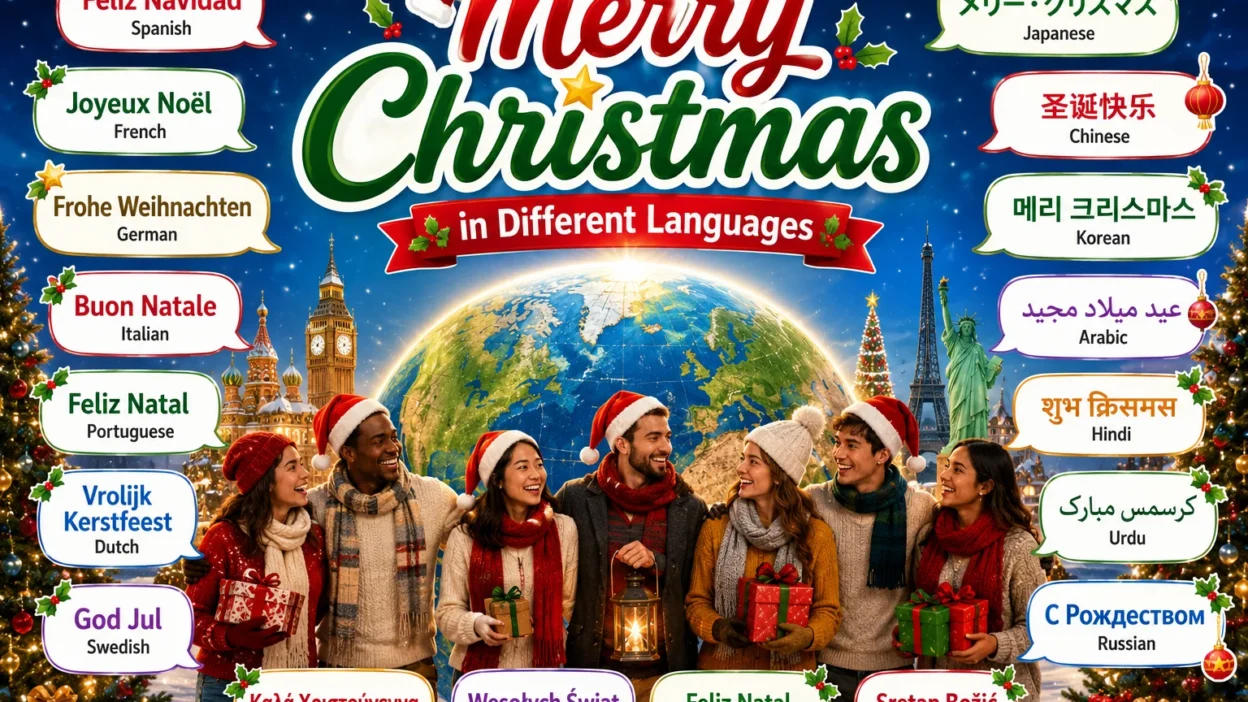
Merry Christmas in Different Languages Around the World
| Language | Native Word | Pronunciation |
|---|---|---|
| English | Merry Christmas | Merry Christmas |
| Spanish | Feliz Navidad | Feh-LEES Na-vee-DAD |
| French | Joyeux Noël | Zhwa-YUH No-EL |
| German | Frohe Weihnachten | FROH-uh VINE-ak-ten |
| Italian | Buon Natale | Bwon Na-TA-le |
| Portuguese | Feliz Natal | Feh-LEES Na-TAU |
| Dutch | Vrolijk Kerstfeest | VRO-lik Kerst-fest |
| Swedish | God Jul | Goo Yool |
| Norwegian | God Jul | Goo Yool |
| Danish | Glædelig Jul | GLEH-de-lig Yool |
| Finnish | Hyvää joulua | HUU-vaa YO-lu-a |
| Icelandic | Gleðileg jól | GLETH-i-leg Yole |
| Polish | Wesołych Świąt | Ve-SO-wikh SHFYONT |
| Czech | Veselé Vánoce | VE-se-le VAA-no-tse |
| Slovak | Veselé Vianoce | VE-se-le VEE-a-no-tse |
| Hungarian | Boldog karácsonyt | BOL-dog Ka-RAA-cho-nyit |
| Romanian | Crăciun fericit | Kru-CHOON Fe-ri-CHEET |
| Greek | Καλά Χριστούγεννα | Ka-LA Hri-STOO-yen-na |
| Russian | С Рождеством | S Razh-de-STVOM |
| Ukrainian | Веселого Різдва | Ve-se-LO-ho Riz-DVA |
| Bulgarian | Весела Коледа | Ve-SE-la Ko-LE-da |
| Serbian | Срећан Божић | SRE-chan BO-zhich |
| Croatian | Sretan Božić | SRE-tan BO-zhich |
| Turkish | Mutlu Noeller | Moot-loo No-el-ler |
| Arabic | عيد ميلاد مجيد | Eid Milad Majid |
| Hebrew | חג מולד שמח | Hag Mo-lad Sa-me-ach |
| Persian | کریسمس مبارک | Christmas Mobarak |
| Hindi | मेरी क्रिसमस | Merry Christmas |
| Urdu | میری کرسمس | Merry Christmas |
| Punjabi | ਮੇਰੀ ਕਰਿਸਮਸ | Merry Christmas |
| Bengali | শুভ বড়দিন | Shubho Borodin |
| Gujarati | મેરી ક્રિસમસ | Merry Christmas |
| Marathi | मेरी ख्रिसमस | Merry Christmas |
| Tamil | கிறிஸ்துமஸ் வாழ்த்துகள் | Kiristhumas Vaazhthukkal |
| Telugu | క్రిస్మస్ శుభాకాంక్షలు | Christmas Shubhakankshalu |
| Kannada | ಕ್ರಿಸ್ಮಸ್ ಶುಭಾಶಯಗಳು | Christmas Shubhashayagalu |
| Malayalam | ക്രിസ്മസ് ആശംസകൾ | Christmas Aashamsakal |
| Nepali | मेरी क्रिसमस | Merry Christmas |
| Sinhala | සුභ නත්තලක් | Suba Naththalak |
| Thai | สุขสันต์วันคริสต์มาส | Sook-san Wan Christmas |
| Vietnamese | Giáng sinh vui vẻ | Zang Sinh Vui Veh |
| Indonesian | Selamat Hari Natal | Se-la-mat Ha-ri Na-tal |
| Malay | Selamat Hari Krismas | Se-la-mat Ha-ri Kris-mas |
| Filipino | Maligayang Pasko | Ma-li-ga-yang Pas-ko |
| Chinese (Mandarin) | 圣诞快乐 | Sheng Dan Kuai Le |
| Japanese | メリークリスマス | Merii Kurisumasu |
| Korean | 메리 크리스마스 | Me-ri Keu-ri-seu-ma-seu |
| Swahili | Heri ya Krismasi | He-ri Ya Kris-ma-si |
| Hawaiian | Mele Kalikimaka | Meh-leh Ka-li-ki-ma-ka |
| Māori | Meri Kirihimete | Meh-ri Ki-ri-hi-me-te |
Why Learn “Merry Christmas” in Different Languages?
Learning Merry Christmas in different languages is a thoughtful way to celebrate one of the world’s most popular holidays while showing respect for different cultures. Wishing someone a Merry Christmas in their native language makes your greeting feel more personal and memorable. It also demonstrates kindness, cultural awareness, and appreciation for traditions around the world.
These festive greetings are useful for travelers, teachers, students, businesses, and anyone with international friends or family. Whether you’re writing greeting cards, sending holiday emails, posting on social media, or celebrating in person, using the local Christmas greeting helps create stronger connections and spreads holiday joy.
Common Uses of “Merry Christmas” Around the World
People exchange Merry Christmas greetings throughout the holiday season in many different ways. Families and friends say it during Christmas gatherings, churches use it during holiday services, and businesses include it in seasonal advertisements and promotional campaigns. It is also commonly written in greeting cards, gift tags, emails, text messages, and social media posts to spread joy and appreciation.
In many countries, Christmas greetings are shared alongside gift exchanges, festive meals, Christmas trees, and charitable activities. Some cultures begin exchanging these wishes weeks before December 25, while others continue celebrating into early January. Learning the local greeting allows you to participate more naturally in these traditions and makes your holiday wishes feel even more sincere.
Pronunciation Tips for Beginners
Learning the pronunciation of Merry Christmas in different languages is easier when you practice a few greetings at a time. Listen to native speakers through language-learning apps, videos, or online dictionaries, then repeat each phrase slowly. Focus on pronunciation, rhythm, and word stress instead of translating every word literally. Regular practice helps you sound more confident and natural.
Grouping similar languages together can also make learning easier. For example, Spanish, Portuguese, Italian, and French Christmas greetings share similar pronunciation patterns. Flashcards, daily repetition, and speaking the greetings aloud are excellent ways to improve your memory and pronunciation before the holiday season.
Interesting Facts About Christmas Greetings
Although the English phrase “Merry Christmas” is recognized worldwide, many countries use greetings that literally mean “Happy Christmas,” “Blessed Christmas,” or “Joyful Christmas.” These differences reflect each country’s language, traditions, and religious customs while sharing the same message of peace, love, and goodwill.
Another interesting fact is that some Christmas greetings have become internationally famous through music and popular culture. For example, “Feliz Navidad” became globally recognized because of the classic Christmas song by José Feliciano, while “Mele Kalikimaka” is the traditional Hawaiian Christmas greeting made famous through holiday music. These festive expressions continue to bring people together across cultures every holiday season.
Conclusion
Learning Merry Christmas in different languages is a meaningful way to celebrate the holiday season while connecting with people from around the world. Whether you’re traveling, sending greeting cards, posting festive messages online or celebrating with international friends and family, using a Christmas greeting in someone’s native language shows thoughtfulness and cultural appreciation. These translations help spread kindness, strengthen relationships and make holiday celebrations even more memorable. Practice a few greetings each year and you’ll be ready to share the spirit of Christmas wherever you go.
Frequently Asked Questions
1. Why should I learn Merry Christmas in different languages?
Learning Christmas greetings helps you celebrate with people from different cultures, show respect for their traditions, and make your holiday wishes feel more personal and meaningful.
2. Which languages have the most popular Merry Christmas greetings?
Some of the most recognized greetings include Feliz Navidad (Spanish), Joyeux Noël (French), Buon Natale (Italian), Frohe Weihnachten (German), and 圣诞快乐 (Chinese). These are widely used during the Christmas season.
3. Can I use these greetings while traveling during Christmas?
Yes. Using the local Christmas greeting is a thoughtful gesture that is appreciated in most countries. It helps you connect with local people and participate naturally in holiday celebrations.
4. Are Christmas greetings the same in every language?
No. While they all express holiday wishes, many languages use different words that translate to “Happy Christmas,” “Blessed Christmas,” or “Joyful Christmas.” The wording varies according to each language and culture.
5. What is the easiest way to remember Merry Christmas in different languages?
Practice a few greetings each day, repeat them aloud, group similar languages together, and listen to native speakers. Flashcards and holiday cards are also excellent tools for remembering festive expressions.