
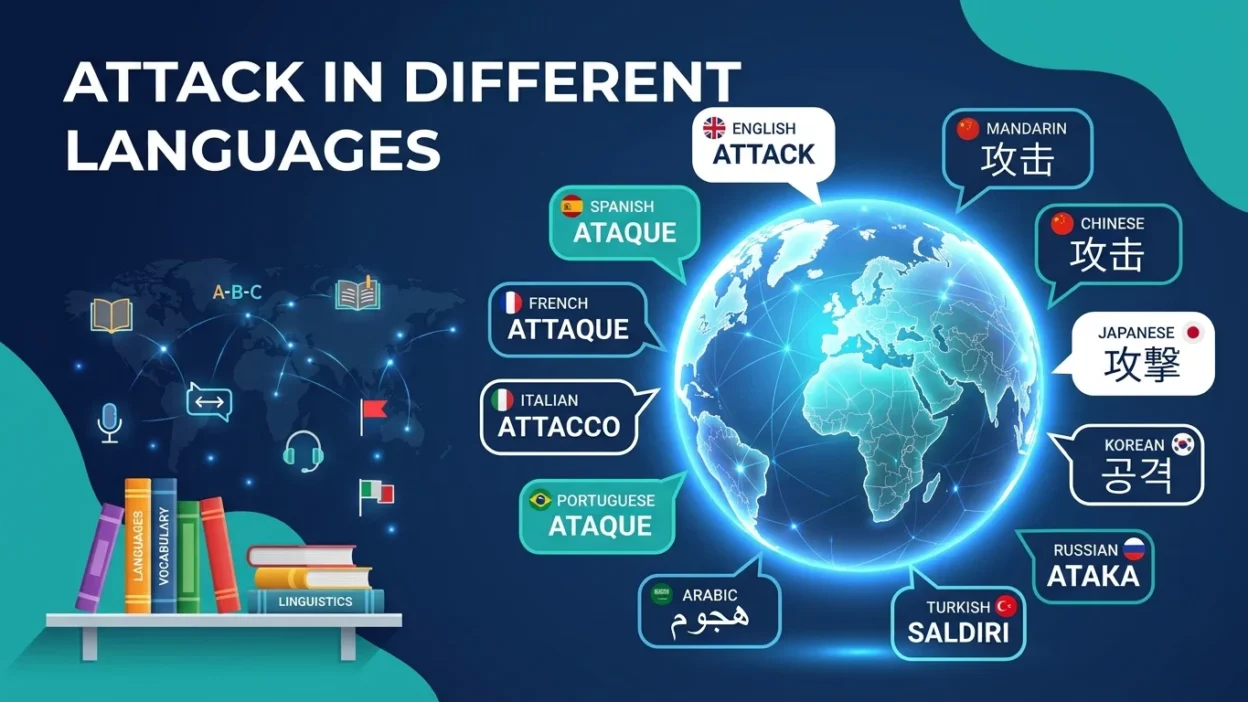
Learning attack in different languages is useful for expanding your vocabulary and understanding how this common word appears in books, news reports, history, sports, movies and everyday conversations. Depending on the context, attack can describe a military action, a sports strategy, a verbal criticism or a medical event such as a heart attack.
In this guide, you’ll discover attack in different languages with native spellings and easy English pronunciations. You’ll also learn why this word is important, where it’s commonly used and practical tips for understanding its different meanings across languages and cultures.
Quick Answer
Attack in different languages includes translations of a widely used word that describes an offensive action, criticism, or aggressive move. Learning these translations improves vocabulary, reading comprehension, and communication across different languages.
Attack in Different Languages Around the World
| Language | Native Word | Pronunciation |
|---|---|---|
| English | Attack | Uh-TACK |
| Spanish | Ataque | Ah-TAH-keh |
| French | Attaque | Ah-TAK |
| German | Angriff | AN-grif |
| Italian | Attacco | At-TAK-ko |
| Portuguese | Ataque | Ah-TAH-kee |
| Dutch | Aanval | AAN-val |
| Swedish | Attack | At-TAK |
| Norwegian | Angrep | AN-grep |
| Danish | Angreb | AN-greb |
| Finnish | Hyökkäys | HUUK-ka-ys |
| Icelandic | Árás | OW-ras |
| Polish | Atak | AH-tak |
| Czech | Útok | OO-tok |
| Slovak | Útok | OO-tok |
| Hungarian | Támadás | TAA-ma-daash |
| Romanian | Atac | Ah-TAK |
| Greek | Επίθεση | E-PEE-the-see |
| Russian | Атака | Ah-TA-ka |
| Ukrainian | Атака | Ah-TA-ka |
| Bulgarian | Атака | Ah-TA-ka |
| Serbian | Напад | Na-pad |
| Croatian | Napad | Na-pad |
| Turkish | Saldırı | Sal-duh-ruh |
| Arabic | هجوم | Hu-joom |
| Hebrew | התקפה | Hat-ka-fa |
| Persian | حمله | Ham-leh |
| Hindi | हमला | Ham-la |
| Urdu | حملہ | Ham-la |
| Punjabi | ਹਮਲਾ | Ham-la |
| Bengali | আক্রমণ | A-kro-mon |
| Gujarati | હુમલો | Hoom-lo |
| Marathi | हल्ला | Hal-la |
| Tamil | தாக்குதல் | Thaak-ku-thal |
| Telugu | దాడి | Daa-di |
| Kannada | ದಾಳಿ | Daa-li |
| Malayalam | ആക്രമണം | Aak-ra-ma-nam |
| Nepali | आक्रमण | Aa-kra-man |
| Sinhala | ප්රහාරය | Pra-ha-ra-ya |
| Thai | การโจมตี | Gaan Joam Tee |
| Vietnamese | Tấn công | Tun Kong |
| Indonesian | Serangan | Se-ra-ngan |
| Malay | Serangan | Se-ra-ngan |
| Filipino | Pag-atake | Pag A-ta-ke |
| Chinese (Mandarin) | 攻击 | Gong Ji |
| Japanese | 攻撃 | Kō-geki |
| Korean | 공격 | Gong-gyeok |
| Swahili | Shambulio | Sham-boo-lee-o |
| Hawaiian | Hoʻouka | Ho-oh-oo-ka |
| Māori | Whakaeke | Fa-ka-eh-keh |
Why Learn “Attack” in Different Languages?
Learning attack in different languages helps you understand vocabulary commonly found in news articles, history books, sports commentary, emergency information, and language-learning materials. Because the word has several meanings depending on the context, recognizing it in different languages improves both reading comprehension and communication.
For language learners, understanding this word is valuable because it appears in discussions about history, politics, military events, cybersecurity, sports, and even medicine. Knowing the correct translation also helps you distinguish between literal and figurative uses in different languages.
Common Uses of “Attack” Around the World
The word attack is used in many different contexts depending on the situation. In news reports and history books, it often refers to military actions, conflicts, or acts of violence. In sports such as football, hockey, and basketball, attack describes an offensive strategy used to score points or goals. The word also appears in technology when discussing cyberattacks, where hackers attempt to damage or gain unauthorized access to computer systems.
In everyday language, attack can also have figurative meanings. People may talk about a verbal attack when someone is criticized harshly or a panic attack and heart attack in medical contexts. Because the meaning changes with the situation, understanding the surrounding words is essential for interpreting the correct sense of the term.
Pronunciation Tips for Beginners
Learning the pronunciation of attack in different languages becomes easier when you practice a few translations each day. Listen to native speakers through language-learning apps, pronunciation dictionaries, or educational videos, then repeat each word aloud. Pay attention to stress patterns and vowel sounds rather than translating each letter individually.
Grouping similar languages together can also improve your memory. For example, Attack, Ataque, Attaque, and Attacco share similar spelling and pronunciation patterns in English, Spanish, French, and Italian. Languages with different writing systems, such as Arabic, Chinese, Japanese, Korean, and Hindi, require additional practice, but regular repetition quickly builds confidence.
Interesting Facts About the Word “Attack”
The English word attack comes from the Old Italian word attaccare, meaning to fasten, to engage, or to begin an assault. Over time, the word entered many European languages and gradually developed broader meanings that include sports, medicine, technology, and everyday communication.
Another interesting fact is that many languages use different words depending on the type of attack being described. For example, military attacks, cyberattacks, animal attacks, and verbal attacks may each have distinct vocabulary rather than a single universal term. This reflects how languages adapt to specific situations and cultural needs.
Conclusion
Learning attack in different languages helps you understand vocabulary commonly used in news, history, sports, technology and everyday communication. Whether you’re studying a foreign language, reading international articles, or expanding your vocabulary, recognizing this word in different languages improves both comprehension and communication. Regular practice with pronunciation and context will help you use these translations accurately and confidently.
Frequently Asked Questions
1. Why should I learn attack in different languages?
Learning this vocabulary helps you understand international news, historical texts, sports commentary, and everyday conversations while improving your overall language skills.
2. Does the word “attack” have the same meaning in every language?
Not always. While the general meaning is similar, many languages use different words depending on whether the attack is military, verbal, medical, digital, or related to sports.
3. Is “attack” commonly used outside military contexts?
Yes. The word is widely used in sports, medicine, cybersecurity, politics, and everyday conversations to describe different types of offensive actions or sudden events.
4. Can I use these translations while traveling?
These translations are mainly useful for understanding signs, news reports, books, conversations, and language learning. Knowing the local word can improve comprehension in various situations.
5. What is the easiest way to remember these translations?
Practice a few words daily, group similar languages together, repeat the pronunciations aloud, and review them regularly using flashcards or language learning apps.