
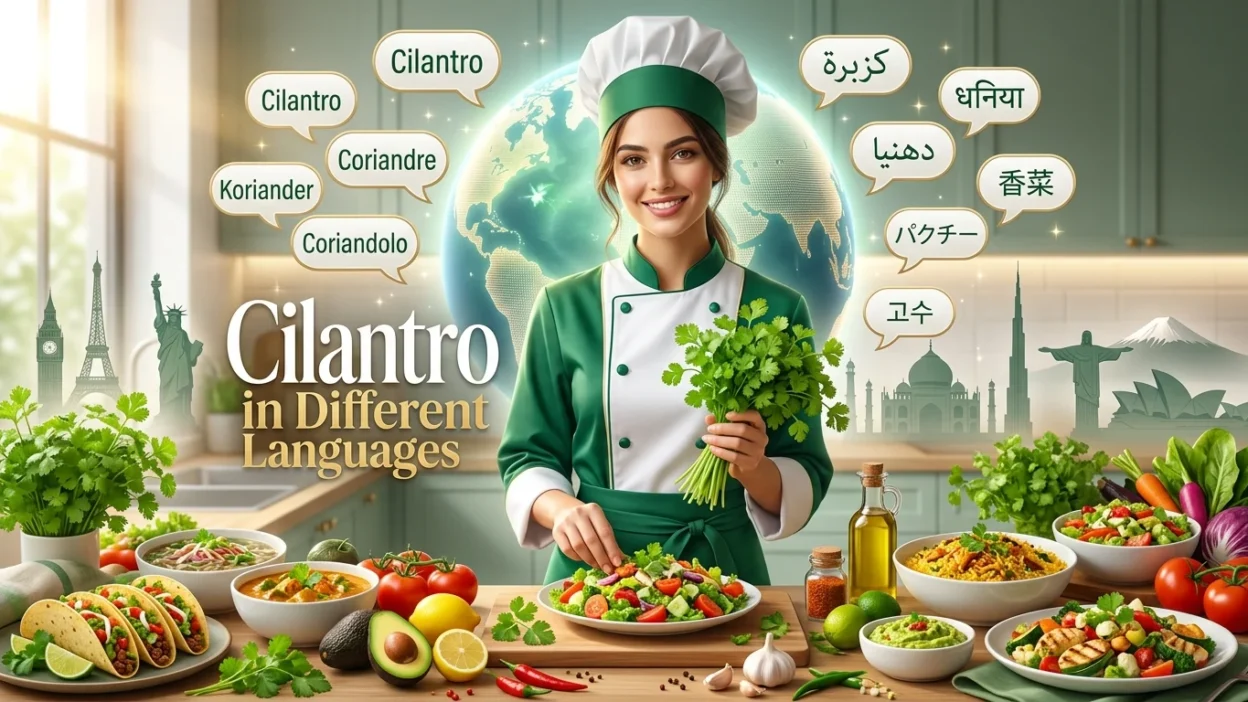
Learning cilantro in different languages is a great way to expand your food and cooking vocabulary while exploring how different cultures refer to one of the world’s most popular herbs. Cilantro, also known as coriander leaves in many countries, is widely used in Mexican, Indian, Middle Eastern, Asian and Mediterranean cuisines.
Its fresh aroma and distinctive flavor make it an essential ingredient in salads, soups, curries, sauces, and garnishes. Whether you’re traveling, learning a new language or trying international recipes, knowing how to say cilantro in different languages can make communication much easier.
In this guide, you’ll discover cilantro in different languages with native spellings and easy English pronunciations. You’ll also learn why this herb is important, where it’s commonly used and interesting facts about cilantro around the world.
Quick Answer
Cilantro in different languages includes the names used worldwide for the fresh leaves of the coriander plant. Learning these translations improves your cooking vocabulary, travel communication and cultural understanding.
Cilantro in Different Languages Around the World
| Language | Native Word | Pronunciation |
|---|---|---|
| English | Cilantro / Coriander | Si-LAN-tro / Kor-ee-AN-der |
| Spanish | Cilantro | Si-LAN-tro |
| French | Coriandre | Ko-ree-ANDR |
| German | Koriander | Ko-ree-AN-der |
| Italian | Coriandolo | Ko-ree-AN-do-lo |
| Portuguese | Coentro | Koo-EN-troo |
| Dutch | Koriander | Ko-ree-AN-der |
| Swedish | Koriander | Ko-ree-AN-der |
| Norwegian | Koriander | Ko-ree-AN-der |
| Danish | Koriander | Ko-ree-AN-der |
| Finnish | Korianteri | Ko-ree-AN-te-ri |
| Icelandic | Kóríander | Ko-ree-AN-der |
| Polish | Kolendra | Ko-LEN-dra |
| Czech | Koriandr | Ko-ree-AN-dr |
| Slovak | Koriander | Ko-ree-AN-der |
| Hungarian | Koriander | Ko-ree-AN-der |
| Romanian | Coriandru | Ko-ree-AN-droo |
| Greek | Κόλιανδρος | Ko-lee-AN-dros |
| Russian | Кинза | KEEN-za |
| Ukrainian | Кінза | KEEN-za |
| Bulgarian | Кориандър | Ko-ree-AN-dur |
| Serbian | Коријандер | Ko-ree-YAN-der |
| Croatian | Korijander | Ko-ree-YAN-der |
| Turkish | Kişniş | Kish-NISH |
| Arabic | كزبرة | Kuz-ba-ra |
| Hebrew | כוסברה | Kus-BA-ra |
| Persian | گشنیز | Gash-neez |
| Hindi | धनिया | Dha-ni-ya |
| Urdu | دھنیا | Dhania |
| Punjabi | ਧਨੀਆ | Dha-ni-aa |
| Bengali | ধনেপাতা | Dho-ne-pa-ta |
| Gujarati | ધાણા | Dha-na |
| Marathi | कोथिंबीर | Ko-thim-beer |
| Tamil | கொத்தமல்லி | Koth-tha-mal-li |
| Telugu | కొత్తిమీర | Koth-thi-mee-ra |
| Kannada | ಕೊತ್ತಂಬರಿ | Koth-tham-ba-ri |
| Malayalam | മല്ലിയില | Mal-li-yi-la |
| Nepali | धनियाँ | Dha-ni-ya |
| Sinhala | කොත්තමල්ලි | Koth-tha-mal-li |
| Thai | ผักชี | Phak Chee |
| Vietnamese | Rau mùi | Rao Moo-ee |
| Indonesian | Daun Ketumbar | Da-un Ke-tum-bar |
| Malay | Daun Ketumbar | Da-un Ke-tum-bar |
| Filipino | Kulantro | Ku-LAN-tro |
| Chinese (Mandarin) | 香菜 | Xiang Cai |
| Japanese | パクチー | Pakuchi |
| Korean | 고수 | Go-su |
| Swahili | Giligilani | Gi-li-gi-LA-ni |
| Hawaiian | Koriana | Ko-ri-a-na |
| Māori | Koriana | Ko-ri-a-na |
Why Learn “Cilantro” in Different Languages?
Learning cilantro in different languages is especially useful for travelers, home cooks, chefs, food bloggers, and language learners. Whether you’re reading recipes, ordering food in a restaurant, shopping at a local market, or discussing ingredients with someone from another country, knowing the local word for cilantro helps you communicate more confidently.
It’s also important to know that cilantro and coriander are not always used the same way around the world. In American English, cilantro usually refers to the fresh leaves, while coriander often refers to the dried seeds. In many other English speaking countries, the entire plant including both leaves and seeds is commonly called coriander.
Common Uses of “Cilantro” Around the World
Cilantro is one of the most widely used culinary herbs and appears in countless traditional recipes across the globe. In Mexican cuisine, it is commonly added to tacos, salsa, guacamole, soups, and rice dishes.
Indian cuisine uses fresh cilantro as a garnish for curries, lentils, chutneys, and biryanis, while Middle Eastern dishes often include it in salads, stews, and herb based sauces. Across Southeast Asia, cilantro is a popular ingredient in noodle soups, stir-fries, spring rolls, and seafood dishes because of its fresh, citrus like flavor. Beyond cooking, cilantro is valued in traditional herbal practices and home gardens. Many people grow it because it is easy to cultivate and can be harvested multiple times throughout the season.
The herb is rich in vitamins A, C, and K and contains antioxidants that contribute to a balanced diet. Whether you’re shopping at a grocery store, visiting a farmers’ market, or following an international recipe, knowing how to say cilantro in different languages makes communication easier and helps you identify the correct ingredient.
Pronunciation Tips for Beginners
Learning the pronunciation of cilantro in different languages becomes easier when you group similar words together. Many European languages use words derived from coriander, such as Coriandre in French, Koriander in German, Dutch, Swedish, and Norwegian, making them relatively easy to remember.
For languages that use different writing systems, including Chinese, Japanese, Korean, Arabic, Hindi and Russian, listen to native speakers through pronunciation guides or language learning apps. Repeat each translation slowly, paying attention to syllable stress and vowel sounds. Practicing a few words every day will improve both your pronunciation and confidence when speaking with native speakers.
Interesting Facts About Cilantro
Cilantro comes from the plant Coriandrum sativum, which has been cultivated for thousands of years. Archaeological evidence shows it was used in ancient Egypt, Greece, and Rome for cooking and medicinal purposes. Today, it remains one of the world’s most popular herbs and is grown on every continent except Antarctica.
One of the most interesting facts about cilantro is that not everyone experiences its flavor the same way. Some people describe it as fresh, citrusy, and refreshing, while others say it tastes like soap. Scientists believe this difference is influenced by genetics, making cilantro one of the most unique herbs in the culinary world.
Conclusion
Learning cilantro in different languages is a practical way to expand your cooking vocabulary while discovering how different cultures use this versatile herb. Whether you’re preparing international recipes, traveling abroad, shopping at local markets or learning a new language, these translations will help you communicate more naturally and confidently.
By practicing these words regularly, you’ll improve your language skills while gaining a greater appreciation for global cuisines and culinary traditions.
Frequently Asked Questions
1. Is cilantro the same as coriander?
It depends on the country. In the United States, cilantro usually refers to the fresh leaves, while coriander refers to the dried seeds. In many other countries, coriander refers to the entire plant.
2. Why should I learn cilantro in different languages?
Learning these translations helps you understand recipes, shop for ingredients, order food while traveling, and communicate with people from different cultures.
3. Which cuisines use cilantro the most?
Cilantro is widely used in Mexican, Indian, Thai, Vietnamese, Chinese, Middle Eastern, and Latin American cuisines.
4. Why do some people dislike cilantro?
Some people have a genetic variation that makes cilantro taste similar to soap, while others experience it as fresh and citrus-like.
5. What is the easiest way to remember these translations?
Practice a few languages each day, group similar words together, listen to native pronunciation, and use the vocabulary while cooking or reading recipes.

Olivia Riley is a passionate content administrator at Diflingo, where she manages and publishes high-quality articles focused on what to say in everyday conversations, special occasions, professional settings, and personal relationships. She ensures every guide is clear, practical, engaging, and helpful for readers.