
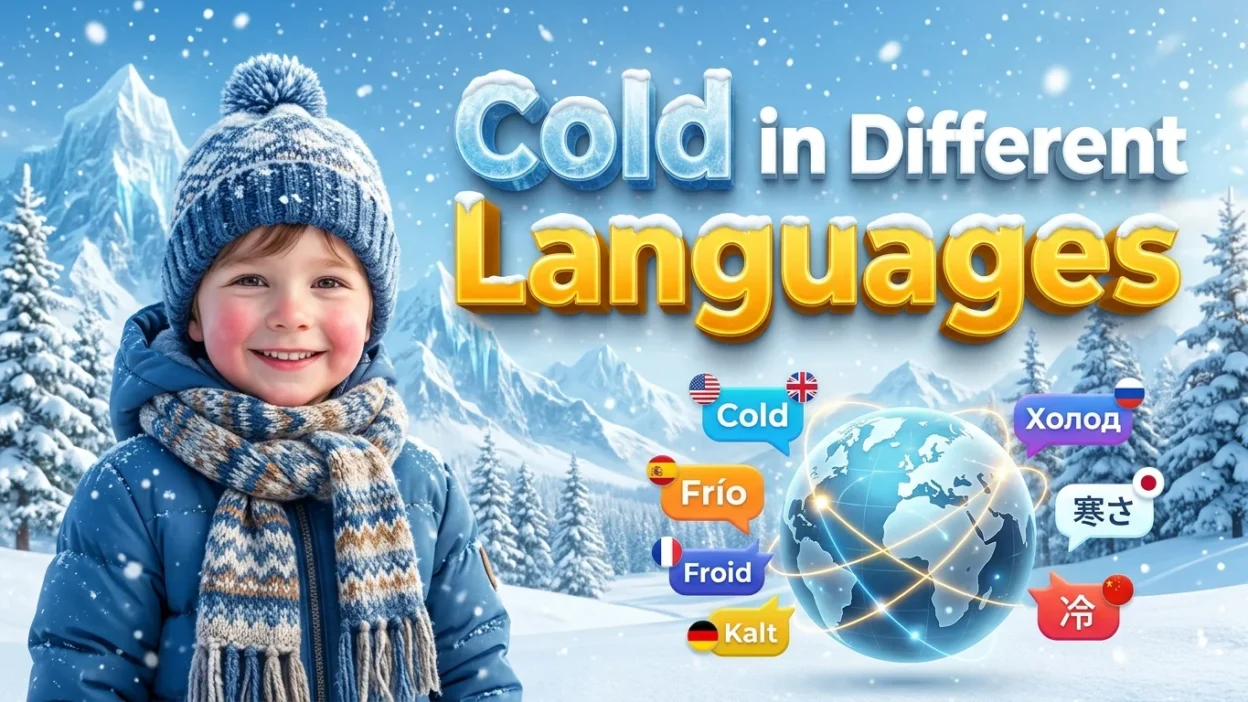
The word cold is used in everyday conversations to describe low temperatures, chilly If , and things that feel cool to the touch. Although people around the world experience cold weather, they express this simple feeling differently in their native languages.
Learning cold in different languages is a fun way to explore vocabulary, pronunciation, and cultural differences. Whether you are learning a new language, traveling abroad, studying vocabulary, or simply curious about international words, this guide introduces 50 translations of cold with easy English pronunciation.
Quick Answer
The word cold has different translations around the world. For example, it is frío in Spanish, froid in French, kalt in German, 冷たい in Japanese, and ٹھنڈا in Urdu.
Cold Around the World
Here are 50 ways to say cold in different languages, including native spellings and simple English pronunciation guides.
| Language | Native Word | Pronunciation |
|---|---|---|
| English | Cold | Kohld |
| Spanish | Frío | Free-oh |
| French | Froid | Frwah |
| German | Kalt | Kahlt |
| Italian | Freddo | Fred-doh |
| Portuguese | Frio | Free-oh |
| Dutch | Koud | Kowt |
| Swedish | Kall | Kahl |
| Norwegian | Kald | Kahl |
| Danish | Kold | Kohl |
| Finnish | Kylmä | Kuhl-ma |
| Icelandic | Kaldur | Kahl-dur |
| Russian | Холодный | Kha-lod-ny |
| Ukrainian | Холодний | Kha-lod-ny |
| Polish | Zimny | Zheem-ny |
| Czech | Studený | Stoo-deh-nee |
| Slovak | Studený | Stoo-deh-nee |
| Hungarian | Hideg | Hee-deg |
| Romanian | Rece | Reh-cheh |
| Greek | Κρύο | Kree-oh |
| Turkish | Soğuk | Soh-ook |
| Arabic | بارد | Baa-rid |
| Urdu | ٹھنڈا | Thun-da |
| Hindi | ठंडा | Thun-da |
| Bengali | ঠান্ডা | Than-da |
| Punjabi | ਠੰਢਾ | Thun-dha |
| Persian | سرد | Sard |
| Hebrew | קר | Kar |
| Chinese (Mandarin) | 冷 | Leng |
| Japanese | 寒い | Samui |
| Korean | 추운 | Chu-un |
| Thai | หนาว | Nao |
| Vietnamese | Lạnh | Lahnh |
| Indonesian | Dingin | Ding-in |
| Malay | Sejuk | Seh-jook |
| Filipino | Malamig | Ma-la-mig |
| Swahili | Baridi | Ba-ree-dee |
| Afrikaans | Koud | Kowt |
| Zulu | Kubanda | Koo-ban-da |
| Yoruba | Tútù | Too-too |
| Amharic | ቀዝቃዛ | Kez-keh-za |
| Somali | Qabow | Qa-bow |
| Irish | Fuar | Foo-er |
| Welsh | Oer | Oir |
| Scottish Gaelic | Fuar | Foo-er |
| Basque | Hotz | Hots |
| Catalan | Fred | Fret |
| Croatian | Hladan | Hla-dan |
| Serbian | Хладан | Hla-dan |
| Bulgarian | Студен | Stoo-den |
Note: Some languages use different words depending on whether cold describes weather, a person, an object, or temperature. The table provides common dictionary forms or everyday equivalents.
Why Learn Cold in Different Languages?
Learning how to say cold in other languages helps expand your everyday vocabulary. Temperature-related words are especially useful because people frequently discuss weather, seasons, clothing, and their surroundings.
This vocabulary can also make traveling easier. You can describe chilly weather, ask for warmer clothes, or explain that a drink feels cold without relying entirely on gestures.
For language learners, starting with simple descriptive words is an effective way to build confidence. Words like cold, hot, warm, and cool are practical vocabulary that you can use in countless everyday situations.
How Different Cultures Describe Cold Weather
Cold weather is experienced differently across the world. In countries with long winters, people often have several expressions for freezing temperatures, snow, ice, and chilly winds.
In warmer regions, cold weather may be discussed less frequently, making basic temperature vocabulary particularly useful when traveling abroad.
Some languages also distinguish between the feeling of cold and the actual temperature of an object. These differences show how culture, climate, and everyday experiences influence language.
Learning these expressions gives you a better understanding of how people communicate about their surroundings.
Understanding the Pronunciation of Cold
Pronunciation is an important part of learning vocabulary in another language. Even when two languages use similar words, their sounds, accents, and speaking patterns may be different.
For example, Spanish speakers pronounce frío with two clear syllables, while the French word froid has a different vowel sound. German kalt uses a firm ending consonant.
To improve your pronunciation, listen carefully to native speakers and repeat each word slowly. Pay attention to vowel sounds, syllable stress, and unfamiliar consonants.
Practicing a few words daily can make speaking more natural and comfortable.
Related Temperature Words in Different Languages
Learning the word cold becomes easier when you also understand related temperature vocabulary. Words such as hot, warm, cool, freezing, and chilly help you describe different weather conditions.
For example, Spanish uses caliente for hot and frío for cold. French uses chaud for hot and froid for cold. German uses heiß for hot and kalt for cold.
These opposite and related expressions are useful in everyday conversations. They also help language learners understand how descriptive vocabulary works in different languages.
When to Use the Word Cold in Everyday Conversations
The word cold has several practical uses in daily communication. You can use it when discussing the weather, describing food and drinks, or explaining how something feels.
For example, you might say that the weather is cold, the water is cold, or your hands feel cold. These simple sentences are useful when traveling, shopping, or talking with friends.
However, remember that some languages have different grammatical forms depending on the noun being described. Learning a few complete example sentences alongside individual words can help you use the vocabulary correctly.
Easy Tips for Remembering Foreign Temperature Words
Memorizing vocabulary from 50 languages may seem difficult, but a few simple learning techniques can make the process easier.
Start by learning five words at a time instead of trying to memorize the entire table. Write each native word beside its English meaning and practice saying it aloud.
You can also create flashcards and review them regularly. Connecting words with pictures of snow, winter clothing, or ice can improve memory.
Another useful method is to compare similar words across languages. Repeated practice and short daily learning sessions can help you remember vocabulary for longer.
Interesting Facts About the Word Cold
The word cold has interesting equivalents across different language families. Some translations look completely different, while others share similar sounds or spelling patterns.
For example, Dutch koud and Afrikaans koud are closely related. Swedish kall, Norwegian kald, and Danish kold also have noticeable similarities.
Another interesting detail is that some languages use different expressions for cold weather and cold objects. Japanese, for instance, distinguishes between samui, commonly used for cold weather, and tsumetai, used for cold objects or touch.
These differences make international vocabulary fascinating to explore.
Common Mistakes When Learning Cold in Other Languages
One common mistake is assuming that a single translation works in every situation. In many languages, the word for cold changes according to context, grammar, or the type of thing being described.
Another mistake is relying only on English pronunciation guides. These guides are helpful for beginners, but they cannot always represent the exact sounds of another language.
Learners should also avoid confusing words that describe cold weather with words that describe cold objects.
The best approach is to study vocabulary in context, listen to native speakers, and practice using complete sentences.
Benefits of Learning Temperature Vocabulary in Multiple Languages
Learning temperature-related vocabulary offers several benefits for language learners and travelers. It makes everyday conversations easier and helps you communicate basic needs in unfamiliar places.
You can understand weather forecasts, describe uncomfortable temperatures, and recognize common expressions used by native speakers.
It also improves your overall vocabulary because temperature words are connected to many other topics, including seasons, clothing, food, and nature.
Exploring these words in different languages can increase cultural awareness and encourage you to learn more international expressions.
Key Takeaways
- Cold has different translations and pronunciations across 50 languages.
- Spanish uses frío, French uses froid, and German uses kalt.
- Some languages have separate words for cold weather and cold objects.
- Practicing pronunciation and everyday sentences improves vocabulary.
- Learning temperature words makes international communication easier.
Conclusion
Learning cold in different languages is a simple and enjoyable way to explore international vocabulary and cultural differences. From Spanish frío to French froid and German kalt, each language has its own way of describing low temperatures. Understanding these translations can help with travel, everyday conversations, and language learning. By practicing native spellings, pronunciation, and related temperature expressions, you can gradually improve your communication skills and discover how people around the world describe the feeling of cold.
FAQs:
1. How do you say cold in different languages?
Cold is expressed differently across languages. Some common translations include frío in Spanish, froid in French, kalt in German, freddo in Italian, and 冷 in Mandarin Chinese. Each word has its own pronunciation and grammatical usage.
2. What is the word for cold in Spanish?
The Spanish word for cold is frío. It is commonly used to describe cold weather, chilly conditions, and low temperatures. For example, you can say Hace frío to mean that it is cold outside.
3. How do you say cold in French?
The French word for cold is froid. It is generally used when describing cold weather or temperatures. French speakers may also use froide when the word needs to agree with a feminine noun.
4. What is cold in Japanese?
Japanese uses 寒い (samui) to describe cold weather or feeling cold. Another word, 冷たい (tsumetai), describes something cold to the touch, such as cold water or ice.
5. Why does cold have different words in different languages?
Languages develop through different histories, cultures, and grammatical systems. As a result, each language develops its own vocabulary for describing temperature. Some languages also distinguish between cold weather, cold objects, and the physical sensation of feeling cold.