
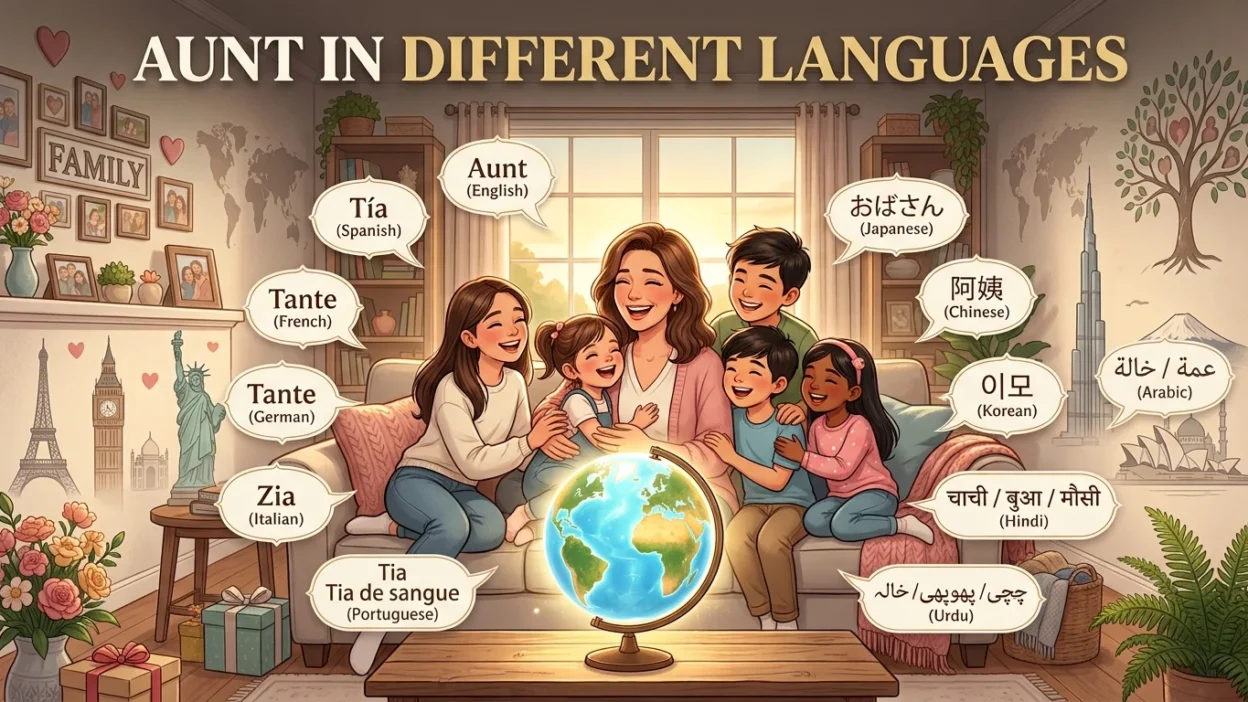
Learning aunt in different languages is a great way to expand your family related vocabulary while discovering how different cultures refer to one of the most important family members. Whether you’re learning a new language, traveling abroad, researching your family heritage or simply curious about global languages, knowing how to say aunt in different languages can help you communicate more naturally and respectfully.
In this guide, you’ll discover aunt in different languages with native spellings and easy English pronunciations. You’ll also learn why this word is useful, when to use it and interesting facts about how the role of an aunt is viewed in different cultures.
Quick Answer
Aunt in different languages includes the words used around the world to refer to your mother’s or father’s sister, or the wife of your uncle. Learning these translations improves your family vocabulary, strengthens cultural understanding and helps you communicate confidently in everyday conversations.
Aunt in Different Languages Around the World
| Language | Native Word | Pronunciation |
|---|---|---|
| English | Aunt | Ant |
| Spanish | Tía | TEE-ah |
| French | Tante | TAHNT |
| German | Tante | TAHN-tuh |
| Italian | Zia | ZEE-ah |
| Portuguese | Tia | TEE-ah |
| Dutch | Tante | TAHN-tuh |
| Swedish | Faster / Moster | FAS-ter / MOS-ter |
| Norwegian | Tante | TAHN-teh |
| Danish | Tante | TAHN-teh |
| Finnish | Täti | TAE-tee |
| Icelandic | Frænka | FRINE-ka |
| Polish | Ciocia | CHO-cha |
| Czech | Teta | TEH-ta |
| Slovak | Teta | TEH-ta |
| Hungarian | Néni | NAY-nee |
| Romanian | Mătușă | Muh-TOO-sha |
| Greek | Θεία | THEE-ah |
| Russian | Тётя | TYO-tya |
| Ukrainian | Тітка | TEET-ka |
| Bulgarian | Леля | LEH-lya |
| Serbian | Тетка | TET-ka |
| Croatian | Teta | TEH-ta |
| Turkish | Teyze / Hala | TAY-zeh / HA-la |
| Arabic | عمة / خالة | Amma / Khala |
| Hebrew | דודה | DO-da |
| Persian | عمه / خاله | Ameh / Khaleh |
| Hindi | चाची / बुआ / मौसी | Chachi / Bua / Mausi |
| Urdu | چچی / پھوپھی / خالہ | Chachi / Phuppi / Khala |
| Punjabi | ਚਾਚੀ / ਭੂਆ / ਮਾਸੀ | Chachi / Bhua / Masi |
| Bengali | পিসি / মাসি | Pishi / Mashi |
| Gujarati | કાકી / ફોઈ / માસી | Kaki / Foi / Masi |
| Marathi | काकू / आत्या / मावशी | Kaku / Aatya / Mavshi |
| Tamil | அத்தை / சித்தி | Athai / Chithi |
| Telugu | అత్త / పిన్ని | Atta / Pinni |
| Kannada | ಅತ್ತೆ / ಚಿಕ್ಕಮ್ಮ | Atte / Chikkamma |
| Malayalam | അമ്മായി | Ammayi |
| Nepali | फुपू / माइजु | Phupu / Maiju |
| Sinhala | නැන්දා | Nenda |
| Thai | ป้า | Paa |
| Vietnamese | Cô / Dì | Koh / Zee |
| Indonesian | Bibi | Bee-bee |
| Malay | Mak Cik | Mak Cheek |
| Filipino | Tiya | Tee-ya |
| Chinese (Mandarin) | 阿姨 / 姑妈 | A-Yi / Gu-Ma |
| Japanese | おばさん | Oba-san |
| Korean | 이모 / 고모 | Ee-mo / Go-mo |
| Swahili | Shangazi | Shan-GAH-zee |
| Hawaiian | ʻAnake | Ah-na-keh |
| Māori | Whaea | Fa-eh-ah |
Why Learn “Aunt” in Different Languages?
Learning aunt in different languages helps you communicate more naturally when talking about family relationships. Family vocabulary is among the first topics taught in language classes because it is useful in everyday conversations, introductions, and cultural exchanges. Knowing the correct word for aunt also helps you understand family structures and traditions in different countries.
Interestingly, many languages have separate words for a maternal aunt and a paternal aunt. Unlike English, which uses a single word, languages such as Hindi, Urdu, Punjabi, Chinese, Turkish, and Arabic distinguish between relatives from the mother’s and father’s sides of the family. Learning these differences provides deeper insight into family traditions and cultural values.
Common Uses of “Aunt” Around the World
The word aunt is commonly used in everyday conversations when talking about family members, introducing relatives, sharing family stories, or describing relationships. Whether you’re attending a family gathering, visiting relatives, filling out family records, or learning a foreign language, knowing how to say aunt in different languages makes communication more natural and meaningful.
In many cultures, the word aunt is also used as a respectful title for older women who are close family friends or respected members of the community, even if they are not biologically related. This tradition reflects the importance of family values, respect for elders, and strong community bonds in many societies around the world.
Pronunciation Tips for Beginners
Learning the pronunciation of aunt in different languages becomes much easier when you practice a few translations each day. Listen to native speakers through language-learning apps, pronunciation dictionaries, or educational videos, then repeat each word slowly. Focus on speaking clearly and paying attention to vowel sounds, as they often vary between languages.
It also helps to group similar languages together. For example, Spanish Tía, Portuguese Tia, and Italian Zia are relatively easy to remember because they have similar sounds. Likewise, German Tante, French Tante, and Dutch Tante share nearly identical pronunciations. Using flashcards and practicing with family-related vocabulary will help you remember these words more quickly.
Interesting Facts About “Aunt” Around the World
One of the most interesting facts about the word aunt is that many languages distinguish between a maternal aunt and a paternal aunt. For example, Hindi, Urdu, Punjabi, Turkish, Chinese, and Arabic use different words depending on whether the aunt is related through the mother’s or father’s side of the family. These distinctions reflect the importance of family relationships in many cultures.
Another fascinating fact is that in several countries, children affectionately call teachers, neighbors, or close family friends Aunt as a sign of respect rather than biological relationship. This practice is especially common in many Asian, African, and Middle Eastern cultures, where community and extended family play an important role in daily life.
Conclusion
Learning aunt in different languages is a practical way to improve your family vocabulary while gaining insight into cultures around the world. Whether you’re studying a new language, traveling abroad, researching your heritage or speaking with international friends, knowing how to say aunt helps you communicate more naturally and respectfully. Since family is an essential part of every culture, these translations provide both useful language skills and a deeper appreciation for global traditions.
Frequently Asked Questions
1. Why should I learn aunt in different languages?
Learning family vocabulary makes everyday conversations easier and helps you communicate naturally while traveling, studying languages, or talking with international friends.
2. Do all languages use one word for aunt?
No. Many languages have separate words for a maternal aunt and a paternal aunt, while English generally uses the single word aunt for both.
3. Which languages have different words for mother’s and father’s sisters?
Languages such as Hindi, Urdu, Punjabi, Turkish, Chinese, Arabic, Bengali, Gujarati, Marathi, Tamil, Telugu, and Korean distinguish between maternal and paternal aunts.
4. Can the word “aunt” refer to someone who is not a relative?
Yes. In many cultures, aunt is used as a respectful title for older women, family friends, neighbors, or community members, even when there is no biological relationship.
5. What is the easiest way to remember these translations?
Practice a few words every day, group similar languages together, listen to native pronunciation, and use family conversations or flashcards to reinforce your memory.