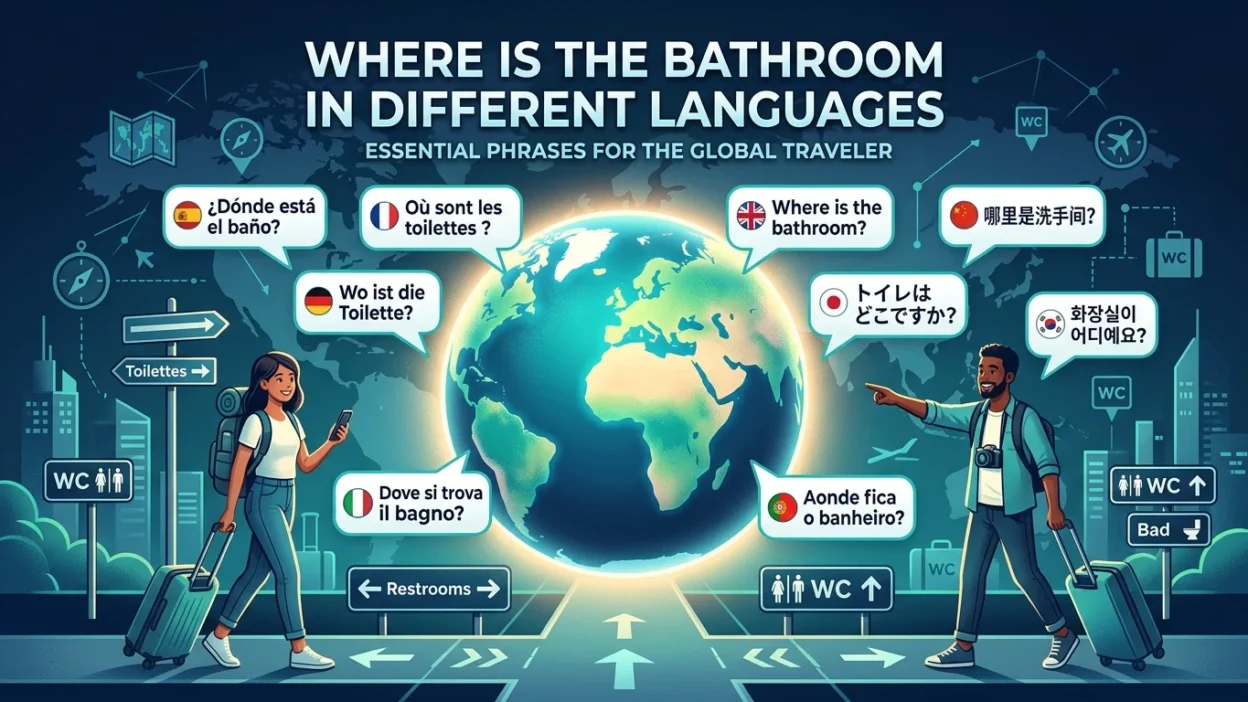
Learning where is the bathroom in different languages is one of the most practical skills for travelers, students and anyone visiting a foreign country. Whether you’re at an airport, hotel, restaurant, shopping mall or tourist attraction, knowing how to politely ask for the bathroom can make your journey much more comfortable and stress free.
In this guide, you’ll discover where is the bathroom in different languages with native spellings and easy English pronunciations. You’ll also learn why this phrase is essential, when to use it and practical tips for asking politely while traveling or communicating with people from different cultures.
Quick Answer
Where is the bathroom in different languages includes polite questions used around the world to ask for the location of a restroom or toilet. Learning these expressions makes traveling easier, improves communication, and helps you navigate unfamiliar places confidently.
Where Is the Bathroom in Different Languages Around the World
| Language | Native Word | Pronunciation |
|---|---|---|
| English | Where is the bathroom? | Where Is the Bathroom |
| Spanish | ¿Dónde está el baño? | DON-day Es-TA El BAN-yo |
| French | Où sont les toilettes ? | Oo Son Lay Twa-LET |
| German | Wo ist die Toilette? | Vo Ist Dee Toy-LET-te |
| Italian | Dov’è il bagno? | Do-VE Il BAN-yo |
| Portuguese | Onde fica o banheiro? | ON-je FEE-ka Oo Ban-YAY-ro |
| Dutch | Waar is de wc? | Vaar Is De Vay-Say |
| Swedish | Var är toaletten? | Var Air Toa-let-ten |
| Norwegian | Hvor er toalettet? | Vor Er Toa-let-tet |
| Danish | Hvor er toilettet? | Vor Er Toy-let-tet |
| Finnish | Missä on vessa? | Mis-sa On Ves-sa |
| Icelandic | Hvar er salernið? | Kvar Er Sa-ler-nith |
| Polish | Gdzie jest toaleta? | Gje Yes Toa-LE-ta |
| Czech | Kde je toaleta? | Kde Ye Toa-LE-ta |
| Slovak | Kde je toaleta? | Kde Ye Toa-LE-ta |
| Hungarian | Hol van a mosdó? | Hol Van A Mosh-do |
| Romanian | Unde este baia? | OON-de Es-te Ba-ya |
| Greek | Πού είναι η τουαλέτα; | Poo EE-ne Ee Too-a-LE-ta |
| Russian | Где туалет? | Gdye Too-a-LYET |
| Ukrainian | Де туалет? | De Too-a-LYET |
| Bulgarian | Къде е тоалетната? | Ka-de E Toa-let-na-ta |
| Serbian | Где је тоалет? | Gde Ye Toa-let |
| Croatian | Gdje je toalet? | Gdye Ye Toa-let |
| Turkish | Tuvalet nerede? | Too-va-let Ne-re-de |
| Arabic | أين الحمام؟ | Ayn Al-Hammam |
| Hebrew | איפה השירותים? | Ay-fo Ha-she-roo-teem |
| Persian | دستشویی کجاست؟ | Dast-shoo-ee Ko-jas-t |
| Hindi | बाथरूम कहाँ है? | Bathroom Kahan Hai |
| Urdu | باتھ روم کہاں ہے؟ | Bathroom Kahan Hai |
| Punjabi | ਬਾਥਰੂਮ ਕਿੱਥੇ ਹੈ? | Bathroom Kit-the Hai |
| Bengali | বাথরুম কোথায়? | Bathroom Ko-thay |
| Gujarati | બાથરૂમ ક્યાં છે? | Bathroom Kyan Chhe |
| Marathi | बाथरूम कुठे आहे? | Bathroom Ku-the Aahe |
| Tamil | கழிவறை எங்கே? | Kazhi-va-rai En-ge |
| Telugu | బాత్రూమ్ ఎక్కడ ఉంది? | Bathroom Ek-ka-da Un-di |
| Kannada | ಬಾತ್ರೂಮ್ ಎಲ್ಲಿದೆ? | Bathroom El-li-de |
| Malayalam | ബാത്ത്റൂം എവിടെയാണ്? | Bathroom Evi-de-yaanu |
| Nepali | बाथरुम कहाँ छ? | Bathroom Kahan Cha |
| Sinhala | නාන කාමරය කොහෙද? | Na-na Ka-ma-ra-ya Ko-he-da |
| Thai | ห้องน้ำอยู่ที่ไหน | Hong Nam Yoo Tee Nai |
| Vietnamese | Nhà vệ sinh ở đâu? | Nya Vay Sinh Uh Dow |
| Indonesian | Di mana kamar mandi? | Dee Ma-na Ka-mar Man-dee |
| Malay | Di mana tandas? | Dee Ma-na Tan-das |
| Filipino | Nasaan ang banyo? | Na-sa-an Ang Ban-yo |
| Chinese (Mandarin) | 洗手间在哪里? | Xi Shou Jian Zai Na Li |
| Japanese | トイレはどこですか? | Toi-re Wa Do-ko Desu Ka |
| Korean | 화장실이 어디예요? | Hwa-jang-shil-i Eo-di-ye-yo |
| Swahili | Choo kiko wapi? | Choo Kee-ko Wa-pee |
| Hawaiian | Aia i hea ka lumi ʻauʻau? | A-ya Ee He-a Ka Loo-mee Au-au |
| Māori | Kei hea te wharepaku? | Kay He-a Te Fa-re-pa-koo |
Why Learn “Where Is the Bathroom?” in Different Languages?
Learning where is the bathroom in different languages is essential for anyone who travels internationally. This simple question can help you quickly find restrooms in airports, train stations, hotels, restaurants, shopping centers, museums, and tourist attractions. Asking politely in the local language often leads to faster assistance and friendlier interactions.
Using the local phrase also shows respect for the culture and demonstrates that you’re making an effort to communicate. Even if your pronunciation isn’t perfect, most people appreciate the attempt and are happy to help.
Common Uses of “Where Is the Bathroom?” Around the World
People ask “Where is the bathroom?” in many everyday situations, especially while traveling or visiting unfamiliar places. This phrase is commonly used in airports, hotels, restaurants, shopping malls, museums, hospitals, schools, train stations, bus terminals, and tourist attractions. Knowing how to ask politely can save time and reduce stress, particularly when you do not speak the local language fluently.
In some countries, people may use different words such as bathroom, restroom, toilet, washroom, or WC, but they all refer to the same facility. Learning the local expression helps you avoid confusion and makes it easier for people to understand what you need. Using polite words like “please” and “thank you” alongside your question also creates a positive impression.
Pronunciation Tips for Beginners
Learning the pronunciation of where is the bathroom in different languages is easier when you practice a few phrases every day. Listen to native speakers through language-learning apps or online pronunciation guides and repeat each phrase slowly. Focus on the rhythm and sounds instead of trying to translate every word. Speaking aloud several times helps improve both your pronunciation and confidence.
Grouping similar languages together is another effective learning technique. For example, Spanish, Italian, Portuguese, and French share similar pronunciation patterns, while Hindi, Urdu, and Punjabi have many familiar sounds. Flashcards, travel phrasebooks, and regular conversation practice are excellent tools for remembering these useful travel expressions.
Interesting Facts About Bathroom Expressions
Interestingly, not every country uses the word bathroom when referring to a restroom. In the United Kingdom, people commonly say toilet or loo, while in the United States, restroom and bathroom are more widely used. In many European countries, you will often see signs marked WC, which stands for Water Closet.
Another fascinating fact is that many airports, hotels, and tourist attractions use internationally recognized restroom symbols instead of words. However, knowing how to ask “Where is the bathroom?” in the local language can still be extremely helpful, especially when traveling in smaller towns or rural areas where English may not be widely spoken.
Conclusion
Learning where is the bathroom in different languages is one of the most practical language skills for travelers and language learners. This simple question helps you communicate confidently, navigate unfamiliar places and handle everyday situations with ease. Whether you’re exploring a new country, studying abroad or meeting people from different cultures, knowing how to ask for the bathroom politely makes your travel experience more comfortable and enjoyable. Practice these translations regularly and you’ll be well prepared wherever your journey takes you.
Frequently Asked Questions
1. Why should I learn where is the bathroom in different languages?
Learning this phrase helps you communicate quickly during travel and find restrooms in airports, hotels, restaurants, shopping centers, and other public places with confidence.
2. Is “bathroom” the same as “toilet” in every country?
No. Different countries use terms such as bathroom, restroom, washroom, toilet, or WC. Although the wording varies, they generally refer to the same facility.
3. Can I use these phrases while traveling internationally?
Yes. Asking for the bathroom in the local language is polite and practical. Most people appreciate the effort and are more likely to help you quickly.
4. Are there formal and informal ways to ask this question?
In some languages, there are formal and informal versions depending on the situation and the person you are speaking to. Using the polite form is usually the safest choice when traveling.
5. What is the easiest way to remember these translations?
Practice a few phrases daily, repeat them aloud, listen to native speakers, and use travel phrasebooks or flashcards. Regular practice will help you remember them naturally.