
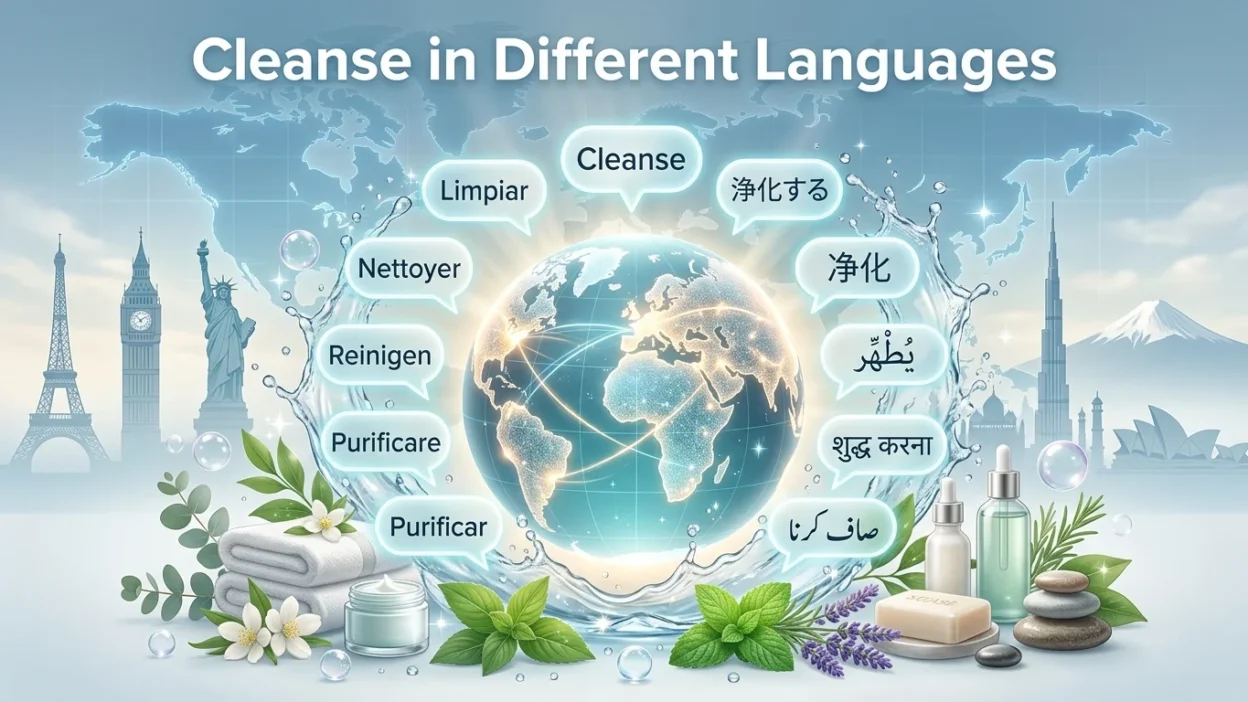
Learning cleanse in different languages is a practical way to expand your vocabulary while exploring how different cultures express the idea of cleaning, purifying or removing impurities.
The word cleanse is commonly used in everyday conversations, health and wellness, skincare, religion, housekeeping and literature. Whether you’re learning a new language, traveling or simply curious about global vocabulary, knowing how to say cleanse in different languages can improve your communication skills.
In this guide, you’ll discover cleanse in different languages with native spellings and easy English pronunciations. You’ll also learn why this word is useful, when to use it and interesting facts about cleansing practices in different cultures.
Quick Answer
Cleanse in different languages includes the words and phrases used worldwide to describe cleaning, purifying, washing or removing impurities. Learning these translations improves your vocabulary, cultural awareness, and everyday communication.
Cleanse in Different Languages Around the World
| Language | Native Word | Pronunciation |
|---|---|---|
| English | Cleanse | KLENZ |
| Spanish | Limpiar / Purificar | Leem-PYAR / Poo-ree-fee-KAR |
| French | Nettoyer / Purifier | Neh-TWA-yay / Poo-ree-fee-YAY |
| German | Reinigen | RYE-ni-gen |
| Italian | Purificare | Poo-ree-fee-KA-re |
| Portuguese | Purificar | Poo-ree-fee-KAR |
| Dutch | Reinigen | RYE-ni-ghen |
| Swedish | Rena | REH-na |
| Norwegian | Rense | REN-seh |
| Danish | Rense | REN-seh |
| Finnish | Puhdistaa | POOH-dis-taa |
| Icelandic | Hreinsa | HRAYN-sa |
| Polish | Oczyścić | O-chi-sh-chitch |
| Czech | Očistit | O-chi-steet |
| Slovak | Očistiť | O-chi-steet |
| Hungarian | Megtisztítani | Meg-tis-TA-ni |
| Romanian | Purifica | Poo-ree-fee-KA |
| Greek | Καθαρίζω | Ka-tha-REE-zo |
| Russian | Очищать | A-chee-SHAT |
| Ukrainian | Очищати | O-chee-SHA-ty |
| Bulgarian | Пречиствам | Pre-chees-TAM |
| Serbian | Очистити | O-chees-tee-tee |
| Croatian | Očistiti | O-chees-tee-tee |
| Turkish | Temizlemek | Teh-meez-LEH-mek |
| Arabic | يُطهِّر | Yu-tah-hir |
| Hebrew | לטהר | Le-ta-her |
| Persian | پاک کردن | Pak Kardan |
| Hindi | शुद्ध करना | Shuddh Karna |
| Urdu | صاف کرنا | Saaf Karna |
| Punjabi | ਸਾਫ਼ ਕਰਨਾ | Saaf Karna |
| Bengali | পরিষ্কার করা | Pori-shkar Kora |
| Gujarati | શુદ્ધ કરવું | Shuddh Karvu |
| Marathi | शुद्ध करणे | Shuddh Karne |
| Tamil | சுத்தப்படுத்து | Suththa-pa-du-thu |
| Telugu | శుభ్రం చేయడం | Shubhram Cheyadam |
| Kannada | ಶುದ್ಧಗೊಳಿಸು | Shuddha-go-lisu |
| Malayalam | ശുദ്ധീകരിക്കുക | Shuddhee-ka-ri-kku-ka |
| Nepali | शुद्ध गर्नु | Shuddha Garnu |
| Sinhala | පිරිසිදු කිරීම | Piri-sidu Kirima |
| Thai | ชำระล้าง | Cham-ra Lang |
| Vietnamese | Thanh tẩy | Thanh Tay |
| Indonesian | Membersihkan | Mem-ber-seeh-kan |
| Malay | Membersihkan | Mem-ber-seeh-kan |
| Filipino | Linisin | Lee-nee-sin |
| Chinese (Mandarin) | 净化 | Jing Hua |
| Japanese | 浄化する | Jo-ka Suru |
| Korean | 정화하다 | Jeong-hwa-ha-da |
| Swahili | Kusafisha | Koo-sa-fee-sha |
| Hawaiian | Hoʻomaʻemaʻe | Ho-o-ma-e-ma-e |
| Māori | Whakapai | Fa-ka-pie |
Why Learn “Cleanse” in Different Languages?
Learning cleanse in different languages helps you communicate in everyday situations involving hygiene, health, cleaning, religion, beauty and wellness.
Whether you’re reading product labels, discussing skincare routines, talking about household cleaning, or learning about spiritual traditions, knowing the local word for cleanse improves your vocabulary and cultural understanding.
The concept of cleansing is important in many cultures and religions around the world. It can refer to physical cleaning, emotional renewal, spiritual purification, or environmental care. Learning these translations provides valuable insight into both language and cultural practices.
Common Uses of “Cleanse” Around the World
The word cleanse is used in many areas of everyday life, including personal hygiene, household cleaning, healthcare, beauty, religion and wellness. People commonly use it when talking about cleansing the skin, washing hands, purifying water, cleaning homes, or removing dirt and impurities.
In beauty and skincare, cleanse often refers to removing makeup, oil, and other impurities before applying skincare products.Beyond physical cleaning, cleanse is also used in emotional and spiritual contexts. Many cultures practice cleansing rituals to symbolize renewal, healing or a fresh beginning.
You may also hear the word in discussions about healthy eating, detox programs, meditation, or environmental conservation. Learning how different languages express this concept helps you communicate naturally in a variety of personal and professional situations.
Pronunciation Tips for Beginners
Learning the pronunciation of cleanse in different languages becomes easier when you practice a few translations each day. Listen to native speakers through language learning apps, pronunciation dictionaries or educational videos, then repeat each word slowly.
Focus on clear pronunciation rather than speed, paying special attention to unfamiliar vowel sounds and consonants.It also helps to group languages with similar pronunciation patterns. For example, Spanish, Portuguese and Italian often have related Latin based vocabulary, while German, Dutch, Swedish and Norwegian share many similar sounds.
Practicing with flashcards, audio recordings, and short daily exercises will improve both your memory and pronunciation over time.
Interesting Facts About “Cleanse”
The idea of cleansing has existed for thousands of years and appears in nearly every culture around the world. Ancient civilizations practiced cleansing for health, hygiene, and religious purposes long before modern cleaning products existed.
Water, herbs, smoke, natural oils, and special ceremonies were commonly used to symbolize purification and renewal.Another interesting fact is that the meaning of cleanse extends beyond physical cleaning. In literature and everyday speech, it can describe emotional healing, mental clarity, or spiritual growth.
Many languages also use separate words depending on whether the cleansing is physical, ceremonial, medical or symbolic, highlighting the rich cultural meanings behind this simple concept.
Conclusion
Learning cleanse in different languages is a practical way to improve your vocabulary while exploring how cultures around the world understand cleanliness, purification and renewal.
Whether you’re discussing personal hygiene, health, religion, beauty or environmental care, knowing these translations helps you communicate more confidently. By practicing these words regularly, you’ll strengthen your language skills while gaining a deeper appreciation for the cultural importance of cleansing in everyday life.
Frequently Asked Questions
1. What does “cleanse” mean?
Cleanse means to clean thoroughly, purify, remove impurities, or make something physically, mentally, or spiritually clean.
2. Is “cleanse” different from “clean”?
Yes. Clean usually means removing dirt from something, while cleanse often implies a deeper cleaning or purification, especially in health, beauty, or spiritual contexts.
3. Why should I learn cleanse in different languages?
Learning these translations helps you communicate in situations involving hygiene, wellness, beauty, healthcare, travel, and cultural traditions.
4. Is the word “cleanse” used in religious traditions?
Yes. Many religions and cultures use words meaning cleanse to describe purification rituals, ceremonial washing, or spiritual renewal before important events or acts of worship.
5. What is the easiest way to remember these translations?
Practice a few words every day, listen to native pronunciation, group similar languages together and use the words in everyday conversations or vocabulary exercises.

Olivia Riley is a passionate content administrator at Diflingo, where she manages and publishes high-quality articles focused on what to say in everyday conversations, special occasions, professional settings, and personal relationships. She ensures every guide is clear, practical, engaging, and helpful for readers.