
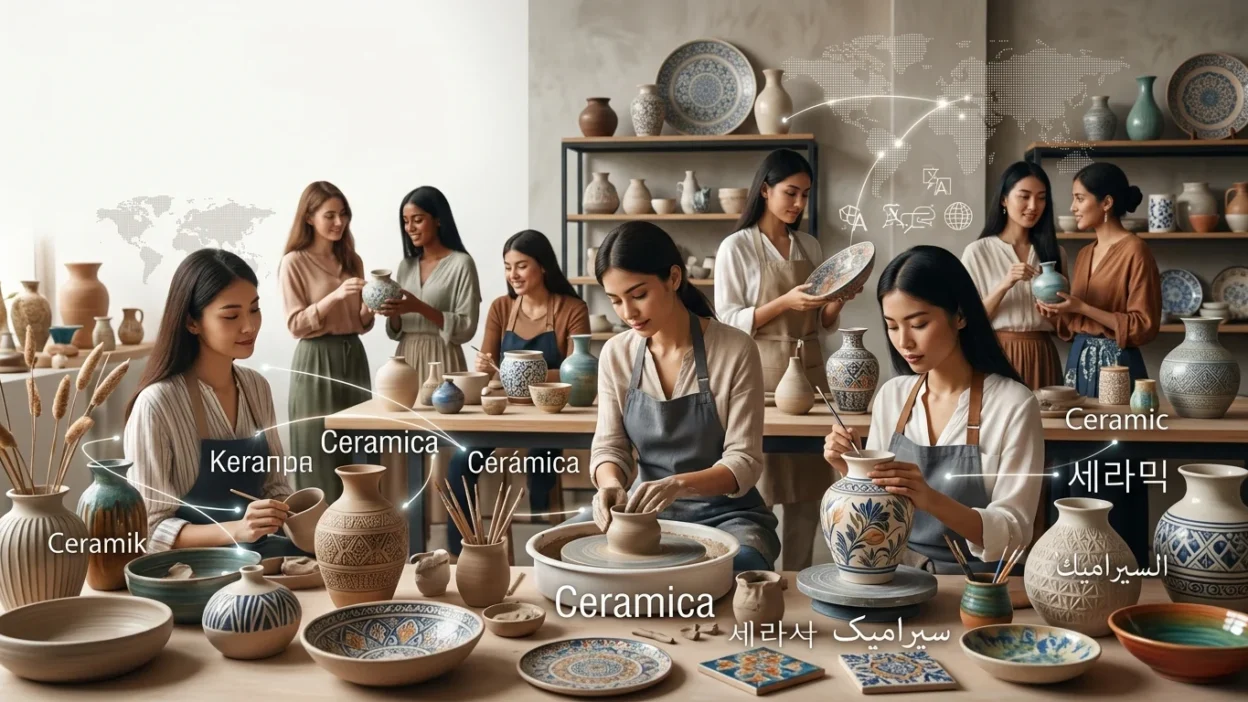
The word ceramic in different languages is useful for anyone interested in art, design, pottery, architecture, crafts or language learning. Ceramic refers to materials made by shaping and heating substances such as clay, often producing durable objects, tiles, dishes, sculptures and decorative pieces.
Learning ceramic in different languages can help students, artists, travelers, designers, and international shoppers communicate more naturally. Many languages use words closely related to the English term, while others have unique expressions connected to pottery or fired clay. Below, you’ll find 50 translations with native spellings and easy English pronunciations.
Quick Answer
“Ceramic” has similar forms in many languages, including cerámica in Spanish, céramique in French, Keramik in German, ceramica in Italian, السيراميك in Arabic, 陶瓷 in Chinese, and セラミック in Japanese.
Ceramic in Different Languages Around the World
| Language | Native Word | Pronunciation |
|---|---|---|
| English | Ceramic | suh-RAM-ik |
| Spanish | Cerámica | seh-RAH-mee-ka |
| French | Céramique | say-rah-MEEK |
| German | Keramik | keh-RAH-meek |
| Italian | Ceramica | cheh-RAH-mee-ka |
| Portuguese | Cerâmica | seh-RAH-mee-ka |
| Dutch | Keramiek | keh-rah-MEEK |
| Swedish | Keramik | keh-rah-MEEK |
| Norwegian | Keramikk | keh-rah-MEEK |
| Danish | Keramik | keh-rah-MEEK |
| Finnish | Keramiikka | keh-rah-MEE-kah |
| Icelandic | Keramík | keh-rah-MEEK |
| Polish | Ceramika | tseh-RAH-mee-ka |
| Czech | Keramika | keh-rah-MEE-ka |
| Slovak | Keramika | keh-rah-MEE-ka |
| Hungarian | Kerámia | keh-RAH-mee-ah |
| Romanian | Ceramică | cheh-RAH-mee-kuh |
| Russian | Керамика | keh-RAH-mee-ka |
| Ukrainian | Кераміка | keh-RAH-mee-ka |
| Bulgarian | Керамика | keh-RAH-mee-ka |
| Greek | Κεραμικά | keh-rah-mee-KA |
| Turkish | Seramik | seh-rah-MEEK |
| Arabic | السيراميك | as-see-RAH-meek |
| Hebrew | קרמיקה | keh-rah-MEE-ka |
| Persian | سرامیک | seh-rah-MEEK |
| Urdu | سیرامک | see-RAH-mik |
| Hindi | सिरेमिक | sih-REH-mik |
| Bengali | সিরামিক | see-RAH-mik |
| Punjabi | ਸਿਰਾਮਿਕ | sih-RAH-mik |
| Gujarati | સિરામિક | sih-RAH-mik |
| Marathi | सिरेमिक | sih-REH-mik |
| Tamil | பீங்கான் | peeng-GAAN |
| Telugu | సిరామిక్ | see-RAH-mik |
| Kannada | ಸೆರಾಮಿಕ್ | seh-RAH-mik |
| Malayalam | സെറാമിക് | seh-RAH-mik |
| Sinhala | සෙරමික් | seh-rah-MIK |
| Chinese | 陶瓷 | táo cí |
| Japanese | セラミック | seh-rah-MIK-koo |
| Korean | 세라믹 | seh-rah-MIK |
| Thai | เซรามิก | seh-rah-MIK |
| Vietnamese | Gốm sứ | gohm SOO |
| Indonesian | Keramik | keh-RAH-meek |
| Malay | Seramik | seh-rah-MEEK |
| Filipino | Seramika | seh-rah-MEE-ka |
| Swahili | Kauri | KOW-ree |
| Zulu | I-ceramic | ee-seh-RAH-mik |
| Afrikaans | Keramiek | keh-rah-MEEK |
| Esperanto | Ceramiko | tseh-rah-MEE-ko |
| Latin | Ceramica | keh-RAH-mee-ka |
| Albanian | Qeramikë | cheh-rah-MEE-keh |
| Serbian | Керамика | keh-RAH-mee-ka |
| Croatian | Keramika | keh-RAH-mee-ka |
Why Learn Ceramic in Different Languages?
Learning ceramic in different languages can be useful for artists, interior designers, architects, collectors, students and travelers. Ceramic products are found everywhere, from kitchenware and bathroom tiles to sculptures, pottery, decorative objects and architectural surfaces.
Knowing the local word can make it easier to understand product descriptions, museum information, craft markets, design catalogs and conversations with artisans.
For language learners, “ceramic” is also interesting because many languages have adopted forms related to the international term. Recognizing these similarities can make vocabulary easier to remember while also revealing how technical and artistic words travel between cultures.
What Does Ceramic Mean?
Ceramic generally refers to materials made by shaping inorganic, non-metallic substances and heating them at high temperatures. Traditional ceramics often begin with clay, which is shaped and then fired to create a hard, durable object.
Ceramics can include everyday products such as plates, cups, bowls, tiles, and sanitaryware. They can also include artistic pottery, sculptures, ornaments, and specialized industrial materials.
The term can describe both the material and objects made from it. Context determines whether “ceramic” refers to a substance, a finished object, or a broader category of products.
Ceramic and Pottery: What’s the Difference?
Pottery generally refers to ceramic objects traditionally made from clay, particularly vessels and decorative pieces.
For example, a ceramic tile is a ceramic product but would not normally be called pottery. A handmade clay vase, however, can be described as pottery and ceramic.
Understanding this distinction is helpful when learning vocabulary related to art, crafts, architecture, and manufacturing.
Ceramic in European Languages
European languages often use words that closely resemble the English term. Spanish uses cerámica, French uses céramique, Italian uses ceramica and Portuguese uses cerâmica.
German, Swedish, Danish, and Dutch use forms related to Keramik or keramiek. Slavic languages also have closely related words, such as Russian керамика and Polish ceramika.
These similarities make the word relatively easy to recognize across Europe. However, pronunciation, spelling, and grammatical gender can differ from one language to another.
Ceramic in Asian Languages
Asian languages demonstrate both borrowed and native terminology. Japanese uses セラミック, a katakana loanword, while Korean uses 세라믹.
Chinese commonly uses 陶瓷 (táocí), a native Chinese term associated with ceramics and porcelain. Vietnamese uses gốm sứ, which is also connected with ceramic and porcelain products.
South Asian languages often use forms resembling the international word, such as Hindi सिरेमिक and Urdu سیرامک.
These variations show how languages adapt technical and artistic vocabulary differently.
Ceramic in Art and Pottery
Ceramics have a major role in art and traditional craftsmanship. Artists use clay and other ceramic materials to create bowls, vases, sculptures, tiles, figurines and decorative pieces.
Ceramic art can range from traditional handmade pottery to contemporary sculptures and experimental installations. Different cultures have developed distinctive techniques, shapes, glazing methods and decorative traditions.
Learning the word for “ceramic” in another language can therefore be especially useful for people interested in museums, galleries, craft fairs, pottery workshops, and cultural tourism.
Ceramic Tiles in Architecture
Designers choose ceramic products for their durability, appearance, ease of cleaning, and wide range of colors, textures, and patterns.
If you are traveling or shopping internationally, ceramic related vocabulary can help you understand product labels and communicate with suppliers or designers.
Useful related terms include tile, glaze, clay, porcelain, pattern, surface, floor, wall, bathroom, kitchen and decoration.
Ceramic in Everyday Life
Ceramic products are part of everyday life in many homes. Plates, mugs, bowls, cookware, tiles, sinks, toilets, ornaments and decorative objects can all involve ceramic materials.
Because of this, the word appears in conversations about cooking, home decoration, renovation, shopping, crafts, and interior design.
Learning everyday examples makes the vocabulary easier to remember. Instead of memorizing “ceramic” alone, connect it with familiar objects such as a ceramic cup, ceramic plate, ceramic tile or ceramic vase.
This approach helps language learners build practical vocabulary around the central word.
Pronunciation Tips for Ceramic in Different Languages
Many European versions of “ceramic” look similar, but their pronunciation varies. Spanish cerámica has a clear Spanish rhythm, French céramique uses French vowel sounds and German Keramik has a different stress pattern.
Asian languages can sound even more different. Mandarin 陶瓷 (táocí) does not resemble the English pronunciation, while Japanese セラミック follows Japanese syllable patterns.
English pronunciation guides are only approximations. For accurate pronunciation, listen to native speakers and practice the word in a complete sentence.
Ceramic in Design and Manufacturing
Ceramics are important in many areas beyond traditional pottery. Designers use ceramic materials in architecture, home products, decorative objects, and specialized industrial applications.
Advanced ceramics can have properties that make them useful in demanding technical environments. Depending on their composition and manufacturing process, ceramic materials can be valued for characteristics such as hardness, heat resistance and electrical insulation.
For professionals, it is useful to learn “ceramic” alongside technical terms such as material, firing, kiln, glaze, clay, tile, porcelain, manufacturing and surface finish.
Common Mistakes When Translating Ceramic
A common mistake is treating “ceramic,” “pottery,” and “porcelain” as exact synonyms. They are related but can describe different materials or categories.
Another mistake is assuming that similar-looking words have identical pronunciation. For example, cerámica, céramique, and Keramik may look related but sound different.
Context is also important. The word used for a ceramic material may differ from the expression used for a specific ceramic product.
When translating technical or artistic content, consider the complete sentence rather than translating the English word in isolation.
Cultural Importance of Ceramic Art
Ceramics have played an important role in many cultures for thousands of years. Pottery has been used for cooking, storage, decoration, trade, ceremonies, and artistic expression.
Different regions developed their own approaches to shaping, firing, glazing, and decorating ceramic objects. These traditions continue today through museums, workshops, artists, and craft communities.
Learning ceramic vocabulary can therefore open the door to cultural history as well as modern design.
A single word can connect language learners with traditional craftsmanship, architecture, archaeology, and contemporary art.
Easy Ways to Remember Ceramic Translations
Because many languages use similar versions of “ceramic,” start by grouping them together. Cerámica, ceramica, ceramique, and Keramik share recognizable patterns.
Then focus on distinctive terms such as Chinese 陶瓷, Vietnamese gốm sứ, and Tamil பீங்கான்.
Use pictures of pottery, tiles, cups, and sculptures to create visual associations. You can also write short sentences such as “This is a ceramic cup” or “The wall has ceramic tiles.”
Combining pronunciation, images, and simple sentences can make the vocabulary much easier to remember.
Interesting Facts About Ceramic
Ceramics are among the oldest material traditions in human history. Archaeological discoveries show that people have been making fired clay objects for thousands of years.
Today, ceramics are used far beyond traditional pottery. Modern ceramic materials appear in architecture, household products, art, electronics, engineering, and other specialized fields.
The word itself also demonstrates the movement of vocabulary between cultures. Many European languages use closely related forms, while Chinese and some other languages have distinct native terms.
This combination of ancient craftsmanship and modern technology makes ceramic an especially interesting word to explore across languages.
Key Takeaways
- Ceramic refers to a broad group of fired, non-metallic materials.
- Many European languages use forms similar to ceramic.
- Chinese uses 陶瓷 (táocí), while Japanese uses セラミック.
- Ceramic is broader than pottery, although the two terms are closely related.
- Ceramics are important in art, architecture, manufacturing, and everyday products.
Conclusion
Learning ceramic in different languages provides an interesting way to explore vocabulary connected with art, architecture, craftsmanship, and everyday life. Many languages use forms similar to the English term, including Spanish cerámica, French céramique, German Keramik, and Italian ceramica.
Other languages have distinct expressions, such as Chinese 陶瓷 and Vietnamese gốm sứ. Understanding these differences can help travelers, designers, artists, students and language learners communicate more effectively. Whether you are interested in pottery, ceramic tiles, interior design or cultural traditions, learning this word across languages offers useful linguistic and cultural insight.
Frequently Asked Questions
1. What is ceramic in different languages?
“Ceramic” has many similar translations around the world. Spanish uses cerámica, French uses céramique, German uses Keramik, Italian uses ceramica, Arabic uses السيراميك, Chinese uses 陶瓷, Japanese uses セラミック, and Korean uses 세라믹.
2. How do you say ceramic in Spanish?
The Spanish word for ceramic is cerámica, pronounced approximately “seh-RAH-mee-ka.” It can refer to ceramic materials, ceramic products, or ceramics as an artistic and manufacturing field. The word is commonly used when discussing pottery, tiles, decorative objects, and other fired-clay products.
3. What is ceramic called in Chinese?
In Chinese, a common term for ceramics is 陶瓷 (táocí), pronounced approximately “taow-tsuh.” The term is associated with ceramic and porcelain products. Chinese has additional vocabulary for specific ceramic materials, manufacturing techniques, pottery, porcelain, glazes, and decorative traditions.
4. How do you say ceramic in Japanese?
Japanese commonly uses セラミック (seramikku) for “ceramic.” It is written in katakana because it is a borrowed technical term. The pronunciation is approximately “seh-rah-MIK-koo.” Japanese also has traditional vocabulary related to pottery, ceramics, porcelain, and fired clay.
5. What is the difference between ceramic and pottery?
Ceramic is a broad category of materials and objects made through processes involving heat, while pottery generally refers to ceramic objects traditionally made from clay. Therefore, pottery is a type of ceramic, but not every ceramic product is considered pottery. Tiles are a common example of ceramics that are not pottery.