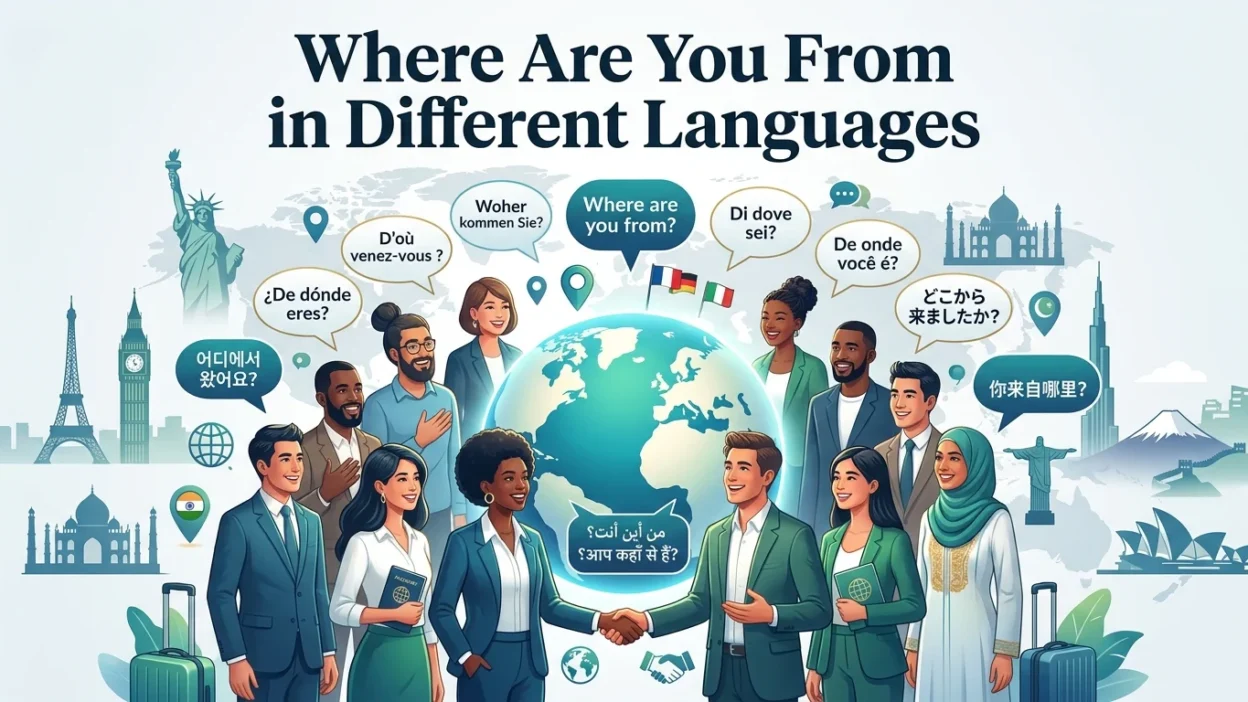
Learning where are you from in different languages is a great way to start friendly conversations with people from different cultures. In this guide, you’ll discover where are you from in different languages with native spellings and easy English pronunciations.
Where are you from in different languages includes polite questions used around the world to ask about someone’s country, city or hometown. Learning these expressions improves communication, helps you make new friends, and shows respect for different cultures.
| Language | Native Word | Pronunciation |
|---|---|---|
| English | Where are you from? | Where Are You From |
| Spanish | ¿De dónde eres? | De DON-day EH-res |
| French | D’où venez-vous ? | Doo Veh-nay Voo |
| German | Woher kommen Sie? | Vo-hair KOM-men Zee |
| Italian | Di dove sei? | Dee DO-ve Say |
| Portuguese | De onde você é? | De ON-je Vo-se Eh |
| Dutch | Waar kom je vandaan? | Vaar Kom Yuh Van-daan |
| Swedish | Var kommer du ifrån? | Var KOM-mer Du Ee-fron |
| Norwegian | Hvor kommer du fra? | Vor KOM-mer Du Fra |
| Danish | Hvor kommer du fra? | Vor KOM-mer Du Fra |
| Finnish | Mistä olet kotoisin? | Mis-ta O-let Ko-toi-sin |
| Icelandic | Hvaðan ert þú? | Kva-than Ert Thoo |
| Polish | Skąd jesteś? | Skont Yes-tesh |
| Czech | Odkud jsi? | Odt-kood Ysee |
| Slovak | Odkiaľ si? | Odt-kee-al See |
| Hungarian | Honnan jöttél? | Hon-nan Yut-tale |
| Romanian | De unde ești? | De OON-de Esht |
| Greek | Από πού είσαι; | A-po Poo EE-se |
| Russian | Откуда ты? | At-KOO-da Ti |
| Ukrainian | Звідки ти? | ZVEED-kee Ti |
| Bulgarian | Откъде си? | Ot-Ka-de See |
| Serbian | Одакле си? | O-da-kle See |
| Croatian | Odakle si? | O-da-kle See |
| Turkish | Nerelisin? | Ne-re-LEE-sin |
| Arabic | من أين أنت؟ | Min Ayn Anta |
| Hebrew | מאיפה אתה? | Me-ay-fo A-ta |
| Persian | اهل کجا هستید؟ | Ahl-e Ko-ja Has-tid |
| Hindi | आप कहाँ से हैं? | Aap Ka-haan Se Hain |
| Urdu | آپ کہاں سے ہیں؟ | Aap Kahan Se Hain |
| Punjabi | ਤੁਸੀਂ ਕਿੱਥੋਂ ਹੋ? | Tu-see Kit-thon Ho |
| Bengali | আপনি কোথা থেকে এসেছেন? | Aap-ni Ko-tha The-ke E-she-chen |
| Gujarati | તમે ક્યાંના છો? | Ta-me Kyan-na Cho |
| Marathi | तुम्ही कुठून आहात? | Tum-hi Ku-thoon Aa-hat |
| Tamil | நீங்கள் எங்கிருந்து வருகிறீர்கள்? | Neengal En-gi-run-thu Va-ru-gee-reer-gal |
| Telugu | మీరు ఎక్కడి వారు? | Mee-ru Ek-ka-di Va-ru |
| Kannada | ನೀವು ಎಲ್ಲಿಂದ ಬಂದಿದ್ದೀರಿ? | Nee-vu El-lin-da Ban-did-dee-ri |
| Malayalam | നിങ്ങൾ എവിടെ നിന്നാണ്? | Ning-al E-vi-de Nin-naan |
| Nepali | तपाईं कहाँबाट हुनुहुन्छ? | Ta-pa-ee Ka-haan-baat Hu-nu-hun-cha |
| Sinhala | ඔබ කොහෙන්ද? | Oba Ko-hen-da |
| Thai | คุณมาจากไหน | Khun Ma Jak Nai |
| Vietnamese | Bạn đến từ đâu? | Ban Den Tu Dow |
| Indonesian | Dari mana Anda berasal? | Da-ri Ma-na An-da Ber-a-sal |
| Malay | Awak dari mana? | A-wak Da-ri Ma-na |
| Filipino | Taga saan ka? | Ta-ga Sa-an Ka |
| Chinese (Mandarin) | 你来自哪里? | Ni Lai Zi Na Li |
| Japanese | どこから来ましたか? | Do-ko Ka-ra Ki-ma-shi-ta Ka |
| Korean | 어디에서 왔어요? | Eo-di-e-seo Wa-sseo-yo |
| Swahili | Unatoka wapi? | U-na-to-ka Wa-pi |
| Hawaiian | No hea mai ʻoe? | No He-a Mai O-eh |
| Māori | Nō hea koe? | Nor He-a Kwe |
Why Learn “Where Are You From?” in Different Languages?
Learning where are you from in different languages is one of the easiest ways to begin meaningful conversations with people from around the world.
Common Uses of “Where Are You From?” Around the World
People commonly ask “Where are you from?” when meeting someone for the first time, attending international events, traveling, studying abroad, or joining online communities. It is a friendly conversation starter that helps people learn about each other’s backgrounds and often leads to discussions about culture, language, food, traditions, and travel experiences.
In many cultures, asking where someone is from is considered polite and shows genuine interest. Learning the appropriate expression helps you communicate respectfully and confidently.
Pronunciation Tips for Beginners
Learning the pronunciation of where are you from in different languages becomes much easier when you practice a few phrases each day. Listen to native speakers using language-learning apps, pronunciation guides, or videos, then repeat each phrase slowly and clearly. Focus on the natural rhythm, stress, and pronunciation rather than trying to memorize every word individually. Regular practice will improve both your speaking skills and your confidence.
Grouping languages with similar pronunciation patterns is another helpful strategy. For example, Spanish, Italian, Portuguese, and French share many similar sounds, while Hindi, Urdu, and Punjabi have familiar pronunciation patterns. Flashcards, audio recordings, and speaking with native speakers are excellent ways to reinforce what you’ve learned and remember these useful conversation starters.
Interesting Facts About Asking Someone’s Origin
Although the English question “Where are you from?” appears simple, many languages express the same idea in different ways. Some languages literally ask “From where do you come?”, while others ask “What place are you from?” These differences reflect the unique grammar and sentence structure of each language, making language learning both interesting and rewarding.
Another fascinating fact is that in many cultures, conversations naturally continue after this question with topics such as hometowns, local traditions, favorite foods, or native languages. Asking about someone’s origin is often seen as an invitation to share personal experiences and cultural identity, helping people build stronger friendships and mutual understanding.
Conclusion
Learning where are you from in different languages is a valuable skill that helps you connect with people from diverse cultures. This simple question opens the door to meaningful conversations, encourages cultural exchange, and creates positive first impressions. Whether you’re traveling, studying a foreign language, working internationally or making new friends, knowing how to ask someone’s origin in their native language demonstrates respect and genuine curiosity. Practice these translations regularly and you’ll feel more confident communicating with people wherever you go.
Frequently Asked Questions
1. Why should I learn where are you from in different languages?
Learning this question helps you start conversations, understand different cultures, and make new friends while traveling, studying, or communicating with people from around the world.
2. Is it polite to ask someone where they are from?
Yes. In most cultures, asking where someone is from is considered a friendly way to begin a conversation. However, it should always be asked politely and respectfully.
3. Can I use these phrases while traveling?
Absolutely. These expressions are useful in hotels, hostels, schools, business meetings, cultural events, and tourist attractions when meeting new people.
4. Do all languages have formal and informal versions?
Many languages, including Spanish, French, German, Japanese, and Korean, have formal and informal ways of asking this question depending on the relationship and situation.
5. What is the easiest way to remember these translations?
Practice a few languages every day, repeat the phrases aloud, listen to native pronunciation, and use flashcards or language learning apps. Consistent practice makes them much easier to remember.