
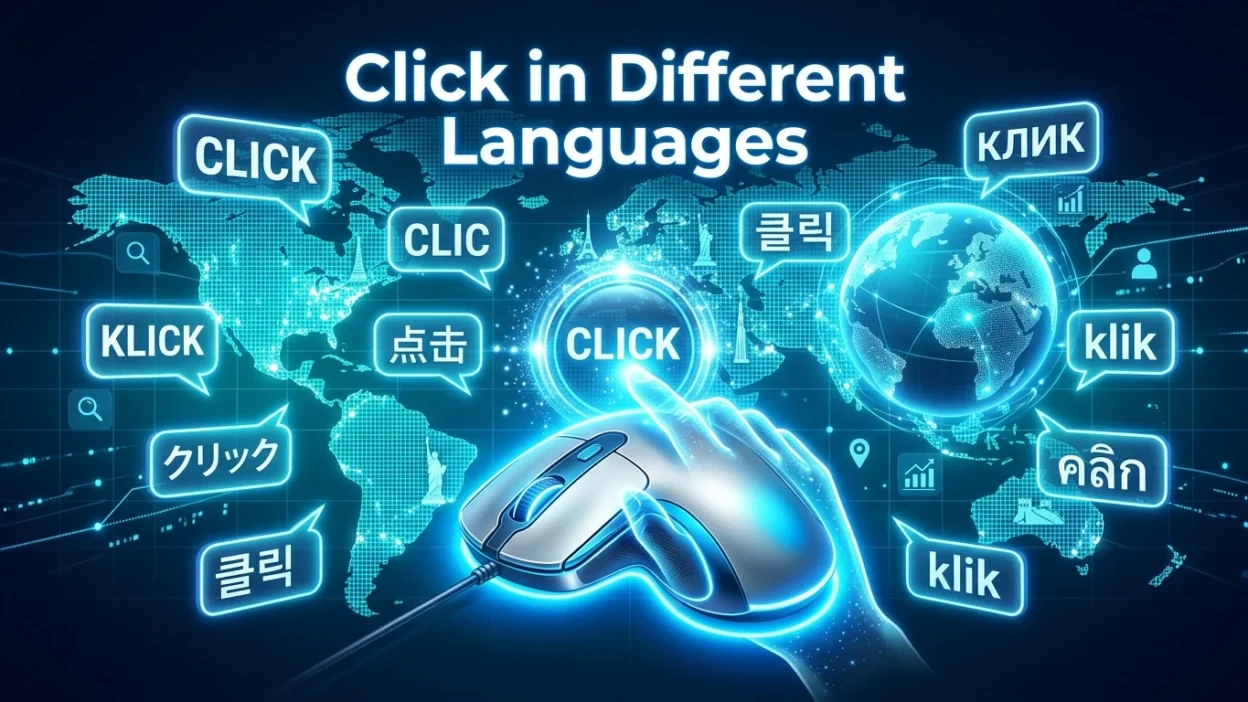
Learning click in different languages is useful for technology, websites, mobile apps, gaming and everyday conversations. The word click is commonly used when talking about computers, smartphones, buttons, links and digital interfaces. Whether you’re learning a new language, traveling or working with international software, knowing how to say click in different languages can help you communicate more naturally.
In this guide, you’ll discover click in different languages with native spellings and easy English pronunciations. You’ll also learn why this word is important, where it is used and interesting facts about how different languages adapt technology related vocabulary.
Quick Answer
Click in different languages includes the words used worldwide to describe pressing a mouse button, tapping a digital button, selecting a link, or making a clicking sound. Learning these translations improves your technology vocabulary and helps you navigate digital devices in different languages.
Click in Different Languages Around the World
| Language | Native Word | Pronunciation |
|---|---|---|
| English | Click | Klik |
| Spanish | Hacer clic | Ah-SER Kleek |
| French | Cliquer | Klee-KAY |
| German | Klicken | KLIK-en |
| Italian | Cliccare | Klee-KA-re |
| Portuguese | Clicar | Klee-KAR |
| Dutch | Klikken | KLIK-en |
| Swedish | Klicka | KLIK-ka |
| Norwegian | Klikke | KLIK-keh |
| Danish | Klikke | KLIK-keh |
| Finnish | Klikata | KLI-ka-ta |
| Icelandic | Smella | SMET-la |
| Polish | Kliknąć | KLEEK-nonch |
| Czech | Kliknout | KLIK-noht |
| Slovak | Kliknúť | KLIK-noot |
| Hungarian | Kattintani | Kat-tin-TA-ni |
| Romanian | Face clic | FA-che Kleek |
| Greek | Κλικ | Klik |
| Russian | Щелкнуть | Shchyel-KNOOT |
| Ukrainian | Клікнути | KLIK-noo-ty |
| Bulgarian | Щракна | Sht-RAK-na |
| Serbian | Кликнути | KLIK-noo-tee |
| Croatian | Kliknuti | KLIK-noo-tee |
| Turkish | Tıklamak | Tuh-kla-MAK |
| Arabic | انقر | Un-qur |
| Hebrew | לחץ | Lakhatz |
| Persian | کلیک کردن | Klik Kardan |
| Hindi | क्लिक करना | Klik Karna |
| Urdu | کلک کرنا | Klik Karna |
| Punjabi | ਕਲਿਕ ਕਰਨਾ | Klik Karna |
| Bengali | ক্লিক করা | Klik Kora |
| Gujarati | ક્લિક કરવું | Klik Karvu |
| Marathi | क्लिक करणे | Klik Karne |
| Tamil | கிளிக் செய் | Klik Sei |
| Telugu | క్లిక్ చేయి | Klik Cheyi |
| Kannada | ಕ್ಲಿಕ್ ಮಾಡು | Klik Maadu |
| Malayalam | ക്ലിക്ക് ചെയ്യുക | Klik Cheyyuka |
| Nepali | क्लिक गर्नुहोस् | Klik Garnuhos |
| Sinhala | ක්ලික් කරන්න | Klik Karanna |
| Thai | คลิก | Klik |
| Vietnamese | Nhấp chuột | Nyap Chuot |
| Indonesian | Klik | Klik |
| Malay | Klik | Klik |
| Filipino | I-click | Ee-Klik |
| Chinese (Mandarin) | 点击 | Dian Ji |
| Japanese | クリック | Ku-ri-kku |
| Korean | 클릭 | Keul-lik |
| Swahili | Bofya | BOF-ya |
| Hawaiian | Kaomi | Ka-oh-mee |
| Māori | Pāwhiri | Paa-firi |
Why Learn “Click” in Different Languages?
Learning click in different languages is especially useful in today’s digital world. The word appears frequently in websites, mobile apps, software instructions, online tutorials, and customer support guides.
Knowing the local translation helps you understand menus, buttons, and instructions when using devices in another language.It is also valuable for travelers, remote workers, programmers, gamers, and anyone who interacts with international technology platforms.
Since many languages have adopted a version of the English word click, you’ll often notice similarities across different countries.
Common Uses of “Click” Around the World
The word click is widely used in today’s digital world. Whether you’re browsing a website, using a smartphone, playing a video game, or operating computer software, you’ll often see instructions such as click here, click the button, or click the link.
Understanding this word in different languages helps you navigate websites, apps, online forms, and digital services more confidently.Beyond technology, click is also used in everyday conversations. In English, people often say two people click when they instantly get along or develop a strong connection.
Photographers use the word to describe the sound of a camera shutter, while marketers use it when discussing online advertising, click-through rates, and website traffic. This makes click a versatile word with both literal and figurative meanings.
Pronunciation Tips for Beginners
Learning the pronunciation of click in different languages is relatively easy because many languages have borrowed the English word or adapted it with only slight pronunciation changes.
Start by practicing languages such as German, Dutch, Swedish, Indonesian, Malay, Japanese, and Korean, where the pronunciation remains very similar to English.For languages that use different scripts, such as Arabic, Chinese, Japanese, Russian, and Hindi, listen to native speakers and repeat the words several times.
Focus on speaking slowly and clearly rather than trying to pronounce each word perfectly on your first attempt. Daily practice and audio examples will quickly improve your confidence.
Interesting Facts About “Click”
One interesting fact about the word click is that it became internationally popular with the rise of personal computers in the 1980s and 1990s. Because computer technology spread rapidly around the world, many languages adopted the English word directly instead of creating an entirely new term.
This is why words like Klik, Klicken, Cliquer, and Klikka appear in many different languages.Another fascinating fact is that the meaning of click has expanded beyond technology.
Today, it can refer to taking a photograph, selecting an option on a digital device, making a mechanical sound, or even forming an instant friendship. This evolution shows how technology continues to influence modern vocabulary across cultures.
Conclusion
Learning click in different languages is a practical way to improve your technology vocabulary and communicate more effectively in today’s digital world.
Whether you’re using software, browsing websites, following online tutorials or working with international teams, these translations help you understand one of the most common computer related words.
By practicing these terms regularly, you’ll become more confident using digital devices and communicating across different languages and cultures.
Frequently Asked Questions
1. Why should I learn click in different languages?
Learning click in different languages helps you understand websites, software, mobile apps, and digital instructions while traveling, studying, or working internationally.
2. Do most languages use the English word “click”?
Many languages have adopted a version of the English word because of the global influence of computers and technology. Others use native verbs meaning press, tap, or select.
3. Is “click” different from “tap”?
Yes. Click usually refers to pressing a computer mouse, while tap commonly refers to touching a smartphone or tablet screen. However, some languages use the same word for both actions.
4. Can “click” have other meanings?
Yes. Besides technology, click can describe the sound of a camera shutter, a mechanical noise, or an instant personal connection between people.
5. What is the easiest way to remember these translations?
Practice a few translations every day, listen to native pronunciation, group similar languages together, and use the words while navigating websites or mobile apps.