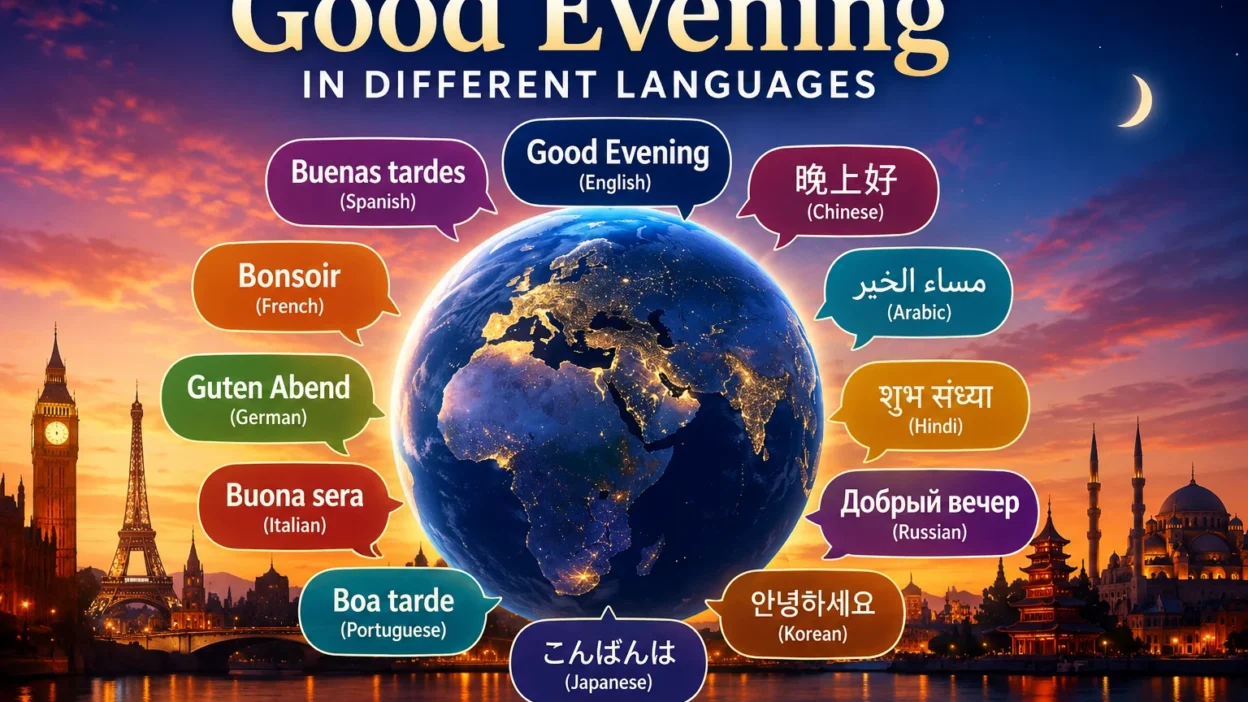
Learning good evening in different languages is a simple but meaningful way to connect with people across cultures. Whether you are traveling, studying a new language or speaking with international friends, a local greeting can make your message feel warmer and more respectful.
This guide explores good evening in different languages with native spellings and easy English pronunciations. You will also learn when to use these greetings, why they matter in everyday communication and how a few simple phrases can make conversations feel more natural and welcoming.
Quick Answer
Good evening in different languages is a collection of polite greetings used around the world to welcome someone later in the day. Learning these phrases helps you communicate respectfully, build cultural awareness and make a stronger first impression.
Good Evening in Different Languages Around the World
| Language | Native Word | Pronunciation |
|---|---|---|
| English | Good evening | Good EE-ving |
| Spanish | Buenas tardes | BWEH-nas TAR-des |
| French | Bonsoir | Bon-SWAR |
| German | Guten Abend | GOO-ten AH-bent |
| Italian | Buona sera | BWO-na SEH-ra |
| Portuguese | Boa tarde | BO-ah TAR-deh |
| Dutch | Goedenavond | HOO-duh-NAA-vont |
| Swedish | God kväll | Go kvell |
| Norwegian | God kveld | Goo kvel |
| Danish | God aften | Goo AF-ten |
| Finnish | Hyvää iltaa | HUU-vaa IL-taa |
| Icelandic | Góðan daginn | GO-than DA-gin |
| Polish | Dobry wieczór | DO-bry VYEH-choor |
| Czech | Dobrý večer | DO-bree VYEH-cher |
| Slovak | Dobrý večer | DO-bree VYEH-cher |
| Hungarian | Jó estét | YOH ES-tet |
| Romanian | Bună seara | BOO-nuh SEH-ra |
| Greek | Καλησπέρα | Ka-lee-SPEH-ra |
| Russian | Добрый вечер | DO-briy VYE-cher |
| Ukrainian | Добрий вечір | DO-bry VYE-chir |
| Bulgarian | Добър вечер | DO-bur VYE-cher |
| Serbian | Добро вече | DOB-ro VEH-che |
| Croatian | Dobra večer | DO-bra VEH-cher |
| Turkish | İyi akşamlar | EE-yee AK-sham-lar |
| Arabic | مساء الخير | Ma-sa-a al-khayr |
| Hebrew | ערב טוב | E-rev Tov |
| Persian | عصر بخیر | Asr Be-kheyr |
| Hindi | शुभ संध्या | Shubh Sandhya |
| Urdu | شام بخیر | Shaam Bakhair |
| Punjabi | ਸ਼ਾਮ ਬਖ਼ੈਰ | Shaam Bakhair |
| Bengali | শুভ সন্ধ্যা | Shubho Shondhya |
| Gujarati | શુભ સાંજ | Shubh Saanj |
| Marathi | शुभ संध्याकाळ | Shubh Sandhya-kal |
| Tamil | மாலை வணக்கம் | Ma-lai Va-nak-kam |
| Telugu | శుభ సాయంత్రం | Shubha Sa-yan-tram |
| Kannada | ಶುಭ ಸಂಜೆ | Shubha Sanje |
| Malayalam | ശുഭ സായാഹ്നം | Shubha Sa-yaah-nam |
| Nepali | शुभ सन्ध्या | Shubha Sandhya |
| Sinhala | සුභ සන්ධ්යාවක් | Suba Sandhyawak |
| Thai | สวัสดีตอนเย็น | Sa-wat-dee Ton Yen |
| Vietnamese | Chào buổi tối | Chow Boo-ee Toy |
| Indonesian | Selamat sore | Se-la-mat SO-reh |
| Malay | Selamat petang | Se-la-mat Pe-tang |
| Filipino | Magandang gabi | Ma-gan-dang Ga-bi |
| Chinese (Mandarin) | 晚上好 | Wan-shang Hao |
| Japanese | こんばんは | Kon-ban-wa |
| Korean | 안녕하세요 | An-nyeong-ha-se-yo |
| Swahili | Habari za jioni | Ha-ba-ri za ji-O-ni |
| Hawaiian | Aloha ahiahi | A-lo-ha a-hi-A-hi |
| Māori | Kia ahiahi pai | Kia a-hi-a-hi pai |
Why Learn Good Evening in Different Languages?
Learning good evening in different languages is useful because greetings are often the first step in building trust. A simple evening greeting can make a conversation feel more polite, friendly and personal. It also shows that you value the other person’s language and culture.
This small effort matters in travel, business, and everyday social interactions. Whether you are checking into a hotel, joining a dinner meeting, or meeting new people online, using the correct local greeting can create a positive impression. It is a practical way to begin learning a language while also sounding more thoughtful and confident.
When to Use These Greetings
Good evening greetings are usually used later in the day, often from late afternoon until night, though the exact timing depends on the language and culture. In some places, the phrase is used as both a greeting and a polite way to start a conversation in the evening.
You can use these greetings when arriving at an event, meeting friends, entering a restaurant, or speaking with guests and coworkers after work. In formal settings, the right greeting helps you sound professional. In casual settings, it makes your interaction feel warmer and more natural.
Pronunciation Tips for Beginners
The best way to learn these phrases is to say them slowly and repeat them often. Listen to native speakers when possible, then practice the rhythm and stress of each phrase. Do not worry about sounding perfect at first. Clear effort matters more than flawless pronunciation.
It also helps to group similar languages together. For example, Spanish, Italian, and Portuguese greetings may feel easier to remember as a set. Flashcards, voice recordings and short daily practice sessions can make these greetings stick much faster than memorizing them all at once.
Interesting Facts About Evening Greetings
Many evening greetings do not translate directly to the exact phrase “good evening.” Some mean “good night,” “peaceful evening,” or simply “welcome tonight.” This shows how language reflects culture, time of day, and social customs in different parts of the world.
Another interesting fact is that some languages use the same greeting in both formal and casual situations, while others change depending on the relationship between speakers. Learning these details makes language study more practical and helps you use each phrase in the right context.
Conclusion
Learning good evening in different languages is a useful and enjoyable way to improve communication with people around the world. These greetings help you show respect, build cultural awareness and create a friendlier atmosphere in both personal and professional conversations. Even a small phrase can make a big difference when meeting someone new. Start with a few common greetings, practice them regularly and you will quickly feel more confident using them in real life situations.
Frequently Asked Questions
1. Why should I learn good evening in different languages?
Learning evening greetings helps you communicate politely, make a positive first impression, and show respect for other cultures. It is also one of the easiest ways to start learning a new language because greetings are practical and used every day.
2. What is the most common way to say good evening in different languages?
Some of the most common greetings include “Bonsoir” in French, “Buenas tardes” in Spanish, “Guten Abend” in German, “Buona sera” in Italian, and “こんばんは” in Japanese. These are widely used in daily conversation and are easy to recognize.
3. Is there a difference between good evening and good night?
Yes. “Good evening” is usually used when greeting someone later in the day, while “good night” is often used when leaving or before going to sleep. Many languages have separate phrases for both situations.
4. Can I use these greetings while traveling?
Absolutely. Evening greetings are useful in hotels, restaurants, airports, meetings, and social events. Using a local greeting makes your interaction more polite and often helps you connect more naturally with local people.
5. What is the easiest way to remember these greetings?
Practice a few greetings every day, speak them aloud, and connect each phrase with its country or culture. Using flashcards or language apps also helps. Short, repeated practice is usually the fastest way to remember them.

Olivia Riley is a passionate content administrator at Diflingo, where she manages and publishes high-quality articles focused on what to say in everyday conversations, special occasions, professional settings, and personal relationships. She ensures every guide is clear, practical, engaging, and helpful for readers.