
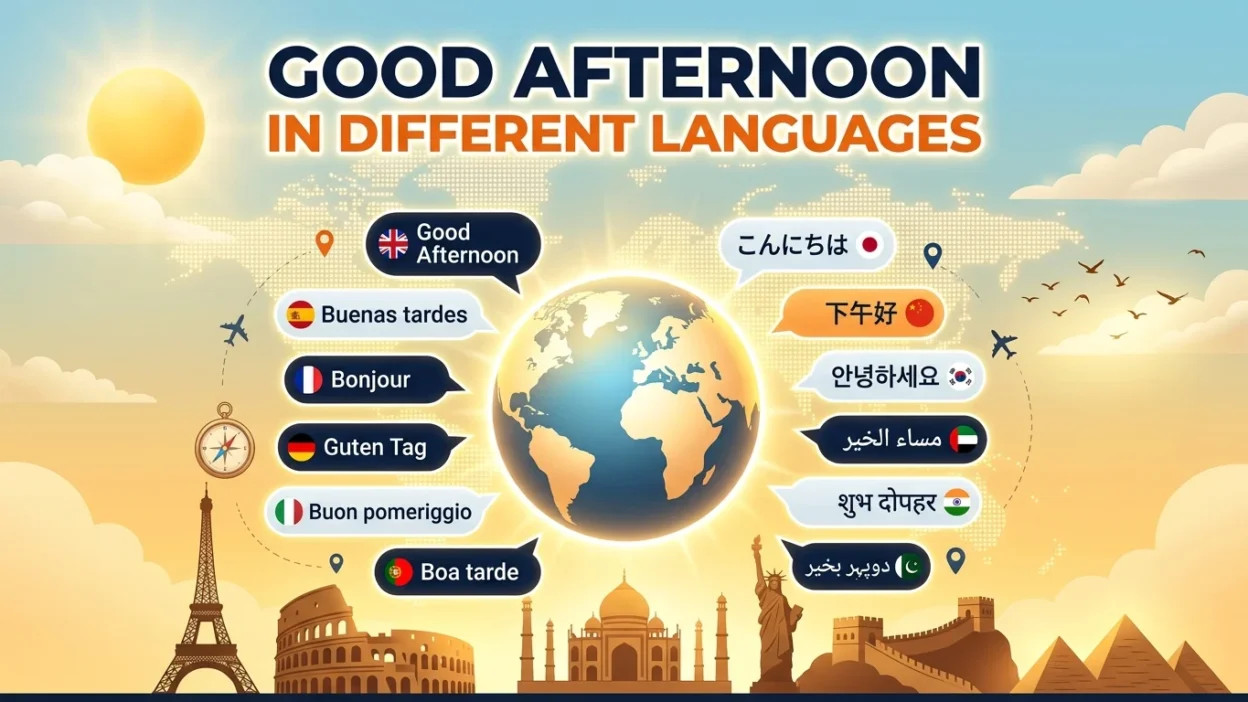
Learning good afternoon in different languages is a great way to communicate politely with people from different cultures. Whether you’re traveling, learning a foreign language or meeting international colleagues, greeting someone in their native language creates a friendly first impression and shows respect for their culture.
In this guide, you’ll discover good afternoon in different languages with native spellings and simple English pronunciations. You’ll also learn when to use these greetings, why they matter and practical tips for remembering them during everyday conversations around the world.
Quick Answer
Good afternoon in different languages includes polite greetings used across the world during the afternoon hours. Learning these expressions helps improve communication, demonstrate cultural respect and build stronger personal and professional relationships.
Good Afternoon in Different Languages Around the World
| Language | Native Word | Pronunciation |
|---|---|---|
| English | Good Afternoon | Good Af-ter-noon |
| Spanish | Buenas tardes | BWAY-nas TAR-des |
| French | Bonjour | Bon-ZHOOR |
| German | Guten Tag | GOO-ten Tahg |
| Italian | Buon pomeriggio | Bwon Po-me-RID-jo |
| Portuguese | Boa tarde | BO-ah TAR-deh |
| Dutch | Goedemiddag | HOO-duh-MID-dakh |
| Swedish | God eftermiddag | Goo EF-ter-mid-dag |
| Norwegian | God ettermiddag | Goo ET-ter-mid-dag |
| Danish | God eftermiddag | Goo EF-ter-mid-dag |
| Finnish | Hyvää iltapäivää | HUU-vaa IL-ta-pie-vaa |
| Icelandic | Góðan dag | GO-than Dag |
| Polish | Dzień dobry | Jen DOB-ri |
| Czech | Dobré odpoledne | DO-breh ODP-oh-led-neh |
| Slovak | Dobré popoludnie | DO-breh PO-po-lud-nye |
| Hungarian | Jó napot | Yoh NA-pot |
| Romanian | Bună ziua | BOO-nuh ZEE-wa |
| Greek | Καλησπέρα | Ka-lee-SPE-ra |
| Russian | Добрый день | DOB-riy DYEN |
| Ukrainian | Добрий день | DO-bry DEN |
| Bulgarian | Добър ден | DO-bur Den |
| Serbian | Добар дан | DO-bar Dan |
| Croatian | Dobar dan | DO-bar Dan |
| Turkish | Tünaydın | Too-NIGH-dun |
| Arabic | مساء الخير | Ma-sa al-Khair |
| Hebrew | אחר הצהריים טובים | A-khar Ha-Tso-ho-ra-yim To-vim |
| Persian | عصر بخیر | Asr Be-kheyr |
| Hindi | शुभ दोपहर | Shubh Dopehar |
| Urdu | دوپہر بخیر | Dopehar Bakhair |
| Punjabi | ਦੁਪਹਿਰ ਦੀਆਂ ਮੁਬਾਰਕਾਂ | Dopehar Diyan Mubarkan |
| Bengali | শুভ অপরাহ্ন | Shubho Oporahn |
| Gujarati | શુભ બપોર | Shubh Bapor |
| Marathi | शुभ दुपार | Shubh Dupaar |
| Tamil | இனிய மதியம் | Iniya Mathiyam |
| Telugu | శుభ మధ్యాహ్నం | Shubha Madhyahnam |
| Kannada | ಶುಭ ಮಧ್ಯಾಹ್ನ | Shubha Madhyahna |
| Malayalam | ശുഭ ഉച്ചതിരിഞ്ഞ് | Shubha Uchathirinj |
| Nepali | शुभ अपराह्न | Shubha Aparahn |
| Sinhala | සුභ දහවල් | Suba Dahawal |
| Thai | สวัสดีตอนบ่าย | Sa-wat-dee Ton Bai |
| Vietnamese | Chào buổi chiều | Chow Boo-ee Chee-ew |
| Indonesian | Selamat siang | Se-la-mat SEE-ang |
| Malay | Selamat petang | Se-la-mat Pe-tang |
| Filipino | Magandang hapon | Ma-gan-dang Ha-pon |
| Chinese (Mandarin) | 下午好 | Xia Wu Hao |
| Japanese | こんにちは | Kon-ni-chi-wa |
| Korean | 안녕하세요 | An-nyeong-ha-se-yo |
| Swahili | Habari za mchana | Ha-ba-ri Za M-cha-na |
| Hawaiian | Aloha auinalā | A-lo-ha Au-ee-na-la |
| Māori | Kia pai te ahiahi | Kia Pai Te A-hi-a-hi |
Why Learn Good Afternoon in Different Languages?
Learning good afternoon in different languages helps you communicate with confidence and respect. A simple greeting can make business meetings, travel experiences, and everyday conversations much more pleasant. Native speakers often appreciate the effort you make to use their language, even if you know only a few words.
These greetings are practical because they are used daily in offices, schools, hotels, restaurants, and social events. By learning them, you improve your communication skills while gaining a better understanding of cultures around the world.
When to Use Good Afternoon Greetings
Good afternoon is generally used from around midday until early evening, although the exact time varies between countries. In many cultures, it is the standard greeting during business hours and is appropriate in both formal and informal situations.
You can use these greetings when meeting clients, visiting tourist attractions, entering shops, attending conferences, or greeting friends during the afternoon. Using the correct greeting helps you sound polite and culturally aware.
Pronunciation Tips for Beginners
Learning to pronounce good afternoon in different languages becomes much easier with regular practice. Start by listening to native speakers and repeat each greeting slowly until you become comfortable with the sounds. Focus on pronunciation rather than translating every word into your own language. Speaking aloud helps improve your confidence and memory.
You can also group similar languages together to make learning easier. For example, Spanish, Italian, and Portuguese greetings share similar pronunciation patterns. Flashcards, language-learning apps, and short daily practice sessions are excellent ways to remember these greetings. Consistent practice will help you speak more naturally over time.
Interesting Facts About Afternoon Greetings
Afternoon greetings vary significantly from one culture to another. While English uses “Good Afternoon,” some languages use phrases that literally mean “Good Day” or “Good Time of the Day.” In countries like France and Germany, afternoon greetings are commonly used in both professional and social settings.
Another interesting fact is that the time considered “afternoon” differs between cultures. Some countries begin using evening greetings earlier than others, while some continue using afternoon greetings until sunset. Understanding these cultural differences helps you communicate more naturally and respectfully when interacting with native speakers.
Conclusion
Learning good afternoon in different languages is a practical way to improve your communication skills while gaining a deeper appreciation for different cultures. These greetings help you make positive first impressions, build stronger personal and professional relationships and show respect for local customs. Whether you’re traveling, studying a new language or meeting people from around the world, using the correct afternoon greeting adds warmth and confidence to every conversation. Practice these phrases regularly and you’ll soon feel comfortable greeting people in many different languages.
Frequently Asked Questions
1. Why should I learn good afternoon in different languages?
Learning afternoon greetings helps you communicate politely with people from different cultures. These phrases are useful for travel, business, education, and everyday conversations while also showing respect for local customs and traditions.
2. Which languages have the most commonly used good afternoon greetings?
Some of the most widely recognized greetings include Buenas tardes (Spanish), Bonjour (French), Guten Tag (German), Buon pomeriggio (Italian), and こんにちは (Japanese). These greetings are commonly used by millions of speakers worldwide.
3. Is good afternoon different from good evening?
Yes. In most languages, good afternoon is used from around noon until late afternoon, while good evening is used later in the day when evening begins. The exact transition time varies depending on the country and culture.
4. Can I use these greetings while traveling?
Absolutely. Using local afternoon greetings in hotels, restaurants, shops, business meetings, and tourist attractions demonstrates politeness and often creates friendlier interactions with local people.
5. What is the best way to remember good afternoon greetings?
Practice a few greetings every day, repeat them aloud, and associate each phrase with its country. Flashcards, language-learning apps, and listening to native speakers regularly are effective ways to improve your pronunciation and memory.