
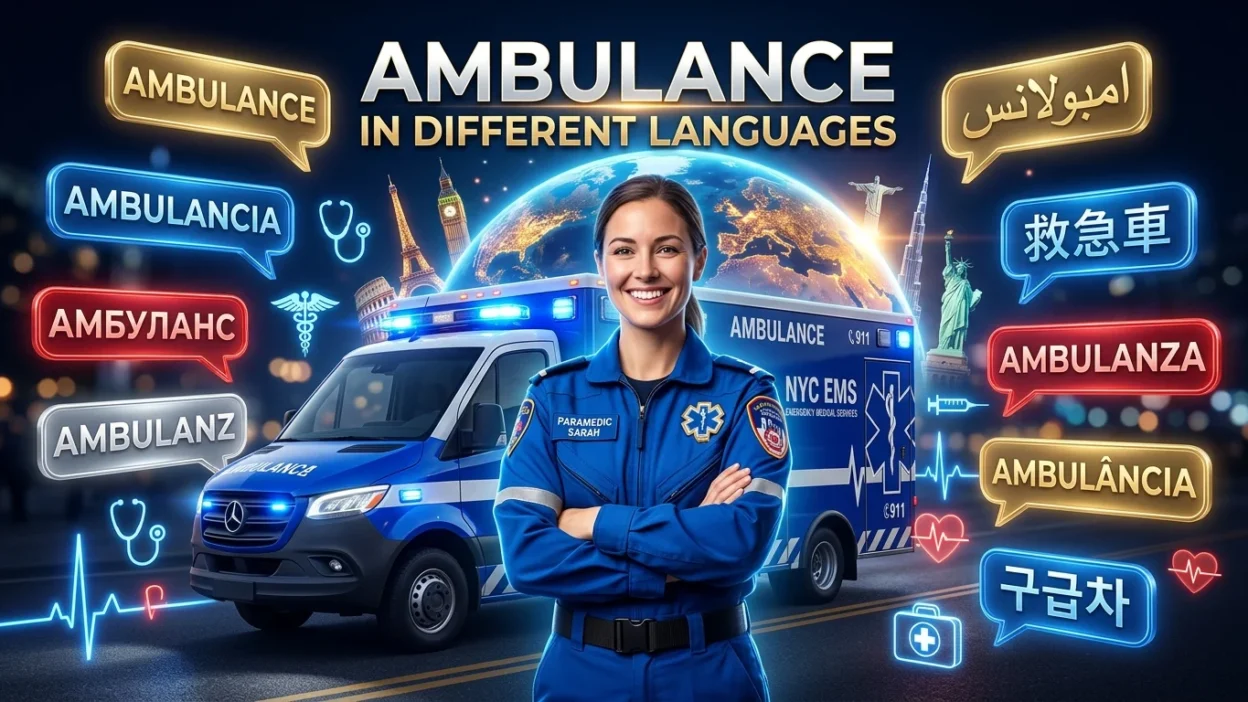
Learning ambulance in different languages is a practical way to expand your emergency and travel vocabulary while understanding how different cultures refer to one of the most important emergency vehicles. An ambulance is a specially equipped vehicle used to transport sick or injured people to hospitals while providing urgent medical care.
Whether you’re traveling abroad, learning a new language, or improving your everyday communication skills, knowing how to say ambulance in different languages can be extremely helpful in emergency situations.
In this guide, you’ll discover ambulance in different languages with native spellings and easy English pronunciations. You’ll also learn why this word is important, where it’s commonly used, and interesting facts about ambulance services around the world.
Quick Answer
Ambulance in different languages includes the words used worldwide to describe emergency medical vehicles that transport injured or ill people to healthcare facilities. Learning these translations improves your travel vocabulary, emergency preparedness, and cultural awareness.
Ambulance in Different Languages Around the World
| Language | Native Word | Pronunciation |
|---|---|---|
| English | Ambulance | AM-byuh-luhns |
| Spanish | Ambulancia | Am-boo-LAN-see-ah |
| French | Ambulance | Ahm-boo-LAHNS |
| German | Krankenwagen | KRANK-en-va-gen |
| Italian | Ambulanza | Am-boo-LAN-tsa |
| Portuguese | Ambulância | Am-boo-LAN-see-ah |
| Dutch | Ambulance | AM-bu-lan-se |
| Swedish | Ambulans | AM-bu-lans |
| Norwegian | Ambulanse | AM-bu-lan-se |
| Danish | Ambulance | AM-bu-lan-se |
| Finnish | Ambulanssi | AM-bu-lans-see |
| Icelandic | Sjúkrabíll | SHOO-kra-beetl |
| Polish | Ambulans | Am-boo-lans |
| Czech | Sanitka | Sa-NIT-ka |
| Slovak | Sanitka | Sa-NIT-ka |
| Hungarian | Mentőautó | MEN-toe-aw-too |
| Romanian | Ambulanță | Am-boo-LAN-tsuh |
| Greek | Ασθενοφόρο | As-the-no-FO-ro |
| Russian | Скорая помощь | SKO-ra-ya PO-mo-shch |
| Ukrainian | Швидка допомога | SHVYD-ka do-po-MO-ha |
| Bulgarian | Линейка | Li-NAY-ka |
| Serbian | Хитна помоћ | HEET-na PO-mo-ch |
| Croatian | Hitna pomoć | HEET-na PO-mo-ch |
| Turkish | Ambulans | Am-boo-LANS |
| Arabic | سيارة إسعاف | Sa-ya-rat Is-aaf |
| Hebrew | אמבולנס | Am-boo-LANS |
| Persian | آمبولانس | Am-boo-LANS |
| Hindi | एम्बुलेंस | Em-bu-lens |
| Urdu | ایمبولینس | Ambulance |
| Punjabi | ਐਂਬੂਲੈਂਸ | Am-boo-lens |
| Bengali | অ্যাম্বুলেন্স | Am-boo-lens |
| Gujarati | એમ્બ્યુલન્સ | Em-byu-lens |
| Marathi | रुग्णवाहिका | Rug-na-va-hi-ka |
| Tamil | ஆம்புலன்ஸ் | Aam-bu-lans |
| Telugu | అంబులెన్స్ | Am-bu-lens |
| Kannada | ಆಂಬುಲೆನ್ಸ್ | Aam-bu-lens |
| Malayalam | ആംബുലൻസ് | Aam-bu-lans |
| Nepali | एम्बुलेन्स | Em-bu-lens |
| Sinhala | ගිලන් රථය | Gi-lan Ra-tha-ya |
| Thai | รถพยาบาล | Rot Pha-ya-ban |
| Vietnamese | Xe cứu thương | Seh Kuu Thuong |
| Indonesian | Ambulans | Am-boo-lans |
| Malay | Ambulans | Am-boo-lans |
| Filipino | Ambulansya | Am-boo-lan-sya |
| Chinese (Mandarin) | 救护车 | Jiu Hu Che |
| Japanese | 救急車 | Kyuu-kyuu-sha |
| Korean | 구급차 | Gu-geup-cha |
| Swahili | Ambulensi | Am-boo-LEN-si |
| Hawaiian | Kaʻa kaʻa maʻi | Ka-ah Ka-ah My-ee |
| Māori | Waka tūroro | Wa-ka Too-ro-ro |
Why Learn “Ambulance” in Different Languages?
Learning ambulance in different languages is especially valuable for travelers, language learners, healthcare professionals and anyone preparing for international travel. In an emergency, being able to recognize or say the local word for ambulance can help you communicate quickly and seek medical assistance when every second matters.
This vocabulary is also useful when reading travel guides, hospital signs, emergency instructions and public safety information. Since emergency medical services differ from country to country,
understanding the local terminology helps you navigate unfamiliar environments with greater confidence while improving your practical language skills.
Common Uses of “Ambulance” Around the World
The word ambulance is commonly used in hospitals, emergency departments, airports, schools, workplaces, sporting events, and public safety announcements. It refers to a specially equipped emergency vehicle designed to provide immediate medical care while transporting patients to a hospital or healthcare facility.
Whether someone experiences an accident, sudden illness, or other medical emergency, an ambulance is often the first point of professional medical assistance. Travelers may also encounter the word ambulance on road signs, hospital entrances, emergency telephone information, insurance documents, and health guides.
Learning how to say ambulance in different languages can be especially valuable when visiting another country, helping you communicate more effectively with emergency responders, healthcare staff, or local residents during urgent situations.
Pronunciation Tips for Beginners
Learning the pronunciation of ambulance in different languages becomes easier when you group similar translations together. Many European languages use words closely related to the English term, such as Ambulancia, Ambulanza, Ambulance, and Ambulans, making them relatively simple for beginners to remember.
For languages that use different writing systems, including Arabic, Chinese, Japanese, Korean, Hindi, Russian and Thai, practice by listening to native speakers through language learning resources or pronunciation dictionaries. Repeat each translation slowly while focusing on syllable stress and vowel sounds. Consistent daily practice will improve both your pronunciation and listening comprehension.
Interesting Facts About Ambulances
The word ambulance comes from the Latin word ambulare, meaning to walk or move. Early ambulances were designed to move injured soldiers away from battlefields for treatment.
Over time, ambulance services evolved into highly specialized emergency medical systems equipped with advanced life saving technology and trained paramedics.
Today, ambulances are available in many forms, including road ambulances, motorcycle ambulances, boat ambulances, helicopter air ambulances and even aircraft used for long distance medical transport. Many countries also have dedicated emergency telephone numbers that dispatch ambulance services, ensuring rapid medical assistance whenever it is needed.
Conclusion
Learning ambulance in different languages is a valuable way to improve your travel vocabulary while preparing for real life situations. Whether you’re visiting another country, studying a foreign language or simply expanding your vocabulary, these translations can help you communicate more effectively during emergencies.
By practicing these words regularly, you’ll strengthen your language skills and gain greater confidence when traveling or interacting with people from different cultures.
Frequently Asked Questions
1. What is an ambulance?
An ambulance is a specially equipped emergency vehicle that provides immediate medical care and transports sick or injured people to hospitals or healthcare facilities.
2. Why should I learn ambulance in different languages?
Learning these translations helps you communicate more effectively while traveling, recognize emergency signs, and seek medical assistance in different countries.
3. Do all countries use the same word for ambulance?
No. Many languages use similar versions of the word, while others have completely different native terms for emergency medical vehicles.
4. What types of ambulances are used today?
Modern emergency services use road ambulances, motorcycle ambulances, helicopter air ambulances, boat ambulances, and fixed-wing medical aircraft depending on local needs.
5. What is the easiest way to remember these translations?
Practice a few languages each day, group similar words together, listen to native pronunciation, and review emergency-related vocabulary regularly.