
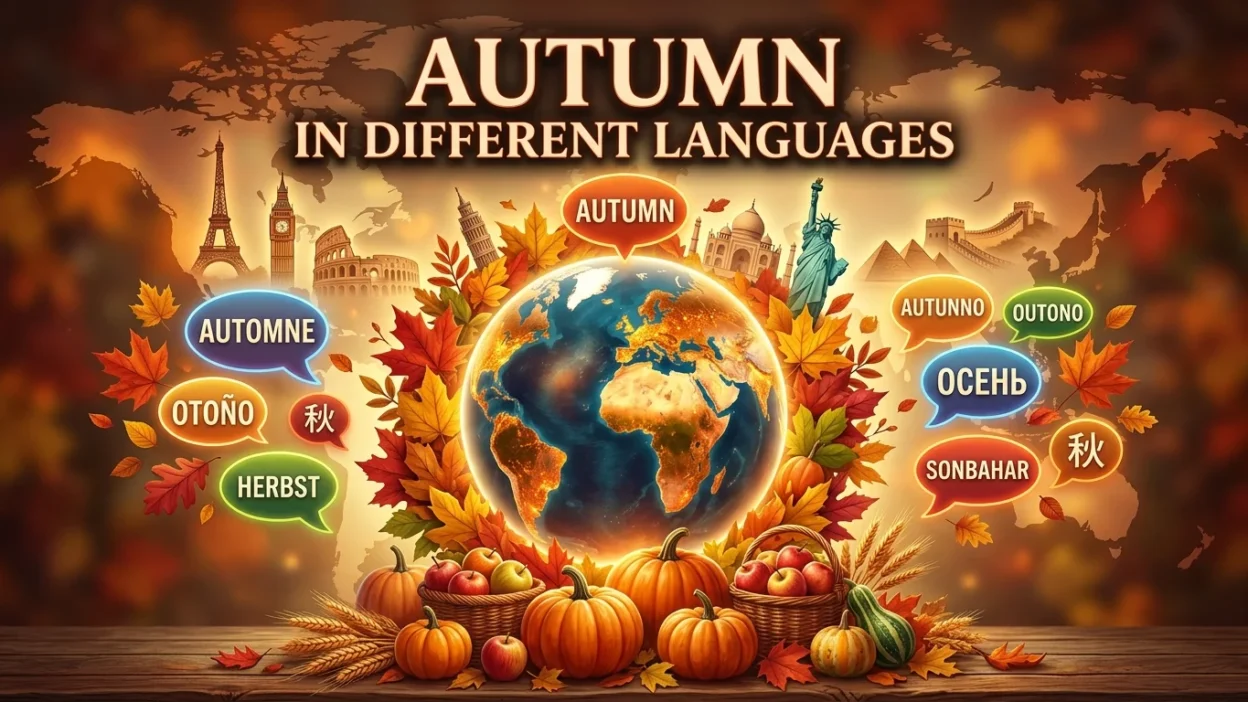
Learning autumn in different languages is a fun way to expand your vocabulary while exploring how different cultures describe one of the most beautiful seasons of the year. Whether you’re studying a new language, traveling or simply curious about seasonal words, knowing how to say autumn can help you communicate more naturally with people around the world.
In this guide, you’ll discover autumn in different languages with native spellings and easy English pronunciations. You’ll also learn why seasonal vocabulary is important, when to use these words and interesting facts about how autumn is celebrated across different countries.
Quick Answer
Autumn in different languages includes the words used around the world to describe the season between summer and winter. Learning these translations improves your language skills, increases cultural awareness, and helps you communicate confidently about seasons and weather.
Autumn in Different Languages Around the World
| Language | Native Word | Pronunciation |
|---|---|---|
| English | Autumn | AW-tum |
| Spanish | Otoño | Oh-TOHN-yo |
| French | Automne | Oh-TON |
| German | Herbst | HERBST |
| Italian | Autunno | Aw-TOON-no |
| Portuguese | Outono | Oh-TOH-no |
| Dutch | Herfst | HERFST |
| Swedish | Höst | Hurst |
| Norwegian | Høst | Hurst |
| Danish | Efterår | EF-ter-or |
| Finnish | Syksy | SUUK-suu |
| Icelandic | Haust | Hoyst |
| Polish | Jesień | YEH-shen |
| Czech | Podzim | POD-zim |
| Slovak | Jeseň | YEH-sen |
| Hungarian | Ősz | Ers |
| Romanian | Toamnă | TOAM-nuh |
| Greek | Φθινόπωρο | Fthi-NO-po-ro |
| Russian | Осень | O-syen |
| Ukrainian | Осінь | O-sin |
| Bulgarian | Есен | EH-sen |
| Serbian | Јесен | YE-sen |
| Croatian | Jesen | YE-sen |
| Turkish | Sonbahar | Son-ba-HAR |
| Arabic | الخريف | Al-Kha-reef |
| Hebrew | סתיו | Stav |
| Persian | پاییز | Pa-eez |
| Hindi | शरद ऋतु | Sharad Ritu |
| Urdu | خزاں | Khizaan |
| Punjabi | ਪਤਝੜ | Pat-jhar |
| Bengali | শরৎ | Shorot |
| Gujarati | શરદ ઋતુ | Sharad Rutu |
| Marathi | शरद ऋतु | Sharad Rutu |
| Tamil | இலையுதிர் காலம் | Ilai-yuthir Kaalam |
| Telugu | శరదృతువు | Sharada Rutuvu |
| Kannada | ಶರದೃತು | Sharada Rutu |
| Malayalam | ശരത്കാലം | Sharath Kalam |
| Nepali | शरद ऋतु | Sharad Ritu |
| Sinhala | සරත් ඍතුව | Sarath Ruthuwa |
| Thai | ฤดูใบไม้ร่วง | Rue-du Bai-mai Ruang |
| Vietnamese | Mùa thu | Moo-a Thu |
| Indonesian | Musim gugur | Moo-sim Goo-goor |
| Malay | Musim luruh | Moo-sim Loo-rooh |
| Filipino | Taglagas | Tag-LA-gas |
| Chinese (Mandarin) | 秋天 | Chiu Tian |
| Japanese | 秋 | Aki |
| Korean | 가을 | Ga-eul |
| Swahili | Vuli | Voo-lee |
| Hawaiian | Kau hāʻule lau | Kow Haa-oo-leh Low |
| Māori | Ngahuru | Nga-hoo-roo |
Why Learn “Autumn” in Different Languages?
Learning autumn in different languages helps you describe seasons, weather, travel experiences, and cultural traditions more naturally. Seasonal vocabulary is among the first topics introduced to language learners because it appears frequently in everyday conversations, school lessons, books, and travel situations.
Knowing the word for autumn also helps you understand local festivals, weather forecasts, and seasonal events. Whether you’re discussing colorful leaves in Canada, harvest festivals in Europe, or autumn holidays in Asia, these translations make communication easier and more meaningful.
Common Uses of “Autumn” Around the World
The word autumn is commonly used when discussing the weather, changing seasons, travel, nature, agriculture, and holidays. People often talk about autumn when describing colorful leaves, cooler temperatures, harvest festivals, pumpkin patches, and outdoor activities. Students also learn seasonal vocabulary early because it is useful in everyday conversations, school assignments, and language lessons.
In many countries, autumn marks the beginning of a new school year, seasonal celebrations, and important cultural traditions. Whether you’re reading a weather forecast, planning a vacation, discussing your favorite season, or learning a foreign language, knowing how to say autumn helps you communicate more naturally with native speakers.
Pronunciation Tips for Beginners
Learning the pronunciation of autumn in different languages becomes much easier when you practice a few words each day. Listen to native speakers through language-learning apps, online dictionaries, or educational videos, then repeat each word aloud several times. Focus on the correct rhythm and stress instead of trying to speak too quickly.
Grouping languages by region can also improve your memory. For example, Romance languages such as Spanish, French, Italian, and Portuguese have several similar pronunciation patterns, while many Slavic languages share comparable sounds. Flashcards, audio recordings, and daily repetition are excellent ways to build confidence and remember seasonal vocabulary.
Interesting Facts About Autumn Around the World
Although autumn is recognized worldwide, not every country experiences the season at the same time. In the Northern Hemisphere, autumn generally lasts from September to November, while in the Southern Hemisphere it usually occurs from March to May. This means countries like Australia, New Zealand, and South Africa celebrate autumn during months when much of Europe and North America enjoy spring.
Another interesting fact is that the word “fall” is commonly used in the United States and Canada, while “autumn” is the preferred term in the United Kingdom and many other English-speaking countries. Despite the different names, both words refer to the same season between summer and winter. Around the world, autumn is celebrated for its colorful landscapes, harvest festivals, and cooler weather.
Conclusion
Learning autumn in different languages is a simple and enjoyable way to expand your vocabulary while discovering how different cultures describe one of the year’s most beautiful seasons. These translations help you discuss weather, travel, nature, festivals and everyday conversations with greater confidence. Whether you’re studying a new language, planning an international trip, or exploring world cultures, knowing how to say autumn in different languages is a practical skill that enhances your communication and cultural understanding.
Frequently Asked Questions
1. Why should I learn autumn in different languages?
Learning seasonal vocabulary improves your language skills, helps you understand weather forecasts, and allows you to communicate naturally while traveling or studying foreign languages.
2. Is “autumn” the same as “fall”?
Yes. Both autumn and fall refer to the same season between summer and winter. “Autumn” is more common in British English, while “fall” is widely used in American English.
3. Which countries use the word “fall” instead of “autumn”?
The United States and Canada commonly use fall, whereas the United Kingdom, Australia, New Zealand, and many other English speaking countries usually prefer autumn.
4. Can I use these translations while traveling?
Absolutely. Knowing seasonal words helps you understand weather reports, travel guides, conversations, and local festivals in different countries.
5. What is the easiest way to remember these translations?
Practice a few languages each day, repeat the words aloud, group similar languages together, and use flashcards or language learning apps. Consistent practice makes seasonal vocabulary easier to remember.