
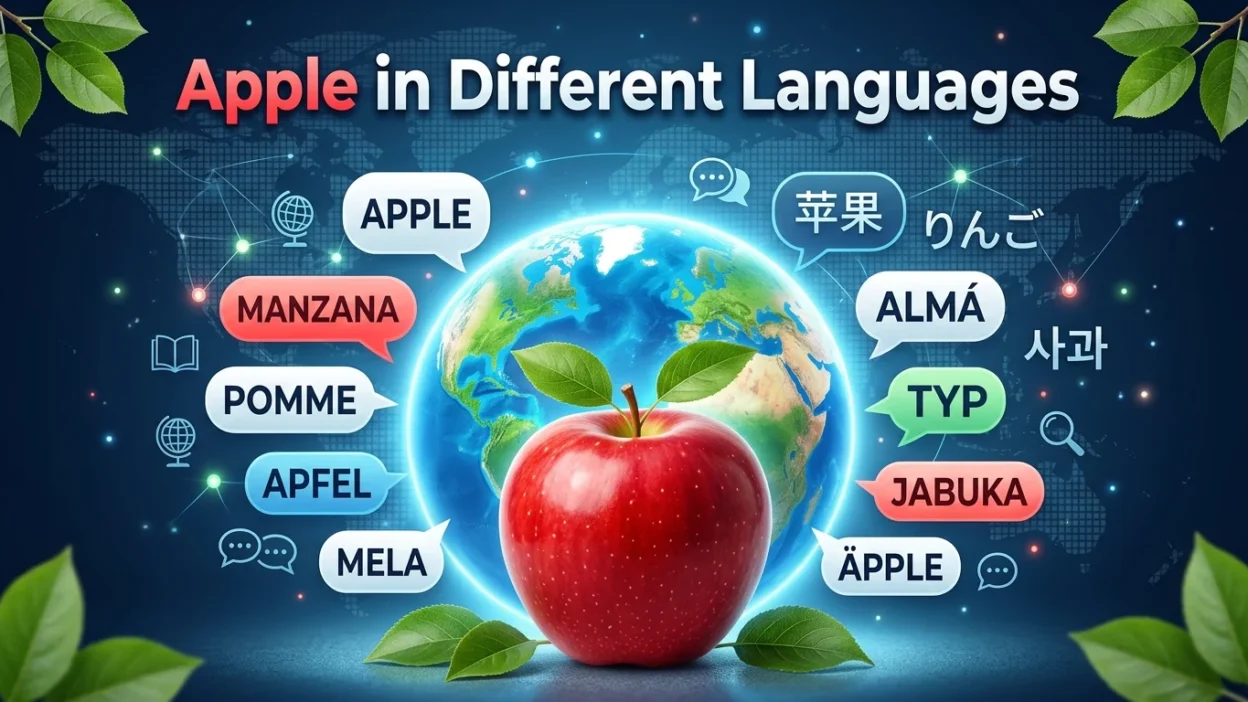
Learning apple in different languages is an enjoyable way to expand your vocabulary while exploring cultures from around the world. As one of the most common and recognizable fruits, the word apple appears frequently in everyday conversations, school lessons, grocery shopping, recipes and language learning. Whether you’re traveling, studying a foreign language or simply curious about global vocabulary, knowing how to say apple in different languages is both practical and fun.
In this guide, you’ll discover apple in different languages with native spellings and easy English pronunciations. You’ll also learn why this word is useful, when to use it and interesting facts about apples in different cultures.
Quick Answer
Apple in different languages includes the translations used worldwide for one of the most popular fruits. Learning these words improves your vocabulary, helps you communicate while traveling, and increases your understanding of different languages and cultures.
Apple in Different Languages Around the World
| Language | Native Word | Pronunciation |
|---|---|---|
| English | Apple | AP-puhl |
| Spanish | Manzana | Man-THA-na |
| French | Pomme | Pom |
| German | Apfel | AP-fel |
| Italian | Mela | MAY-la |
| Portuguese | Maçã | Ma-SANG |
| Dutch | Appel | AP-pel |
| Swedish | Äpple | EP-pleh |
| Norwegian | Eple | EP-leh |
| Danish | Æble | EH-bleh |
| Finnish | Omena | O-me-na |
| Icelandic | Epli | EP-li |
| Polish | Jabłko | YAB-ko |
| Czech | Jablko | YABL-ko |
| Slovak | Jablko | YABL-ko |
| Hungarian | Alma | AL-ma |
| Romanian | Măr | Mur |
| Greek | Μήλο | MEE-lo |
| Russian | Яблоко | YAB-la-ka |
| Ukrainian | Яблуко | YAB-loo-ko |
| Bulgarian | Ябълка | YA-bal-ka |
| Serbian | Јабука | YA-boo-ka |
| Croatian | Jabuka | YA-boo-ka |
| Turkish | Elma | EL-ma |
| Arabic | تفاح | Tuf-fah |
| Hebrew | תפוח | Ta-poo-ach |
| Persian | سیب | Seeb |
| Hindi | सेब | Seb |
| Urdu | سیب | Seb |
| Punjabi | ਸੇਬ | Seb |
| Bengali | আপেল | A-pel |
| Gujarati | સફરજન | Sa-fa-ra-jan |
| Marathi | सफरचंद | Sa-fa-ra-chand |
| Tamil | ஆப்பிள் | Aa-pil |
| Telugu | ఆపిల్ | Aa-pil |
| Kannada | ಸೇಬು | Se-boo |
| Malayalam | ആപ്പിൾ | Aa-pil |
| Nepali | स्याउ | Sya-u |
| Sinhala | ඇපල් | Ae-pal |
| Thai | แอปเปิล | Ap-pern |
| Vietnamese | Táo | Tao |
| Indonesian | Apel | A-pel |
| Malay | Epal | Eh-pal |
| Filipino | Mansanas | Man-sa-nas |
| Chinese (Mandarin) | 苹果 | Ping Guo |
| Japanese | りんご | Rin-go |
| Korean | 사과 | Sa-gwa |
| Swahili | Tufaha | Too-fa-ha |
| Hawaiian | ʻĀpala | Aa-pa-la |
| Māori | Āporo | Aa-po-ro |
Why Learn “Apple” in Different Languages?
Learning apple in different languages helps you build practical vocabulary that you can use in everyday situations. Whether you’re shopping at a local market, ordering food, reading recipes, or studying a new language, knowing the word for apple makes communication easier. Since apples are one of the world’s most widely consumed fruits, this vocabulary is useful almost everywhere.
It also helps children and beginner language learners develop confidence because fruit names are among the first words taught in most language courses. Understanding these translations allows you to recognize food labels, menus, grocery items, and cultural references more easily.
Common Uses of “Apple” Around the World
The word apple is widely used in everyday conversations, grocery shopping, restaurants, recipes, schools, and health discussions. Whether you’re buying fresh fruit at a market, ordering apple juice in a café, reading a recipe, or learning food vocabulary in a language class, knowing how to say apple in different languages makes communication much easier. It is one of the first fruit names taught to beginners because it is simple, common, and practical.
Apples also appear in many famous sayings and cultural references. Expressions such as “An apple a day keeps the doctor away” are recognized around the world. In addition, apples are featured in desserts, festivals, children’s stories, and traditional celebrations in many countries, making this word useful beyond everyday conversations.
Pronunciation Tips for Beginners
Learning the pronunciation of apple in different languages becomes easier when you practice a few words every day. Listen to native speakers through language-learning apps, pronunciation dictionaries, or educational videos, then repeat each translation several times. Focus on speaking clearly and naturally rather than trying to sound perfect immediately. Consistent practice helps improve both pronunciation and confidence.
Grouping similar languages together is another effective learning strategy. For example, Romance languages such as Spanish, French, Italian, and Portuguese often share similar pronunciation patterns, while Germanic languages like German, Dutch, Swedish, and Norwegian also have related sounds. Flashcards, audio recordings, and daily vocabulary review can help you remember these translations much faster.
Interesting Facts About Apples Around the World
Apples are among the oldest cultivated fruits in human history and are grown in thousands of varieties across the globe. They come in many colors, including red, green, yellow, and even pink, with each variety offering a unique flavor and texture. Countries such as China, the United States, Turkey, Poland, and India are among the world’s largest apple producers.
Another interesting fact is that apples hold symbolic meaning in many cultures. They often represent health, knowledge, prosperity, and love. Apples appear in famous stories, myths, and traditions, including the tale of Snow White, the legend of William Tell, and the famous story of Isaac Newton and gravity. Because of their rich history and global popularity, apples remain one of the most recognized fruits worldwide.
Conclusion
Learning apple in different languages is a simple yet valuable way to expand your vocabulary and improve your communication skills. Whether you’re traveling, shopping, studying a foreign language or exploring world cultures, knowing how to say apple in different languages helps you communicate naturally in everyday situations. Practice these translations regularly and you’ll quickly build confidence while discovering the fascinating diversity of languages around the world.
Frequently Asked Questions
1. Why should I learn apple in different languages?
Learning fruit names improves your everyday vocabulary and makes it easier to communicate while shopping, dining, traveling, or studying a foreign language.
2. Which languages have the most commonly recognized word for apple?
Some of the most recognized translations include Manzana (Spanish), Pomme (French), Apfel (German), Mela (Italian), 苹果 (Píngguǒ) (Chinese), and りんご (Ringo) (Japanese).
3. Can I use these translations while traveling?
Yes. Knowing the local word for apple is helpful when visiting grocery stores, fruit markets, restaurants, cafés, and supermarkets in different countries.
4. Why is apple one of the first words taught in language classes?
Apples are common around the world, making the word easy to use in everyday conversations. It also appears frequently in children’s books, vocabulary lessons, and educational materials.
5. What is the easiest way to remember these translations?
Practice a few languages each day, repeat the words aloud, use flashcards, and group similar languages together. Regular review helps improve both pronunciation and memory.

Olivia Riley is a passionate content administrator at Diflingo, where she manages and publishes high-quality articles focused on what to say in everyday conversations, special occasions, professional settings, and personal relationships. She ensures every guide is clear, practical, engaging, and helpful for readers.