
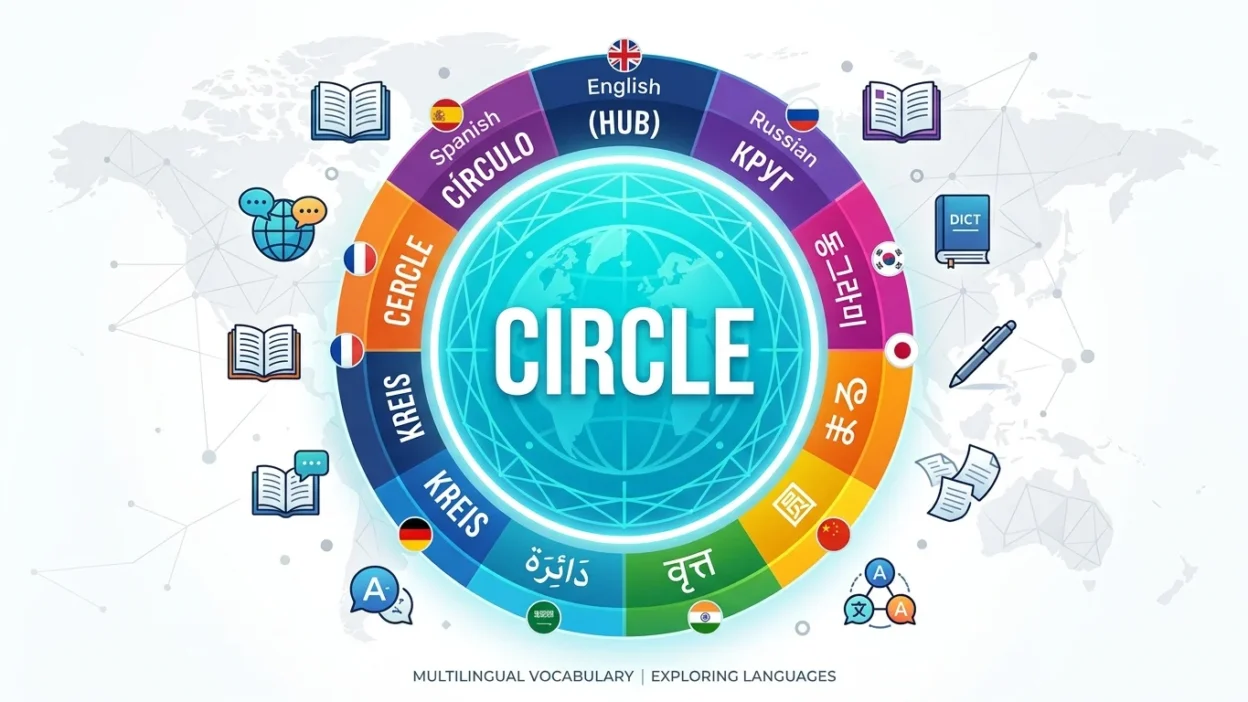
The word circle in different languages reveals how languages describe one of the most familiar shapes in everyday life. A circle has no corners, has a continuous curved boundary, and appears in mathematics, art, nature, architecture and communication.
Learning circle in different languages is useful for language learners, travelers, students, designers, and anyone interested in global vocabulary. From Spanish and French to Japanese, Arabic, Hindi and Chinese, each language has its own spelling and pronunciation. Below, you’ll find 50 ways to say “circle,” along with simple pronunciation guides and helpful cultural and language learning information.
Quick Answer
“Circle” has different names across languages. Examples include círculo in Spanish, cercle in French, Kreis in German, cerchio in Italian, 円 (en) in Japanese, and 圆 (yuán) in Chinese.
Circle in Different Languages Around the World
| Language | Native Word | Pronunciation |
|---|---|---|
| English | Circle | SUR-kul |
| Spanish | Círculo | SEER-koo-lo |
| French | Cercle | serkl |
| German | Kreis | krys |
| Italian | Cerchio | CHER-kyoh |
| Portuguese | Círculo | SEER-koo-lo |
| Dutch | Cirkel | SEER-kul |
| Swedish | Cirkel | SEER-kel |
| Norwegian | Sirkel | SEER-kel |
| Danish | Cirkel | SEER-kel |
| Finnish | Ympyrä | UM-puh-ra |
| Icelandic | Hringur | HRING-ur |
| Polish | Koło | KOH-woh |
| Czech | Kruh | krooh |
| Slovak | Kruh | krooh |
| Hungarian | Kör | kur |
| Romanian | Cerc | cherk |
| Russian | Круг | kroog |
| Ukrainian | Коло | KOH-lo |
| Bulgarian | Кръг | krug |
| Greek | Κύκλος | KEEK-los |
| Turkish | Daire | dah-ee-REH |
| Arabic | دائرة | DAA-ee-rah |
| Hebrew | מעגל | ma-GAL |
| Persian | دایره | DAA-yeh-reh |
| Urdu | دائرہ | DAA-i-ra |
| Hindi | वृत्त | vritt |
| Bengali | বৃত্ত | brit-to |
| Punjabi | ਚੱਕਰ | CHAK-kar |
| Gujarati | વર્તુળ | var-TOOL |
| Marathi | वर्तुळ | var-TOOL |
| Tamil | வட்டம் | VAT-tam |
| Telugu | వృత్తం | VRI-tam |
| Kannada | ವೃತ್ತ | VRIT-ta |
| Malayalam | വൃത്തം | VRIT-tam |
| Sinhala | වෘත්තය | VRI-tha-ya |
| Chinese | 圆 | yuan |
| Japanese | 円 | en |
| Korean | 원 | won |
| Thai | วงกลม | wong-glom |
| Vietnamese | Hình tròn | hing chon |
| Indonesian | Lingkaran | ling-KA-ran |
| Malay | Bulatan | boo-LA-tan |
| Filipino | Bilog | BEE-log |
| Swahili | Duara | doo-AH-ra |
| Zulu | Isiyingi | ee-see-YING-ee |
| Afrikaans | Sirkel | SEER-kel |
| Esperanto | Cirklo | SEER-kloh |
| Latin | Circulus | SEER-koo-loos |
| Albanian | Rreth | rreth |
| Serbian | Круг | kroog |
| Croatian | Krug | kroog |
Why Learn Circle in Different Languages?
Learning the word circle in different languages can expand your vocabulary while introducing you to useful words connected with mathematics, art, design, and everyday descriptions. Shape vocabulary is especially valuable for beginners because it frequently appears in classrooms, instructions, games and conversations.
For students, knowing words for common shapes can make multilingual learning more practical. Travelers and language enthusiasts may also encounter these terms in museums, signs, educational materials, or conversations about objects and designs.
Learning one simple word in several languages can also improve memory. Comparing similar words helps you notice patterns between related languages and understand how vocabulary changes from one region to another.
The Meaning of Circle Across Languages
A circle generally refers to a round, two-dimensional shape made up of points that are equally distant from a central point. Although the mathematical concept remains consistent, languages may use different words and grammatical structures to describe it.
In some languages, the word is closely related to terms meaning ring, wheel, round shape, or surrounding movement. This connection reflects how languages develop vocabulary from everyday objects and experiences.
The concept of a circle also has broader meanings. It can represent unity, continuity, completeness, equality, or repetition. Because the shape has no obvious beginning or ending point, people have used it symbolically in many cultures throughout history.
How to Pronounce Circle in Different Languages
Pronunciation varies significantly from one language to another. For example, the Spanish círculo contains several syllables, while the German Kreis is short and has a sound that differs considerably from English.
When learning pronunciation, avoid relying only on English spelling. The pronunciation column above provides an approximate guide, but listening to native speakers is the best way to understand natural sounds and rhythm.
Start by saying each word slowly. Break longer words into syllables, repeat them several times, and then practice them in a sentence. This approach can make unfamiliar vocabulary easier to remember and pronounce naturally.
Circle in Mathematics and Education
The word circle is particularly important in mathematics. Students learn about circles when studying geometry, measurements, angles, radius, diameter, circumference, and area.
Multilingual students may encounter different terminology when studying mathematics in another language. Knowing the local word for circle can therefore make lessons, textbooks, and classroom discussions easier to understand.
Common related mathematical terms include radius, diameter, circumference, center, and area. Learning these words alongside the translation for circle creates a stronger vocabulary foundation.
For example, a student learning Japanese mathematics may encounter 円 (en), while someone studying Chinese may see 圆 (yuán). Understanding these terms helps connect language learning with practical academic knowledge.
Circle as a Symbol in Different Cultures
The circle has been an important symbol throughout human history. Its continuous shape is often associated with ideas such as eternity, wholeness, harmony, unity, and cycles.
In visual art and cultural traditions, circles may represent the sun, moon, seasons, life cycles, or community. Their interpretation depends on the cultural and historical context in which they appear.
Circles are also common in architecture, religious art, logos, jewelry, flags, and decorative patterns. Learning the vocabulary surrounding this shape can therefore provide a useful entry point into cultural studies.
While the basic geometric definition remains stable, its symbolic meaning can vary considerably between traditions.
Common Words Related to Circle
Learning related vocabulary can help you use the word more naturally. Useful English terms include round, ring, sphere, oval, curve, arc, center, radius, and diameter.
However, these words do not all have the same meaning. A circle is a two-dimensional geometric shape, while a sphere is a three-dimensional object. A ring generally describes a circular band or shape with an opening in the middle.
Understanding these distinctions becomes especially important when translating technical, educational, or design-related content. A direct translation may not always communicate the intended meaning if the surrounding context is ignored.
Practical Uses of Circle in Everyday Language
You can encounter the word circle in many everyday situations. People may talk about a circle when describing road signs, tables, drawings, logos, buttons, wheels, clocks, or patterns.
The word can also have meanings beyond geometry. In English, circle can describe a group of people, such as a social circle or professional circle. As a verb, it can mean moving around something or drawing a curved line around an item.
Other languages may use separate words for these meanings, so context matters when translating. Learning both the basic and extended meanings can help you communicate more accurately.
Easy Ways to Remember Circle in Different Languages
One effective way to remember vocabulary is to connect every new word with a visual image. When learning the translations above, picture a simple circle while saying each word aloud.
You can also group languages together. Spanish círculo, Portuguese círculo, French cercle, and Italian cerchio show noticeable similarities, making them easier to compare.
Flashcards are another useful technique. Put the language on one side and the native word on the other. Review the cards regularly instead of trying to memorize everything in one session.
Finally, use the words in short sentences. Practical repetition usually makes vocabulary easier to retain than memorizing isolated words.
Interesting Facts About Circles and Language
The circle is one of the most recognizable shapes in the world, and its vocabulary appears across numerous fields. Mathematics, astronomy, engineering, art, architecture, sports, and technology all use concepts connected with circles.
Interestingly, languages do not always distinguish between a geometric circle and other round objects in exactly the same way. Some words can describe circular forms, rings, wheels, or groups depending on context.
The word circle itself also has an interesting extended meaning in English. A “circle of friends” refers to a group of people, while “to circle” can describe moving around something. These meanings demonstrate how physical shapes can inspire abstract language.
Common Mistakes When Learning Circle Translations
One common mistake is assuming that a translation always has exactly the same meaning in every context. A word used for a geometric circle may not be the best choice when describing a ring, group, or circular movement.
Another mistake is ignoring pronunciation. Seeing the correct spelling does not automatically tell you how a word sounds in its native language.
Learners should also pay attention to accents and writing systems. Words such as 円, 圆, 원, and دائرة may look unfamiliar at first, but regular exposure makes them easier to recognize.
Using context, pronunciation practice, and example sentences can prevent many vocabulary mistakes.
Key Takeaways
- The word circle has different translations across languages and writing systems.
- Spanish uses círculo, French uses cercle, and German uses Kreis.
- Japanese uses 円 (en), while Chinese uses 圆 (yuán).
- Circle-related vocabulary is useful in mathematics, art, travel, and everyday communication.
- Learning related words and practicing pronunciation can make multilingual vocabulary easier to remember.
Conclusion
Learning circle in different languages is a simple but useful way to expand vocabulary and discover how languages describe familiar concepts. The translations may differ greatly in spelling, pronunciation, and structure, yet they all communicate the same basic geometric idea.
From European languages such as French, Spanish and German to Asian languages such as Japanese, Chinese, and Korean, each translation offers a small insight into another language and culture. Whether you are studying languages, mathematics, travel vocabulary or cultural expressions, these 50 translations provide a practical starting point for multilingual learning.
Frequently Asked Questions
1. What is circle in different languages?
“Circle” has many translations around the world. Examples include círculo in Spanish, cercle in French, Kreis in German, cerchio in Italian, 円 (en) in Japanese and 圆 (yuán) in Chinese. The exact pronunciation and usage depend on the language and context.
2. What is circle called in Spanish?
Circle is círculo in Spanish. It is commonly pronounced approximately as “SEER-koo-lo.” The word is used for the geometric shape and can appear in mathematics, education, art, design, and everyday descriptions involving round shapes.
3. How do you say circle in Japanese?
In Japanese, circle is commonly written as 円 and pronounced en when referring to the geometric concept. Depending on context, Japanese also has other expressions related to round shapes and circular forms, so the appropriate word can vary with the intended meaning.
4. What is the word for circle in Chinese?
In Chinese, circle is 圆, written as 圓 in Traditional Chinese. It is pronounced yuán in Mandarin. The word is widely used in mathematics and everyday language to describe circular or round forms, although related expressions may be used for specific objects or contexts.
5. Why should I learn circle in different languages?
Learning circle in different languages can improve vocabulary, support multilingual education, and make international communication easier. Shape-related words are useful in mathematics, travel, art, design and everyday conversations. Comparing translations can also help learners recognize similarities between related languages.